Why Kinsale Looks So Different: The Architecture Behind Ireland’s Most Colourful Town
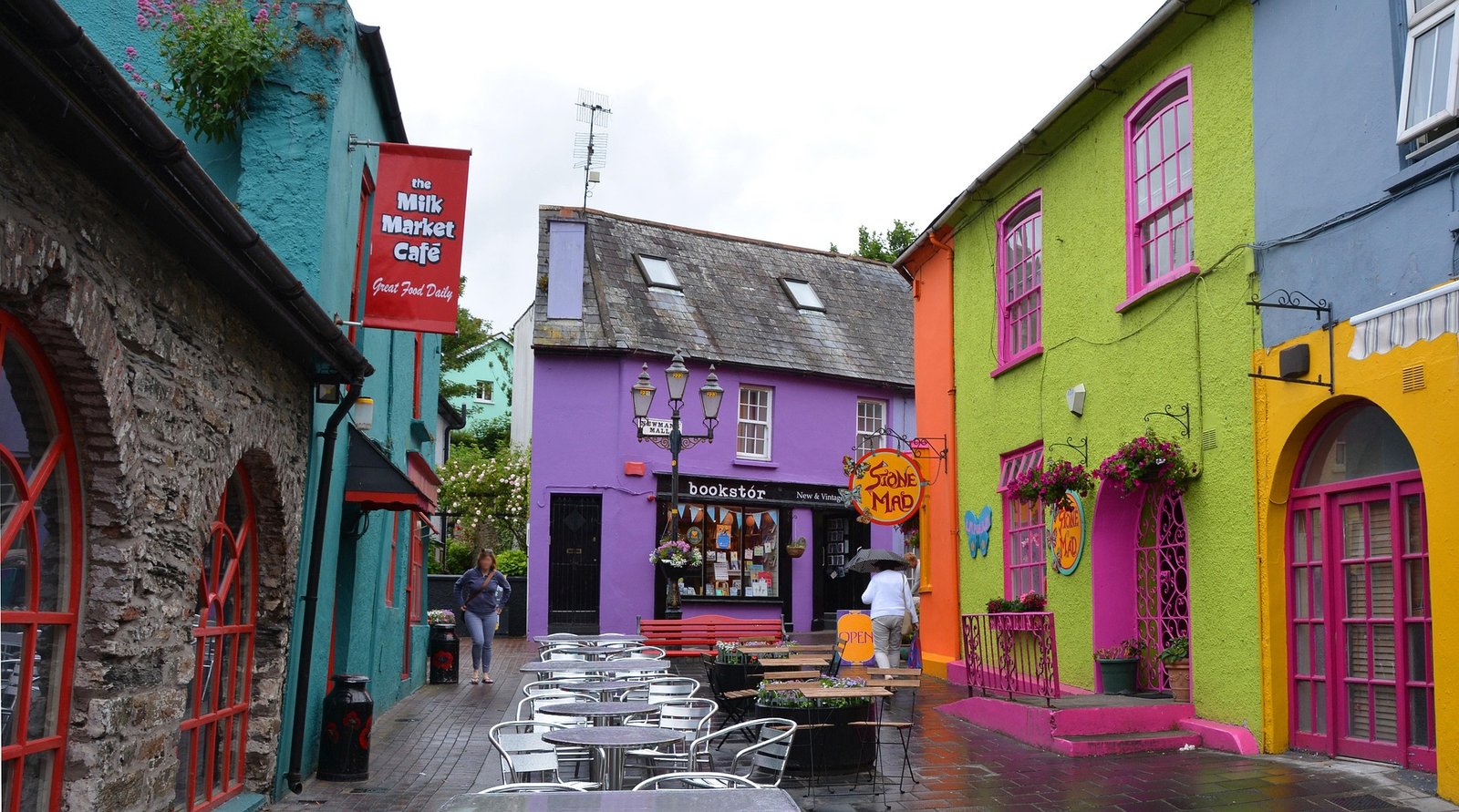
Kinsale is one of those places that looks immediately different before you can quite explain why.
At first, it seems obvious.
The colour.
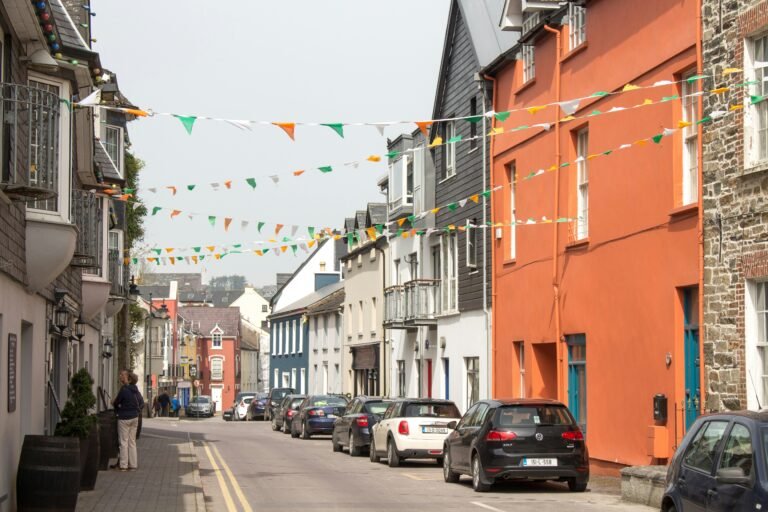
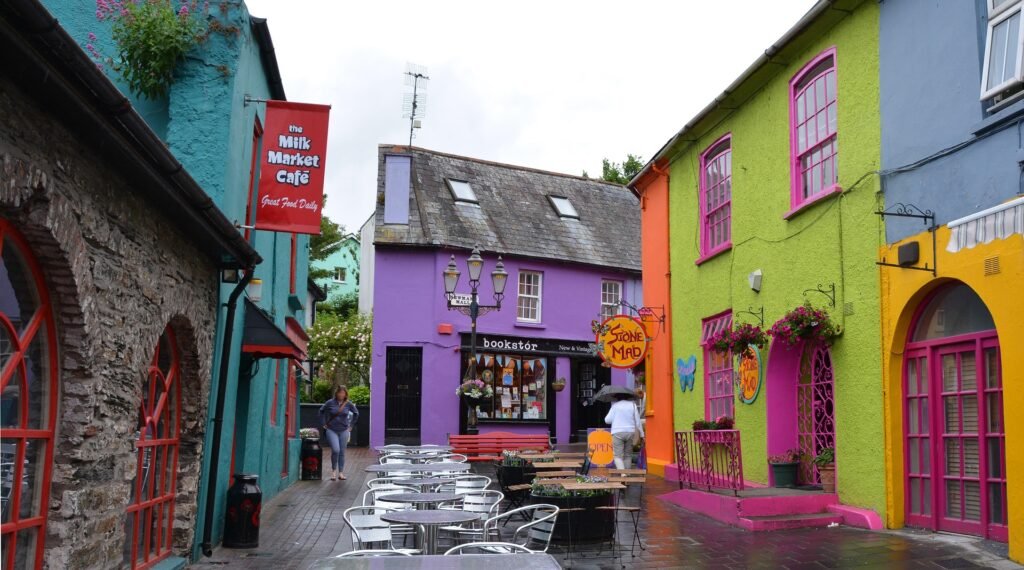
Turquoise shopfronts. Coral walls. Pink window frames. Mustard yellow doors. Deep navy façades. Flowers spilling from baskets.
But spend a little longer looking at Kinsale and something else starts to emerge.
The colour is only part of it.
What makes Kinsale feel so distinctive is the way its buildings fit together: narrow streets, irregular rooflines, old façades sitting beside newer shopfronts, buildings squeezed onto tight plots, streets that bend instead of marching neatly through town.
It feels layered.
And that’s because it is.
Kinsale grew over centuries as a fishing port, trading town and military stronghold at the edge of one of Ireland’s most strategically important harbours. Its streetscape reflects that history, from medieval buildings and later Georgian influences to the brightly painted commercial façades that now define the town visually.
So why does Kinsale look the way it does?
The answer isn’t one architectural style.
It’s the accumulation of many.
Kinsale Was Shaped by the Harbour First
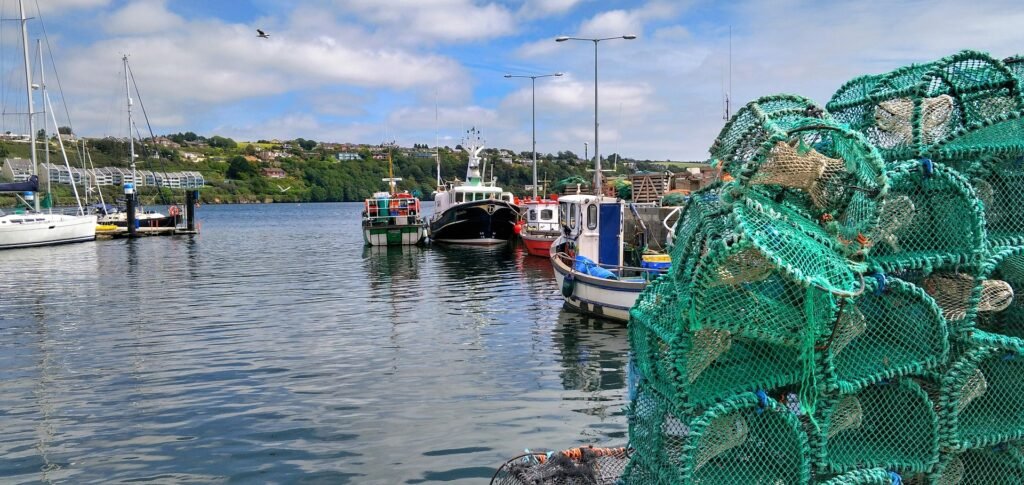
Before colour, before tourism, before seafood restaurants and art galleries, there was the harbour.
Kinsale developed around a deep natural inlet on Ireland’s southern coast.
Its protected position made it valuable for fishing, trade and defence, and the town’s layout still reflects that relationship with the water.
Rather than sitting on a neat grid, Kinsale folds itself into the landscape.
Streets curve.
Buildings climb slightly uphill.
Narrow lanes connect larger streets.
Views open unexpectedly towards the harbour.
This is one of the reasons Kinsale feels more organic than planned.
It wasn’t designed in one moment.
It accumulated.
And visually, that gives the town a kind of informality that newer places struggle to reproduce.
A waterfront building may sit beside something Georgian in proportion, which sits beside a narrow painted shopfront, which sits beneath a slate roof that looks considerably older than everything around it.
None of it matches perfectly.
Which is precisely why it works.
The Narrow Plots Matter More Than You Think
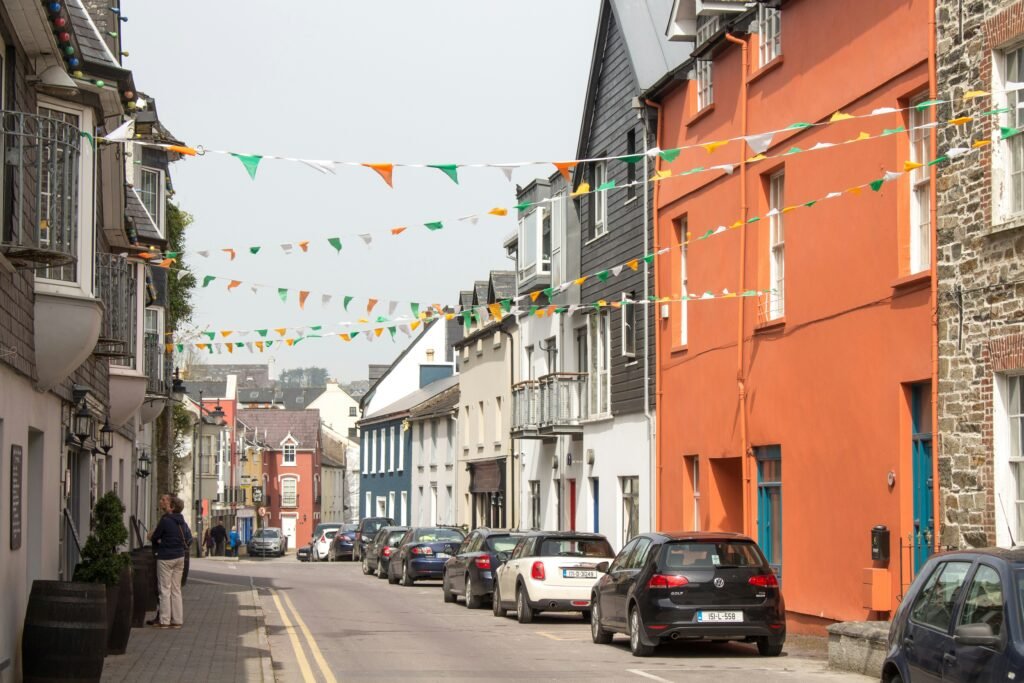
One of the most important features of Kinsale’s streets is something most people barely notice.
The buildings are often narrow.
Historically, towns like Kinsale developed around compact plots, particularly in commercial streets where having street frontage mattered.
That creates a rhythm.
Door.
Window.
Shopfront.
Door.
Window.
Another shop.
Rather than one huge building occupying half a block, you get a sequence of smaller façades.
And every façade has the opportunity to be slightly different from the one beside it.
That matters enormously in Kinsale.
It is the reason a row of buildings can be painted orange, blue, cream, pink and green without feeling like one enormous wall of colour.
Each narrow frontage becomes almost an individual object.
This is also what makes the streets photograph so well.
There is constant visual variation.
Your eye is never really allowed to settle.
Kinsale’s Buildings Don’t Line Up Perfectly
Modern developers like alignment.
Same roof height.
Same setback.
Same windows.
Same materials.
Kinsale does the opposite.
Rooflines jump.
Some buildings project slightly forward.
Others sit back.
Windows vary in size.
Ground-floor shopfronts have been changed over generations.
One building may be two storeys while the next feels taller because of its proportions or roof form.
That irregularity gives Kinsale something architecture desperately needs:
depth.
A street that is perfectly aligned can feel flat.
A street that has been altered over centuries feels three-dimensional.
It catches shadows differently.
It creates corners.
Little recesses appear.
Signs hang out over the pavement.
Doors appear unexpectedly.
The result is a streetscape that feels lived in rather than composed.
The Colour Works Because the Architecture Is Simple
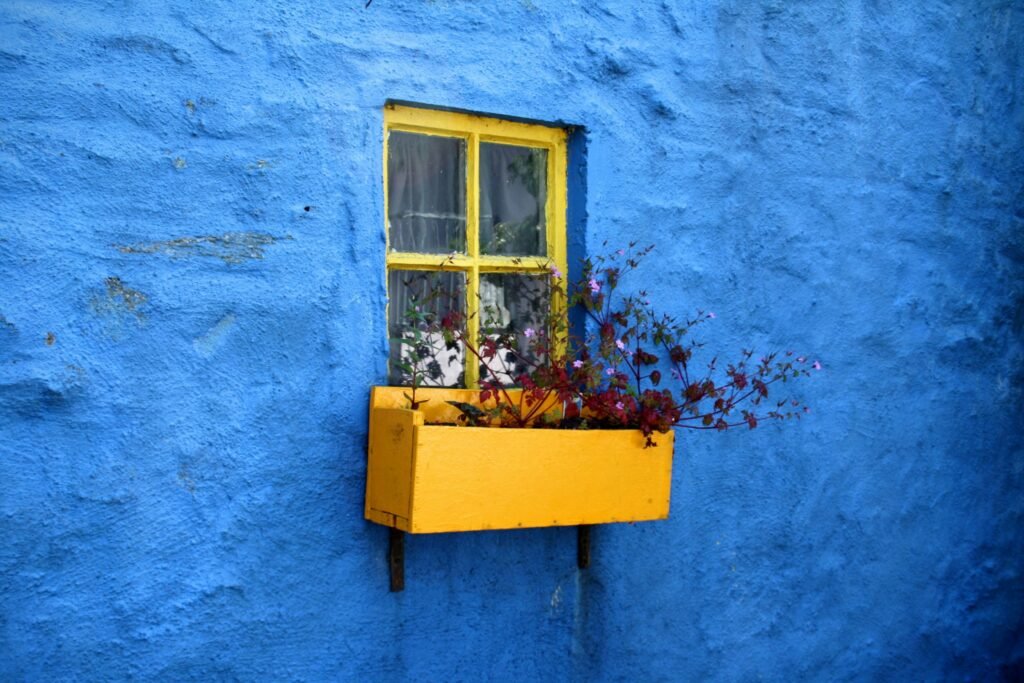
Here’s the interesting thing about Kinsale.
If the architecture were incredibly ornate, the colour might be too much.
But a lot of the building forms are actually pretty restrained.
Simple rendered walls.
Traditional sash-style windows.
Straightforward rooflines.
Stone or plaster façades.
Modest openings.
Then the colour arrives on top.
That is why something like a bright teal wall or deep pink doorway works.
The building itself isn’t competing with the paint.
Instead, colour becomes the decoration.
Kinsale’s tourism material regularly highlights its brightly painted cottages, shopfronts and streets as one of the town’s defining characteristics.
But the colour isn’t merely random decoration.
It creates identity at street level.
A shop becomes memorable because it is purple.
A doorway becomes a landmark because it is yellow.
A corner becomes recognisable because three neighbouring buildings clash beautifully.
There is a lesson in that.
Sometimes architecture doesn’t need more detail.
Sometimes it needs more confidence.
Why the Shopfronts Matter So Much
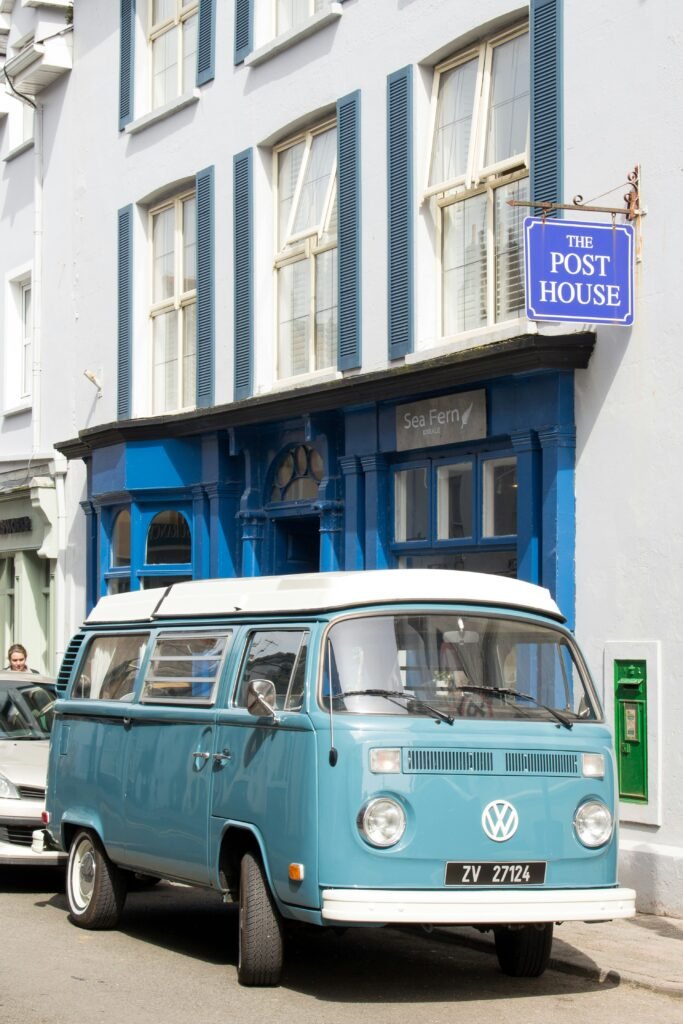
Kinsale’s shopfronts do a huge amount of visual heavy lifting.
They are often timber-framed, individually painted, and far more expressive than the walls above them.
You’ll see:
painted fascia boards,
contrasting window surrounds,
traditional-style lettering,
hanging signs,
arched door openings,
flower baskets,
and windows packed with independent retail displays.
Kinsale’s retail scene is strongly independent, with boutiques, galleries, bookshops and local design businesses occupying many of these colourful façades.
That helps the architecture too.
A chain store usually wants consistency.
An independent store wants personality.
Kinsale has personality everywhere.
And because the shops are small, their branding often becomes part of the building.
A deep green shopfront may sit beneath a pale pink upper storey.
A turquoise doorway might be framed by purple trim.
A restaurant sign may hang from wrought iron rather than sit in a generic illuminated box.
All these small decisions add up.
Flowers Are Basically Part of the Architecture
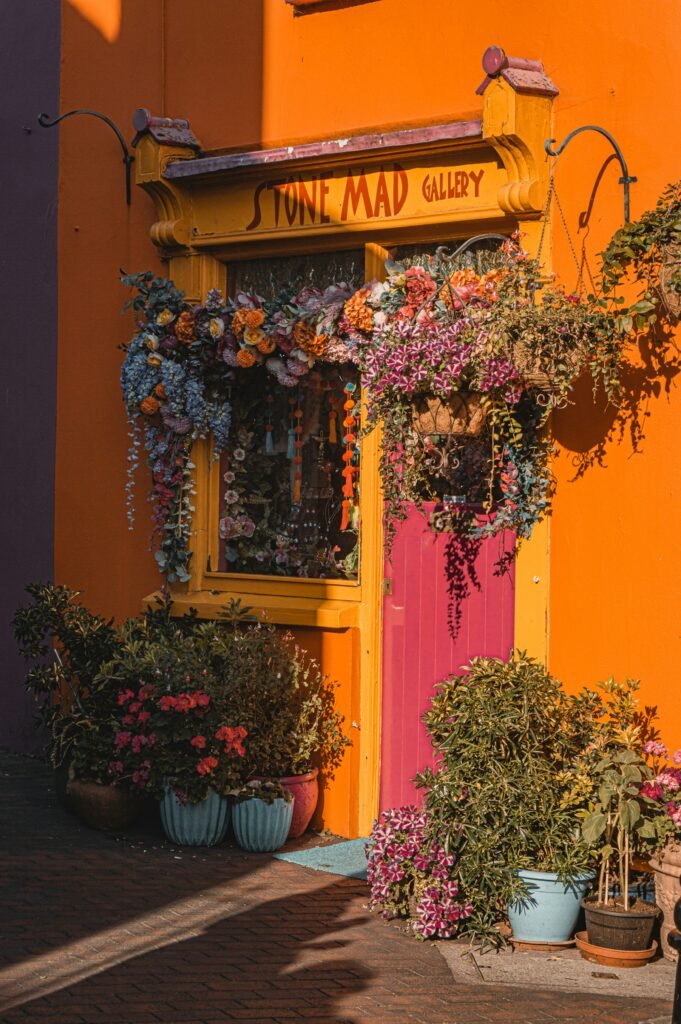
Technically, hanging baskets are not architecture.
Visually?
They absolutely are.
Kinsale uses flowers almost like another building material.
They soften hard edges.
They frame doors.
They break up large areas of colour.
They turn window sills into focal points.
And crucially, they stop the brightly painted façades from feeling too graphic.
Without flowers, some of Kinsale’s streets could almost look like a film set.
With flowers, the buildings become softer and more domestic.
There’s a slightly messy quality to it.
And that messiness helps.
Perfect design is often less charming than accumulated design.
Kinsale understands that instinctively.
Georgian Influence Without Georgian Formality
Kinsale contains plenty of later historic building fabric too, particularly from periods when the town was commercially prosperous.
Some buildings show Georgian influence through their proportions, windows and relatively restrained façades.
But Kinsale is not Bath.
It doesn’t have vast terraces where every building appears to have been drawn with the same ruler.
Instead, Georgian characteristics sit inside a much older and less orderly town.
That combination is important.
You might see elegant window proportions on a building positioned beside something much more vernacular.
A formal frontage may face a crooked lane.
Symmetry appears occasionally but never takes over.
This mixing of architectural languages is part of what gives Kinsale its visual richness.
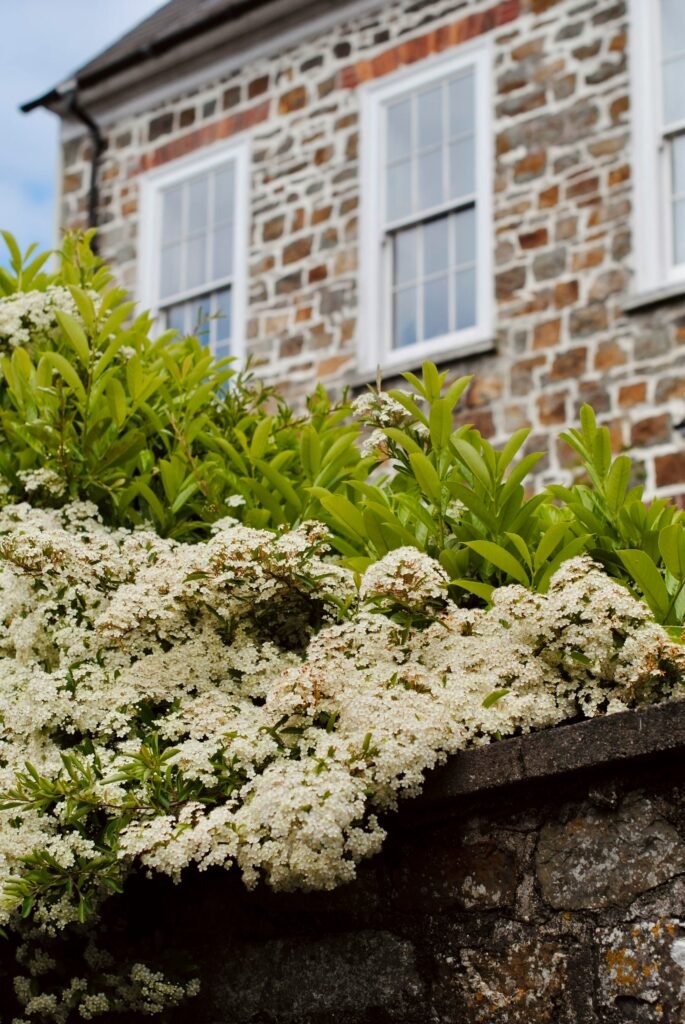
Kinsale Museum Shows How Layered the Town Really Is
A good example is the building now occupied by Kinsale Museum.
The main structure dates to around the late 16th or very early 17th century, originally serving as a market house, while its more formal façade was added in the early 1700s.
That later frontage is described as Dutch in style and includes a rare Venetian window above the entrance.
And this is exactly the point.
Kinsale’s architecture rarely belongs neatly to one moment.
Buildings were adapted.
Refronted.
Extended.
Reused.
A marketplace becomes a courthouse.
A defensive town becomes a tourism town.
A working port becomes a food destination.
The buildings carry those transitions.
St Multose Adds the Medieval Layer
Even though it’s harder to find good imagery for it, St Multose Church is crucial to understanding Kinsale.
The church was originally built around 1190 and has remained in continuous use for centuries.
Parts of the original Norman building survive, including important elements of the bell tower, while later alterations were added over time.
Architecturally, it gives Kinsale an anchor.
The town may look playful today, but this is not a newly prettified coastal village.
It has serious age underneath it.
St Multose reminds you that the colourful shopfronts are simply the newest layer in a much older town.
You don’t need a full-page photograph of the church to make that point.
A smaller contextual image is enough.
The Harbour Buildings Feel Different Again
Move toward the water and Kinsale changes character.
The buildings tend to feel broader.
There is more sky.
More open space.
More horizontal emphasis.
The colourful harbourfront houses sit against yachts, masts and water, and the overall effect becomes less intimate and more maritime.
This matters because Kinsale’s architecture isn’t experienced in isolation.
It is always being read against landscape.
Grey slate roofs against green hills.
Pastel walls against blue water.
Bright shopfronts beneath overcast skies.
White windows against saturated paint.
That contrast is a huge part of the town’s visual identity.
And ironically, Irish weather probably helps.
The colours often look even stronger beneath soft grey light.
Then There’s the Military Architecture
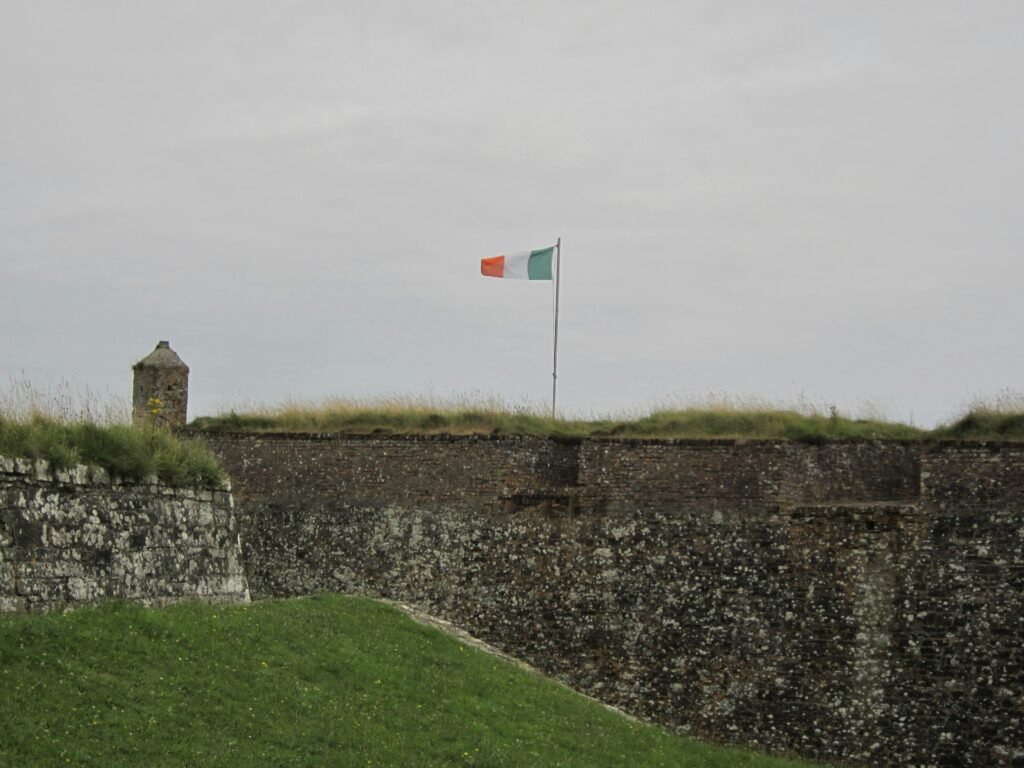
Kinsale’s prettiness can distract you from the fact that it was once extremely strategically important.
The harbour entrance was defended by major fortifications.
James Fort was built in the early 17th century.
Charles Fort, constructed later in the century, is a huge star-shaped defensive complex overlooking the estuary.
Charles Fort’s walls and outer defences are massive, with some sections reaching roughly 16 metres high.
Visually, it is the complete opposite of central Kinsale.
The town is colourful.
The fort is stone.
The town is intimate.
The fort is monumental.
The town twists.
The fort is geometric.
And yet both exist because of the same harbour.
That is the architectural story of Kinsale in miniature.
Everything begins with location.
Feel like walking Kinsale? Check out our Walking Kinsale article
Why Kinsale Never Feels Too Polished
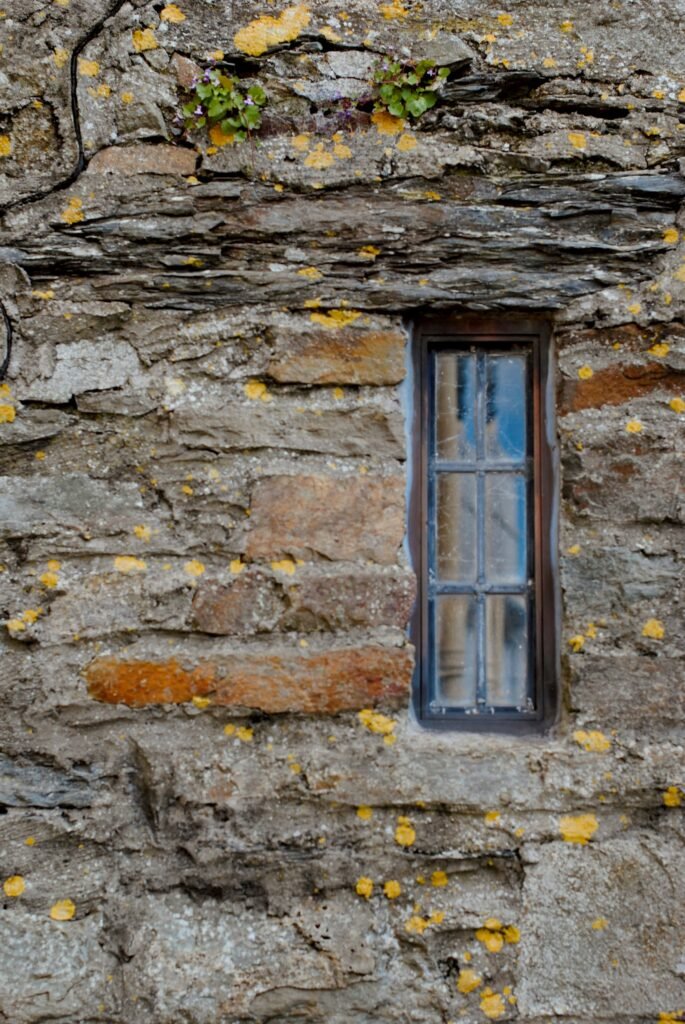
There is another reason Kinsale works.
It isn’t pristine.
Paint chips.
Walls age.
Signs overlap.
Buildings have been modified.
Flowers spill beyond their containers.
Some façades are a little wonky.
And thank God for that.
There is a danger with colourful towns that they become overly curated.
The architecture begins to feel like a backdrop rather than somewhere people actually live.
Kinsale generally avoids that.
Its beauty comes from accumulation rather than perfection.
And that is a very different thing.
The Design Lesson Hidden in Kinsale
There’s something worth stealing from Kinsale.
Not literally.
Please don’t remove a door.
But the town demonstrates a design principle that works almost anywhere:
variation within a consistent framework.
The buildings are all different.
But they share enough common DNA.
Similar scale.
Traditional windows.
Simple walls.
Compact plots.
Slate roofs.
Street-facing entrances.
Then individuality happens through colour, signage and detail.
That is why the whole town feels coherent without being repetitive.
It’s the same reason a well-designed room works when every piece of furniture isn’t from the same collection.
You need relationships.
Not matching.
Why Modern Developments Rarely Feel Like Kinsale
We often try to recreate places like this.
Developers build “heritage villages.”
Shopping precincts are given colourful façades.
New estates add fake traditional details.
And somehow it never quite works.
The problem is usually time.
Kinsale wasn’t designed to look charming.
It became charming.
Buildings were altered because businesses changed.
Colours were added because owners wanted their shops noticed.
Streets evolved because geography demanded it.
Historic buildings survived because they continued to serve a purpose.
That unpredictability cannot easily be master-planned.
Which is why the best new architecture inspired by places like Kinsale shouldn’t copy the surface.
It should copy the principle.
Build for place.
Allow variation.
Use real materials.
Make room for change.
Let buildings age.
Then get out of the way.
So Why Does Kinsale Look So Different?
It isn’t just the colour.
It’s the harbour.
The narrow streets.
The small building plots.
The changing rooflines.
The Georgian influence.
The medieval fabric.
The military history.
The independent shopfronts.
The layers.
And then yes…
Someone painted half of it pink.
Kinsale works because its colour sits on top of architecture that already had character.
Take away the bright paint and the town would still be interesting.
Add the colour back in and suddenly it becomes unforgettable.
That is the difference.
And maybe that is why so many places try to imitate towns like Kinsale and fail.
They copy the paint.
They forget the history underneath it.
Britt & Tyler
We’re Britt and Tyler, the two Australians behind Cocktails & Cathedrals. We’re drawn to old buildings, beautiful rooms, bookshops and places that seem to hold a story. Our journal brings those interests together, with a fondness for slow afternoons and a well-made cocktail. We hope it helps you find places you’ll want to linger.
Travel slowly. Stay beautifully.
A little more about us →