A Literary Walking Tour of Trieste: In the Footsteps of James Joyce, Italo Svevo and Umberto Saba
There are cities that happen to have produced writers.
And then there is Trieste.
Wedged into Italy’s far north-eastern corner between the Adriatic and the Slovenian border, Trieste feels less like a conventional Italian city and more like somewhere Europe accidentally overlapped.
Vienna is here. Venice is here. The Balkans are close enough to feel. Italian, Slovenian, German and Jewish histories have all left their fingerprints on the streets.
And everywhere, there are writers.
James Joyce spent some of the most formative years of his life here. Italo Svevo walked these streets before the wider literary world had any idea what to make of him. Poet Umberto Saba ran a second-hand bookshop in the city centre for decades.
Their Trieste wasn’t simply a backdrop. The city got into their work.
So rather than treating the literary landmarks as a checklist, this walking tour follows them through the sort of Trieste they actually inhabited: cafés, bookshops, arcades, waterfront streets and slightly gloomy corners where it isn’t difficult to imagine someone sitting down with a notebook and wasting an afternoon.
Allow half a day, longer if you intend to do the sensible thing and stop repeatedly for coffee, cake and wine.
Why is Trieste such a literary city?
For centuries Trieste sat at an unusual cultural crossroads.
As the major seaport of the Habsburg Empire, it attracted merchants, sailors, intellectuals and migrants from across Europe. Italian culture mingled with Austrian, Slovenian, Croatian, Greek, Jewish and other communities.
That mixture gave Trieste something slightly different from the cities around it.
It was cosmopolitan without being enormous. Italian without being entirely Italian. Central European while sitting beside the Mediterranean.
It also developed one of Europe’s great café cultures. By the 19th and early 20th centuries, cafés weren’t simply places to get coffee. They functioned as informal offices, reading rooms, debating chambers and meeting places for writers and artists.
Joyce, Svevo and Saba all became part of that world.
Joyce arrived in Trieste in October 1904 and, with interruptions, spent almost sixteen years connected to the city. He finished or developed much of his early work here, including Dubliners, A Portrait of the Artist as a Young Man, Exiles and Giacomo Joyce, while significant parts of Ulysses began taking shape during his Trieste years.
Which makes the first stop rather appropriate.
Stop 1: Piazza Unità d’Italia
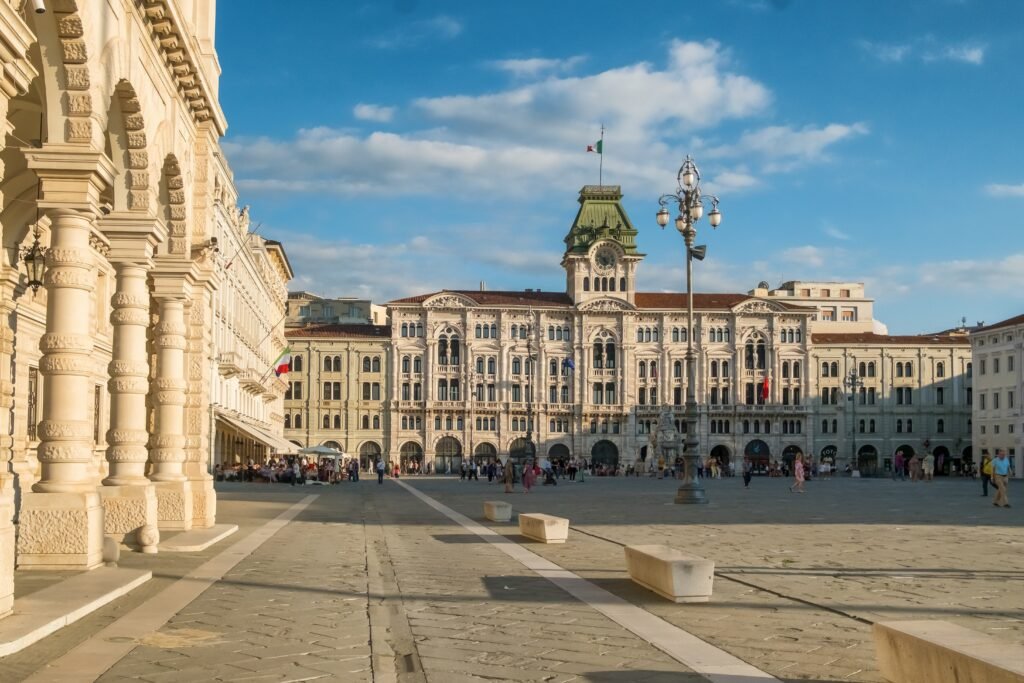
Start on Piazza Unità d’Italia, Trieste’s magnificent waterfront square.
It’s almost comically grand.
Three sides are enclosed by enormous palazzi while the fourth simply opens onto the Adriatic, as though whoever designed the place decided a building would only spoil the view.
This is a good place to understand Trieste before chasing its writers.
Look around and the city’s history becomes visible: monumental Habsburg-era architecture facing a distinctly Mediterranean sea.
And before we do any serious walking, there is coffee.
Coffee stop: Caffè degli Specchi
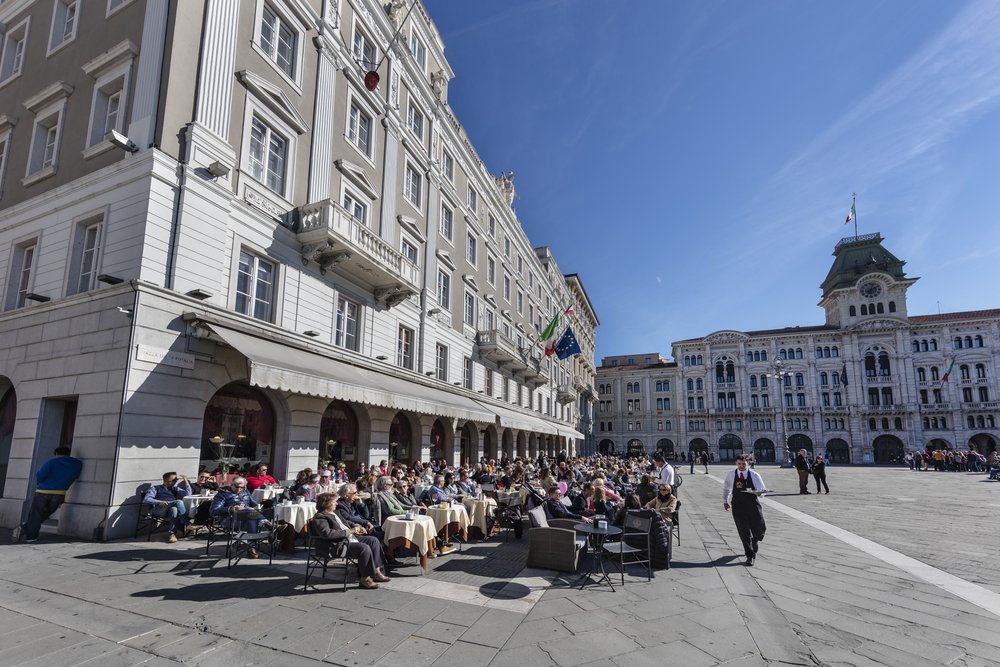
Set beneath Palazzo Stratti on the square, Caffè degli Specchi dates to 1839 and belongs to Trieste’s tradition of grand historical cafés.
You could easily save it for the end of the walk, but there is something pleasingly decadent about beginning a literary pilgrimage with coffee beneath chandeliers.
Don’t rush it.
Trieste is not really a city that rewards rushing.
Stop 2: Caffè Tommaseo
From Piazza Unità, wander a few minutes towards the waterfront side of Piazza Tommaseo.
Here you’ll find Caffè Tommaseo, another of Trieste’s famous literary cafés.
The regional tourism authority includes Tommaseo among the city’s historic literary gathering places and describes the café culture of Trieste as closely connected with writers including Joyce, Svevo and Saba.
You don’t necessarily need another coffee.
Although this is a literary tour, not a medical examination, so we won’t judge you if you do.
From here, turn inland towards one of the most atmospheric parts of central Trieste.
Stop 3: The Grand Canal and James Joyce
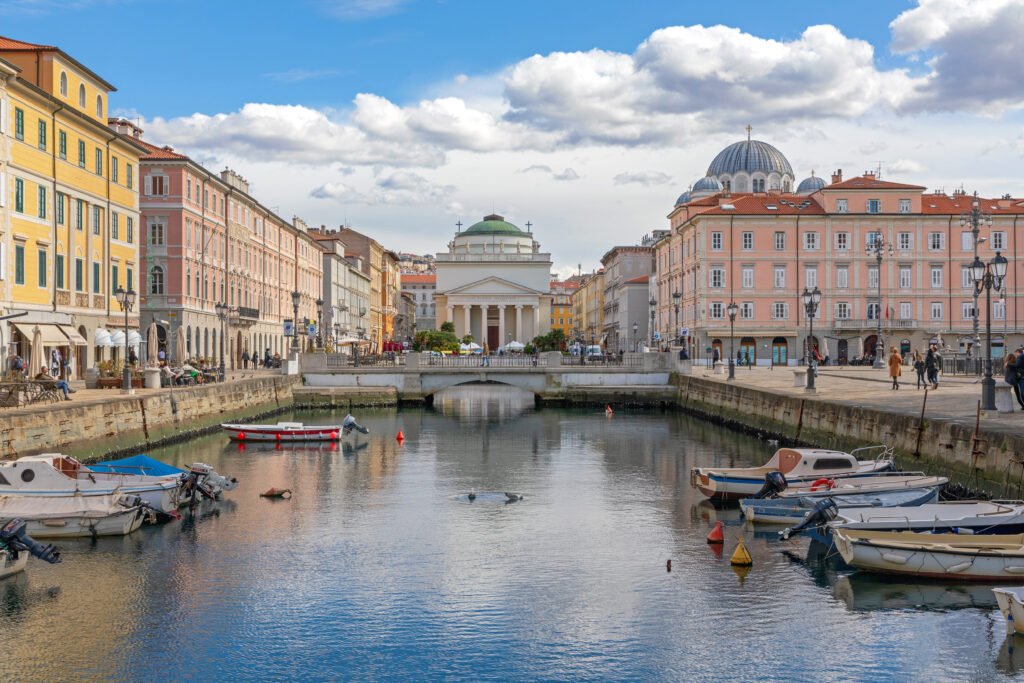
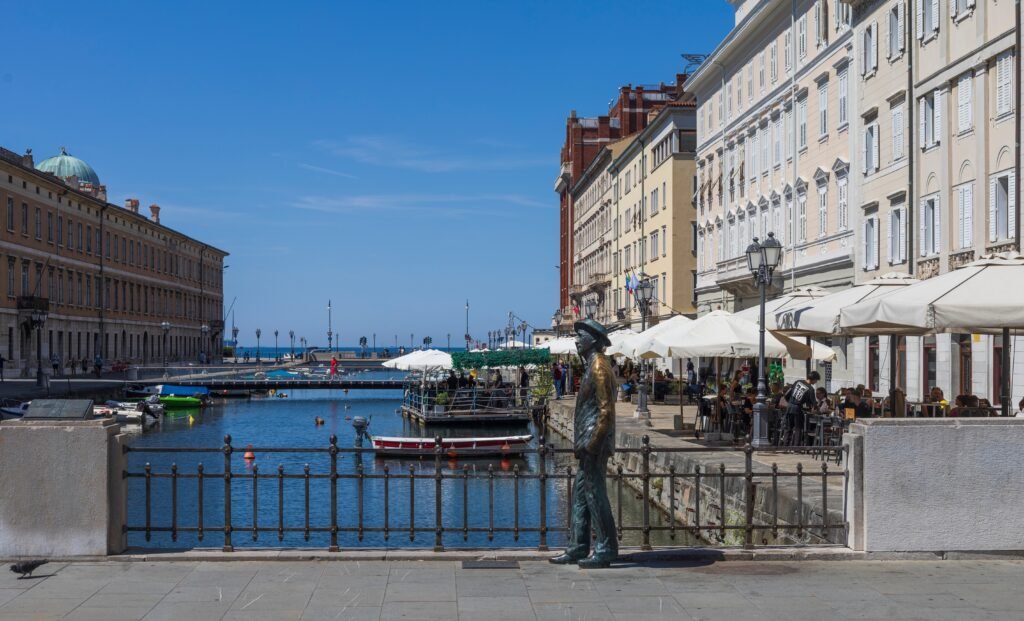
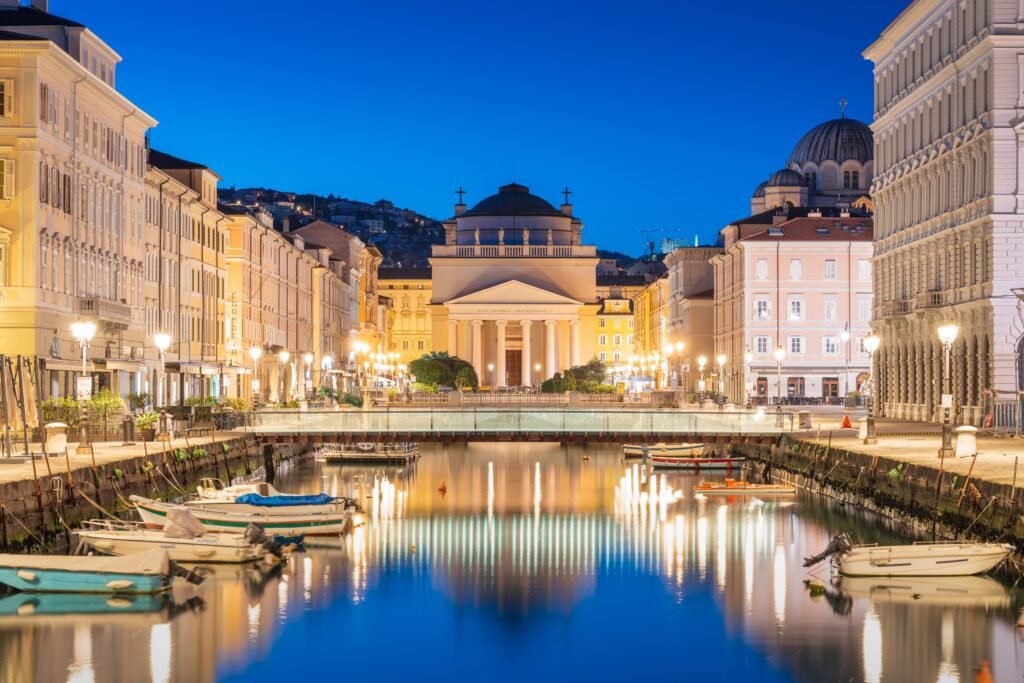
The Canal Grande slices unexpectedly into the middle of the city.
Boats sit beneath elegant façades. Cafés occupy the edges. At the far end, the domed Church of Sant’Antonio Nuovo rises above the water.
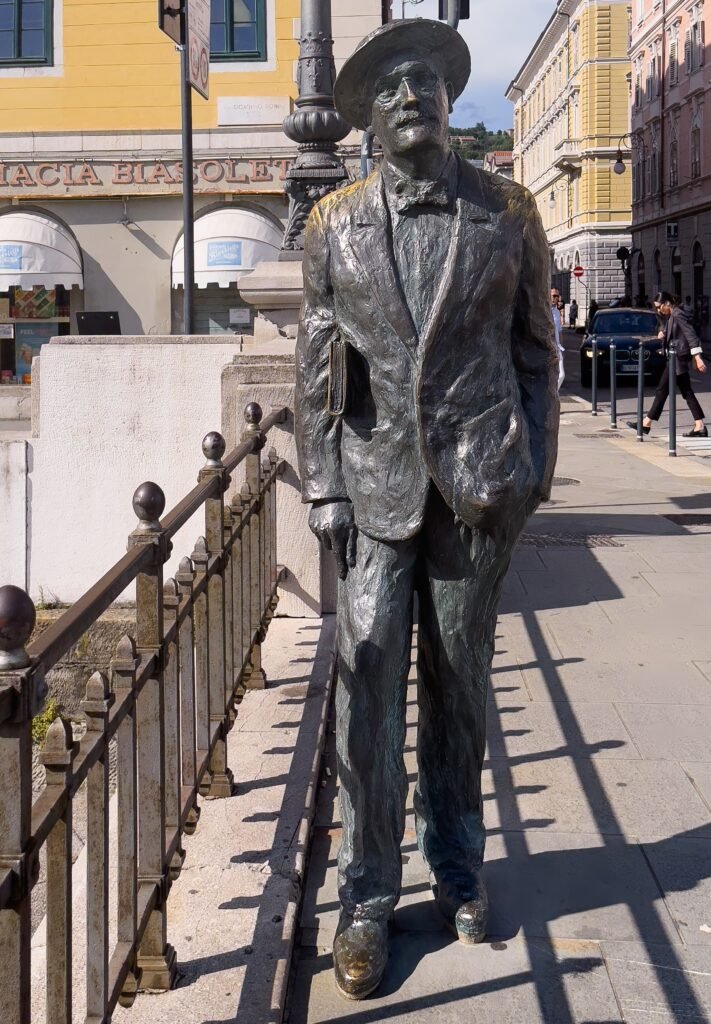
And halfway along you’ll encounter a familiar-looking man in a hat.
The James Joyce statue
Joyce stands casually beside the canal near the corner of Via Roma and Via Rossini, looking as though he has somewhere mildly inconvenient to be.
Unlike many monumental statues of writers, he’s placed at street level.
That works beautifully.
You don’t stand beneath Joyce.
You meet him.
The location is appropriate because Joyce’s Trieste was an intensely urban one. He moved constantly between rented rooms, teaching jobs, cafés, taverns and friends’ houses.
He arrived here as a relatively unknown 22-year-old English teacher in 1904. By the time his Trieste years were over, many of the ideas that would eventually transform modern literature were already underway.
Even the relationship between Joyce and Trieste’s other great modernist novelist began rather mundanely.
Italo Svevo hired Joyce for English lessons.
The teacher discovered his pupil happened to be a largely ignored novelist.
And things got interesting.
James Joyce and Italo Svevo: one of literature’s great accidental friendships
Italo Svevo wasn’t actually called Italo Svevo.
He was born Ettore Schmitz in Trieste in 1861 and adopted his literary pseudonym partly to reflect the city’s blended Italian and Germanic identities.
By the time he met Joyce, Svevo had already written novels but had received little recognition.
Joyce saw something in them.
The two became friends, discussing literature and exchanging manuscripts, and Joyce later played an important role in drawing attention to Svevo’s work outside Italy.
Trieste’s official literary itineraries still connect the two writers across the city, including cafés, homes and places where they met.
But before looking for Svevo, we’re going to find Trieste’s poet.
Stop 4: Meet Umberto Saba on Via Dante
Walk towards Via Dante and Via San Nicolò.
On the corner you’ll find another bronze pedestrian.
This is Umberto Saba.
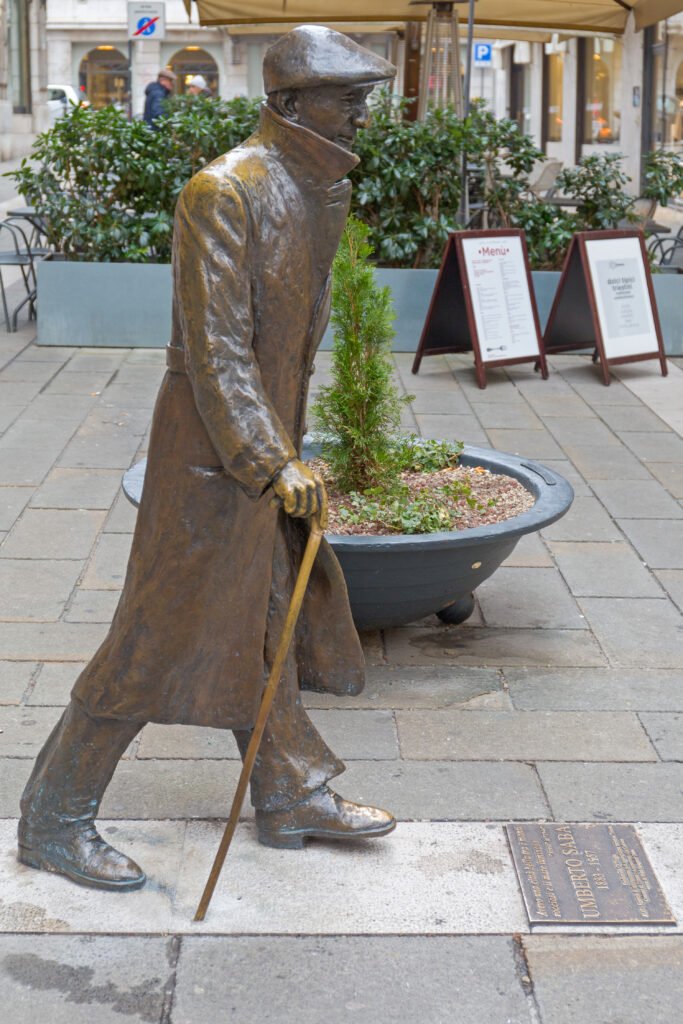
Like Joyce, Saba isn’t posed heroically on a pedestal. Sculptor Nino Spagnoli depicted him walking through his city, heading towards the bookshop where he spent so much of his life.
The statue was installed in 2004. It originally included Saba’s characteristic pipe, although repeated thefts eventually persuaded the city to stop replacing it.
But the real reason for coming here is waiting just around the corner.
Stop 5: Libreria Antiquaria Umberto Saba
Via San Nicolò 30
For us, this might be the best stop on the entire walk.
Umberto Saba bought this second-hand bookshop with his friend Giorgio Fano in 1919.
Their original idea wasn’t terribly romantic.
They intended to buy the stock, clear it out and resell the premises.
Then Saba fell for the books.
There were more than 28,000 of them.
He persuaded Fano to keep the business and spent more than 35 years associated with the shop.
The Libreria Antiquaria Umberto Saba survives at Via San Nicolò 30, and after a major restoration it reopened in 2025 with its historic collection and retail activity restored.
This is exactly the sort of place we travel for.
Not because it has been polished into some enormous literary attraction, but because it still feels small enough to imagine Saba walking through the door.
Wooden shelving. Old books. Layers of history.
As of 2026, listed opening hours are Tuesday to Saturday, with morning and afternoon sessions; it is closed Sunday and Monday, so check before building your entire day around it.
Cocktails & Cathedrals tip
If you’re photographing this walk, don’t just photograph the shopfront.
This is one of those streets where the contrast tells the story: ordinary modern city outside, old bookseller within.
Stand further back and capture the narrow façade as part of Via San Nicolò.
Stop 6: Antico Caffè San Marco
Now wander north through the centre towards Via Cesare Battisti.
Eventually you’ll arrive at what may be Trieste’s ultimate literary café.
Caffè San Marco opened in 1914.
Inside are mirrors, brass chandeliers, dark wood, red marble tables and decorative details that feel much closer to Vienna than to the Italy of beach umbrellas and Aperol postcards.
San Marco became part of Trieste’s intellectual life and remains a café, restaurant and bookshop today. Its own history records more than a century of cultural activity, while regional tourism material connects it with generations of writers and intellectuals.
This is where I would stop properly.
Not five minutes.
Order something. Find a table. Read a few pages.
For maximum thematic commitment, bring Joyce, Svevo or Saba with you.
Although nobody is checking.
What should you order in a Trieste café?
Coffee language here can become surprisingly specific.
One local speciality you’ll see mentioned is the capo in b — roughly speaking, a small cappuccino served in a glass rather than a cup.
Learning one obscure coffee order also allows you to feel unbearably knowledgeable for the rest of the trip.
Optional detour: looking for more Svevo
If you’re particularly interested in Italo Svevo, his trail continues through this part of the city.
Trieste’s official Svevo itinerary includes Via Battisti, Caffè San Marco, Joyce’s statue, Saba’s statue and ultimately Piazza Hortis.
But rather than turning this walk into an eight-hour archaeological expedition, we’ll follow the literary story towards its natural conclusion.
A museum about a city of writers.
Stop 7: LETS – Trieste’s Museum of Literature
Make your way south-east towards Piazza Hortis.
Here you’ll find LETS – Museum of Literature Trieste, the city’s dedicated literary museum.
LETS brings the stories of Joyce, Svevo and Saba together rather neatly.
The museum contains dedicated Joyce, Svevo and Saba sections alongside exhibitions exploring Trieste’s multilingual literary culture, historic cafés, publishing, translation and the city’s complicated position on the borders of languages and countries.
The Joyce collection is particularly worthwhile after you’ve physically walked through his Trieste.
It covers his years in the city, the places he lived and frequented and the works he developed here.
And rather beautifully, the museum doesn’t really consider literature something that ends at its doors.
Its Triestemetro project sends visitors back into the streets along themed walking routes — including a literary line connecting locations associated with the city’s writers.
At the time of writing, LETS is at Piazza Hortis 4, is free to enter and generally opens Wednesday to Monday, closing Tuesdays. Check the current schedule before visiting.
Stop 8: Italo Svevo in Piazza Hortis
Outside, look for another bronze man caught mid-walk.
This time it’s Italo Svevo.
His statue was placed in Piazza Hortis in 2004 and portrays the writer walking towards the civic library.
There is something wonderfully consistent about Trieste’s writer statues.
Nobody is standing triumphantly on top of a horse.
Everyone appears to be going somewhere.
Which feels exactly right.
These weren’t distant literary gods.
They bought coffee.
They worried about money.
They worked ordinary jobs.
They argued with publishers.
They walked home.
And somewhere along the way, they wrote books.
Finish back on the waterfront
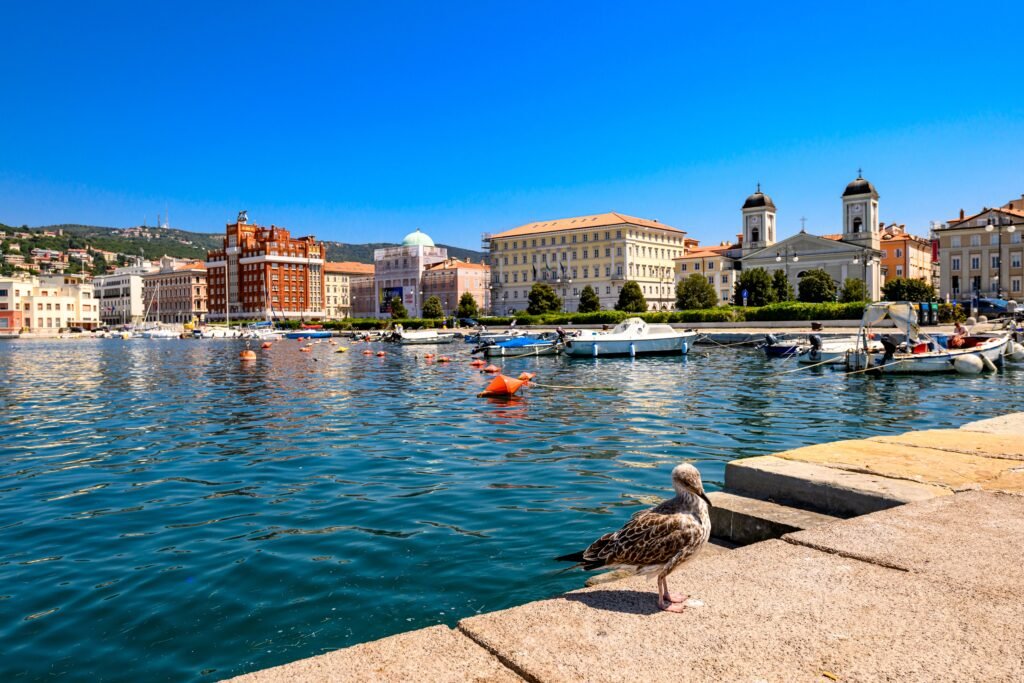
From Piazza Hortis, wander back towards the sea.
You can loop through the old streets of Cavana and emerge again near Piazza Unità.
If you’ve timed it well, do this around sunset.
Walk out onto Molo Audace, the long stone pier projecting into the Adriatic.
The city spreads behind you — cream façades, church domes and Habsburg grandeur — while the open water stretches towards a horizon that has spent centuries carrying people in and out of Trieste.
Svevo’s official literary route includes the wind rose at the end of Molo Audace as one of the places connecting his writing with Trieste’s sea and bora wind.
It’s an appropriately Triestine place to finish.
Half Italian.
Half Central European.
Entirely itself.
If you only have two hours
You can cut the walk down to a very satisfying short version:
Piazza Unità → Caffè Tommaseo → Canal Grande and Joyce → Saba statue → Libreria Antiquaria Saba → Caffè San Marco
That gives you most of the atmosphere without turning the afternoon into a forced march.
If you have longer, add LETS and allow enough time to actually sit inside San Marco instead of simply photographing it and moving on.
Literary tourism should involve a certain amount of sitting around doing very little.
The writers would probably approve.
What to read before visiting Trieste
You don’t need to arrive carrying the complete works of James Joyce.
Frankly, carrying Ulysses around all day seems unnecessarily punitive.
But these make good travelling companions:
James Joyce — Dubliners
Trieste isn’t the setting, but much of Joyce’s work on the collection took place during his years here.
James Joyce — Giacomo Joyce
The obvious Trieste choice.
This short, strange work is the only one of Joyce’s literary pieces specifically set in the city.
Italo Svevo — Zeno’s Conscience
Neurotic, funny and startlingly modern, it is the book that eventually established Svevo’s reputation.
Umberto Saba — The Songbook / Canzoniere
For Saba, Trieste wasn’t merely somewhere he lived.
The city repeatedly enters his poetry as part of his own identity.
The best time to take this walk
Spring and early autumn are probably the sweet spot.
The central route is compact and largely easy to explore on foot, but summer afternoons can make lingering in cafés considerably more attractive than lingering on pavements.
Which isn’t necessarily a problem.
Winter gives the city an entirely different personality.
Grey Adriatic skies, dark cafés and Trieste’s infamous bora wind arguably make the whole place even more literary.
Just don’t expect your carefully arranged scarf to survive.
Is Trieste worth visiting for book lovers?
Absolutely — although the books aren’t really the whole story.
What makes literary Trieste unusual is that the distance between the literature and the city remains incredibly small.
You can stand beside Joyce on the canal.
Walk past Saba on his way to his bookshop.
Sit beneath the mirrors of cafés where writers actually spent their days.
Then walk down to the sea that appears again and again in Trieste’s understanding of itself.
In some literary cities, you need a plaque to tell you something important happened there.
Trieste barely needs the plaques.
The atmosphere is still doing most of the work.
And perhaps that is why Joyce stayed so long.
He came to Trieste looking for a teaching job.
He ended up finding one of the strangest, most cosmopolitan corners of Europe at exactly the moment he was becoming James Joyce.
Not bad for a walk along the Adriatic.
If you fell in love with Trieste and want to take a little bit home with you why not check out our article on Trieste Colour Palettes or The Design Styles of Trieste
Britt & Tyler
We’re Britt and Tyler, the two Australians behind Cocktails & Cathedrals. We’re drawn to old buildings, beautiful rooms, bookshops and places that seem to hold a story. Our journal brings those interests together, with a fondness for slow afternoons and a well-made cocktail. We hope it helps you find places you’ll want to linger.
Travel slowly. Stay beautifully.
A little more about us →