Picture Rails: The Forgotten Old-World Detail That Makes a Room Feel Finished
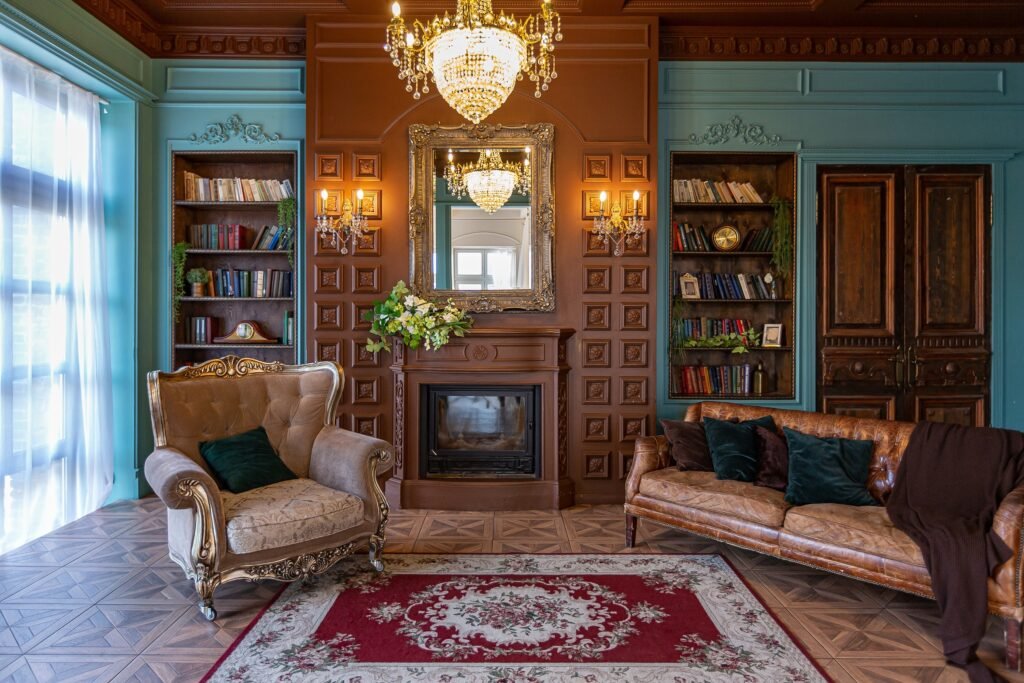
There is something about an old European home that feels effortlessly complete. It might be the tall ceilings, the beautifully worn floorboards, or the delicate plasterwork that frames a room without demanding attention.
But sometimes, it’s a much smaller detail.
Look closely at the walls of a Victorian townhouse, a Georgian drawing room, or an elegant Parisian apartment, and you may notice a slender strip of moulding running just below the ceiling.
It’s called a picture rail, and it’s one of those wonderfully practical architectural details that somehow manages to make an entire room feel more considered.
Once a familiar feature in period homes, picture rails have gradually disappeared from modern interiors. Yet their understated elegance is precisely what makes them worth rediscovering.
What Exactly Is a Picture Rail?
A picture rail is a narrow length of decorative moulding, traditionally installed high on a wall, often a little below the cornice or ceiling.
Its original purpose was beautifully straightforward: to provide a place to hang pictures without repeatedly hammering nails into plaster walls.
Special hooks fitted over the rail, allowing paintings, mirrors, and framed photographs to be suspended from cords, ribbons, or chains.
Artwork could be rearranged whenever the mood struck, without leaving a collection of holes behind.
It was a practical solution, certainly. But like so many details found in older homes, its usefulness became part of its charm.
A Small Detail With a Surprisingly Rich History
Picture rails became particularly familiar in Victorian and Edwardian interiors, although systems for suspending artwork had been used in grand European homes long before.
In an era when decorative plasterwork, elaborate wallpapers, and carefully arranged artwork were important elements of domestic life, picture rails offered an ingenious solution.
They protected delicate wall finishes while giving homeowners the freedom to change their displays.
More importantly, they introduced another subtle horizontal line into the architecture of a room.
Much like cornices, ceiling roses, and decorative skirting boards, picture rails helped create the layered architectural character we now associate with beautiful period interiors.
They were never necessarily the star of the room.
And perhaps that’s exactly why they worked so well.

Why Picture Rails Make a Room Feel More Elegant
One of the loveliest things about picture rails is the way they give a wall a sense of structure.
Modern interiors often feature large, uninterrupted expanses of plasterboard. While this can feel clean and contemporary, it can sometimes leave a room looking a little unfinished.
A picture rail gently interrupts that blank surface.
It creates a delicate architectural boundary, drawing the eye upward and giving the wall a more thoughtful sense of proportion.
In rooms with generous ceiling heights, this additional detail can feel particularly beautiful.
Painted in the same colour as the walls, a picture rail becomes almost invisible, revealing itself through the natural play of light and shadow.
In a contrasting colour, it can introduce a more decorative, traditional quality.
Neither approach needs to feel elaborate.
Sometimes, the smallest architectural gesture is enough to change the atmosphere of a room.
The Charming Art of Hanging Pictures From a Rail
Of course, part of the appeal lies in actually using a picture rail for its original purpose.
There is something wonderfully romantic about an old oil painting or a gilded mirror suspended from a slender brass chain.
It immediately brings to mind the slightly eclectic interiors of historic European apartments, where art has been collected over generations rather than purchased to match a particular decorating scheme.
And that is perhaps the secret to making picture rails feel beautiful rather than overly formal.
They work especially well with artwork that has a little personality.
Antique landscapes, botanical prints, family photographs, and mismatched vintage frames can all look lovely when thoughtfully arranged.
The result feels collected rather than decorated.
A room that suggests a history, even if that history is still being written.

Can Picture Rails Work in a Modern Home?
Absolutely. In fact, picture rails can be especially effective in homes that lack original architectural features.
You don’t need a grand Victorian terrace or soaring ceilings to appreciate their appeal.
A simple, well-proportioned picture rail can add character to a modest bedroom, living room, or hallway without requiring an elaborate renovation.
The key is restraint.
Choose a moulding that suits the scale of the room rather than something excessively ornate. In spaces with standard ceiling heights, a slender profile will generally feel more balanced than a heavy decorative one.
For a subtle effect, paint the rail the same colour as the wall.
If you prefer a more traditional look, consider a soft contrast between the wall and moulding, perhaps warm ivory against a muted sage green, or creamy white against a dusty blue.
You can even use the rail as a visual boundary between two complementary paint colours, creating a softly layered effect reminiscent of historic interiors.
And if you intend to hang artwork from it, make sure you select a proper load-bearing picture rail, securely installed for the weight it will support, rather than ordinary decorative trim.
The aim isn’t to make a new home look artificially old.
It’s simply to borrow one of the little details that made older homes so appealing in the first place.
The Beauty of Details We Almost Forgot
Perhaps what makes picture rails so appealing today is that they belong to a different approach to decorating.
One where the architectural details of a room mattered just as much as the furniture placed inside it.
Where practical features were given beautiful proportions, and where even the simplest moulding could contribute to the character of a home.
Picture rails aren’t essential. A room can be perfectly lovely without them.
But they remind us that beautiful interiors are often created through a collection of small, thoughtful decisions rather than a single dramatic statement.
And sometimes, all it takes is a slender line of moulding beneath the ceiling to make a room feel as though it has always been that way.
Britt & Tyler
We’re Britt and Tyler, the two Australians behind Cocktails & Cathedrals. We’re drawn to old buildings, beautiful rooms, bookshops and places that seem to hold a story. Our journal brings those interests together, with a fondness for slow afternoons and a well-made cocktail. We hope it helps you find places you’ll want to linger.
Travel slowly. Stay beautifully.
A little more about us →
One Comment