9 Boutique Hotel Bedroom Ideas Inspired by Europe’s Most Beautiful Interiors
From romantic Parisian hideaways to richly decorated hotels in Vienna and Prague, discover nine ways to bring the warmth, character and understated luxury of a beautiful European boutique hotel into your own bedroom.

There is something rather wonderful about opening the door to a beautiful boutique hotel room.
Perhaps it is the soft glow of a bedside lamp, the weight of heavy curtains framing a tall window, or the sight of a perfectly dressed bed beneath an antique mirror. There might be a velvet armchair tucked into a corner, an old wooden writing desk, or wallpaper that looks as though it belongs in a grand European townhouse.
Nothing feels accidental, yet nothing feels overly perfect.
The most memorable boutique hotel bedrooms have a quality that can be difficult to describe. They feel intimate, atmospheric and quietly luxurious, as though each piece of furniture has been chosen with care and the room has gradually acquired its personality over time.
Across Europe, this approach to interior design takes many forms.
In Paris, it might mean delicate mouldings, antique furniture and soft, romantic textiles. Vienna brings a sense of classical elegance, with polished wood, decorative details and beautiful lighting. Prague offers something altogether moodier, with rich colours, old-world architecture and the occasional touch of Gothic drama.
And then there are the smaller, character-filled hotels of Italy, where faded grandeur, warm plaster walls and mismatched antiques can feel infinitely more appealing than anything brand new.
Fortunately, recreating this atmosphere at home does not require a grand apartment, an enormous budget or a complete renovation.
Often, it is the smaller details that make the greatest difference.
Here are nine boutique hotel bedroom ideas inspired by Europe’s most beautiful interiors.
1. Begin with a Beautifully Upholstered Headboard
Few things give a bedroom an immediate sense of luxury quite like a beautifully upholstered headboard.
In an atmospheric European boutique hotel, the bed is rarely treated as simply another piece of furniture. It is the centrepiece of the room, often framed by elegant bedside tables, decorative lighting and thoughtfully chosen artwork.
An upholstered headboard helps create that feeling of softness and permanence.
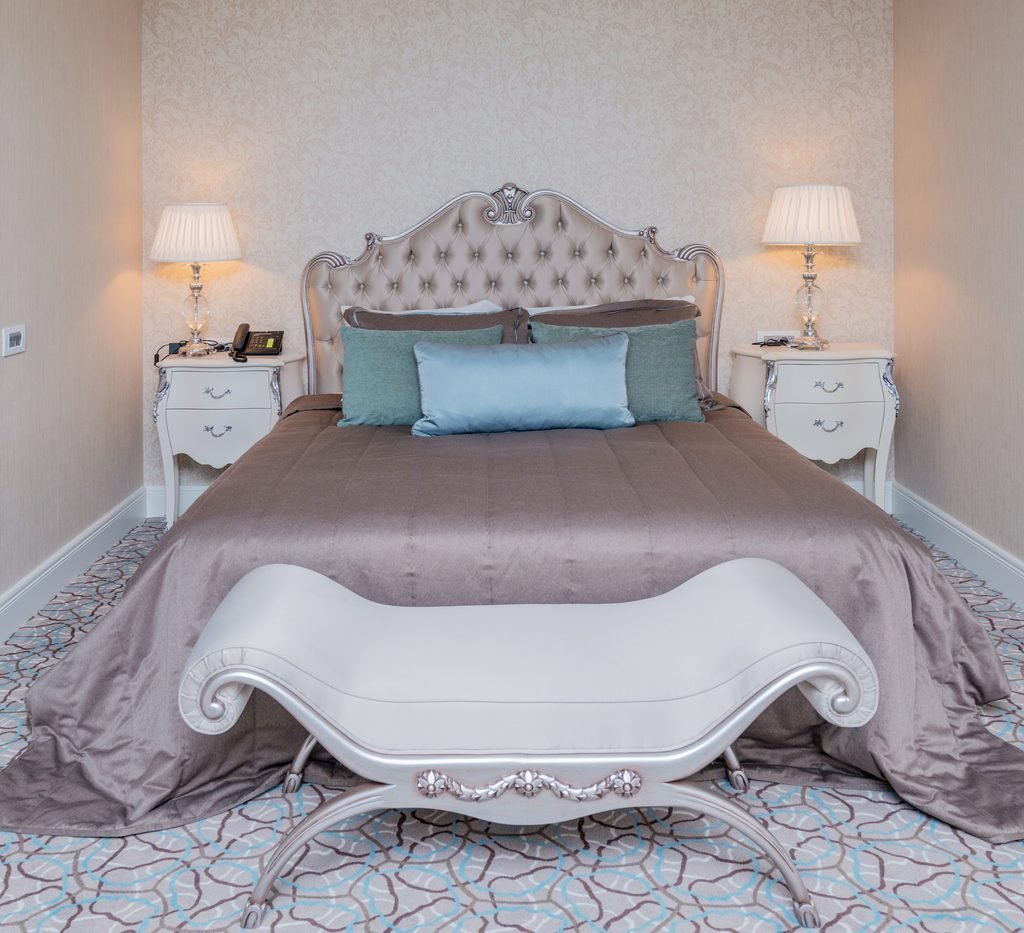
Velvet is particularly lovely in old-world interiors. Deep olive green, tobacco brown, muted burgundy and dusty rose can all bring richness to a bedroom without making it feel overly formal.
For something a little lighter, consider natural linen or a softly textured fabric in oatmeal, antique beige or warm ivory.
The shape matters, too.
A gently curved headboard can introduce a romantic Parisian feeling, while a tall, rectangular design with subtle piping or button detailing offers a more tailored, traditional appearance.
If you already have a simple bed frame, replacing the headboard alone can transform the entire room.
The trick is to choose something that feels timeless rather than fashionable. A beautiful headboard should look just as appealing in ten years as it does today.
Try this at home: Pair a deep green upholstered headboard with ivory bedding, dark timber bedside tables and small brass reading lamps for an effortlessly elegant European hotel look.
2. Embrace Rich, Atmospheric Wall Colours
White bedrooms can be beautiful, but some of Europe’s most memorable interiors are defined by colour.
Deep green walls, muted burgundy, warm charcoal and earthy brown tones create a sense of intimacy that feels particularly suited to a bedroom.
Darker colours can make a room feel more enclosed, but that can be part of their appeal. Balance them with lighter bedding and enough light for reading and dressing.
Imagine a bedroom in an old Prague townhouse, with olive-green walls, walnut furniture, cream bedding and the warm glow of a shaded lamp.
Or a romantic Parisian room painted in dusty rose, with antique gold picture frames and soft linen curtains.
The effect is less about dramatic colour and more about creating a beautiful atmosphere.
For a sophisticated old-world palette, consider combinations such as:
- Olive green and antique brass: Warm, elegant and quietly luxurious.
- Oxblood and ivory: Romantic, rich and beautifully dramatic.
- Warm charcoal and walnut: A refined, masculine-leaning interpretation of European style.
- Dusty rose and aged gold: Soft Parisian elegance without excessive sweetness.
- Antique beige and chocolate brown: Understated and timeless.

If painting an entire bedroom feels too adventurous, begin with a feature wall behind the bed. Alternatively, introduce these colours through upholstery, curtains or a large decorative throw.
Remember that darker colours work best when combined with thoughtful lighting and lighter textiles.
The goal is to create a room that feels enveloping, never gloomy.
For more combinations to try, explore our old-world European colour combinations, with ideas you can adapt through paint, curtains and upholstery.
3. Choose Antique Bedside Furniture with Character
One of the most appealing qualities of older European hotels is their willingness to mix furniture from different periods.
A beautifully worn wooden bedside table might sit beside an upholstered bed, while a delicate vintage chair occupies the opposite corner.
The pieces do not necessarily match.
Our guide to Trieste-inspired interiors explores a similar approach, bringing together dark timber, tactile fabrics and furniture with character.
And that is precisely why the room feels interesting.
Modern bedroom furniture is often purchased in coordinated sets, with identical finishes and perfectly matching proportions. While this creates a consistent appearance, it can also leave a room feeling a little impersonal.
European boutique hotel style offers a more relaxed alternative.
Look for small antique chests, vintage side tables, narrow wooden cabinets or traditional bedside pieces with decorative handles.
Walnut, mahogany and darker stained timbers work particularly well, bringing warmth and richness to the room.
Even modest second-hand furniture can look surprisingly elegant when paired with good lighting and beautiful textiles.
Do not worry if the two sides of the bed are slightly different.
A small antique chest on one side and a round pedestal table on the other can create a charming, collected-over-time effect.
A little design secret: Keep one element consistent, such as matching bedside lamps or a shared timber tone. This gives mismatched furniture a sense of intention.
4. Create Warm Pools of Light with Vintage-Inspired Lamps
Lighting may be the single most important detail in creating the atmosphere of a beautiful boutique hotel bedroom.
It is also one of the easiest things to get wrong.
A bright overhead light might be practical when searching for a missing sock, but it rarely creates the sort of atmosphere that makes you want to linger in a room.
The most inviting European hotel bedrooms rely on layers of softer light.
A pair of shaded bedside lamps might illuminate the bed, while a small lamp on a writing desk creates another welcoming corner.
Wall sconces can provide gentle reading light, particularly when positioned on either side of an upholstered headboard.
Look for lighting with character.
Aged brass, antique bronze, ceramic lamp bases and pleated fabric shades all work beautifully in old-world settings.
Avoid bulbs that produce a harsh, cool white glow. Warm-white bulbs, ideally around 2700K, create a softer, more comfortable atmosphere.
Dimmers are particularly useful, allowing the room to transition from practical daytime lighting to something much more intimate in the evening.
If you are decorating a smaller bedroom, wall-mounted reading lamps can free up valuable bedside space.
And there is something undeniably charming about switching on a beautifully shaded lamp beside a stack of books.
It is a small detail, but one that instantly makes a bedroom feel more like a place to escape.
5. Dress the Bed with Beautiful Linen and Layered Textures
There is a certain art to dressing a hotel bed.
The most beautiful examples are rarely overloaded with decorative cushions or complicated arrangements of pillows.
Instead, they rely on excellent proportions, generous layers and an appealing combination of textures.

Begin with simple, high-quality bedding in a restrained colour palette.
Warm white, ivory, natural linen and soft oatmeal provide a lovely foundation for almost any old-world bedroom.
From there, introduce a little depth.
A quilted coverlet, a softly textured throw or an elegant blanket folded across the foot of the bed can make the arrangement feel far more inviting.
For a romantic European look, consider washed linen paired with a velvet cushion in olive or oxblood.
For something more traditional, a subtle floral or striped fabric can introduce pattern without overwhelming the room.
The important thing is restraint.
A beautifully dressed bed should look inviting enough to climb into, not so elaborate that preparing it for sleep becomes an evening chore.
This emphasis on texture and restraint also runs through our guide to quiet luxury interiors. In a bedroom, it can be as simple as comfortable bedding and a few well-chosen materials.
Natural materials are especially appealing because they develop character through use.
Slightly rumpled linen, a soft wool throw and a generously filled duvet can feel far more luxurious than stiff, perfectly arranged synthetic fabrics.
Try this combination: Ivory linen bedding, a chocolate-brown quilted coverlet, two large pillows and a single burgundy velvet cushion.
Simple, beautiful and wonderfully atmospheric.
6. Introduce Vintage Wallpaper and Decorative Architectural Details
Walk into an older European townhouse hotel and you may find that the walls themselves are among the most beautiful features.
Delicate plaster mouldings, traditional wallpaper, high skirting boards and decorative ceiling details give these rooms a sense of history.
Fortunately, you do not need to live in a nineteenth-century building to borrow some of their charm.
Wallpaper is one of the simplest ways to introduce an old-world feeling.

Look for traditional botanical prints, subtle damask patterns, delicate florals or designs inspired by historic European textiles.
William Morris-style patterns, with their intricate leaves and muted colours, can be particularly effective in creating a cosy, heritage-inspired bedroom. The V&A’s guide to William Morris and wallpaper design offers a closer look at the plant forms behind his designs.
For a different decorative direction, our Art Nouveau colour palettes offer combinations of botanical greens, warm neutrals and richer accents. Morris belongs to the Arts and Crafts tradition; the two approaches share an interest in nature but are distinct styles.
For a more restrained look, consider wallpaper in soft olive, faded blue, antique cream or muted burgundy.
Using it behind the bed can create a beautiful focal point without overwhelming the entire space.
Decorative wall mouldings offer another possibility.
Simple applied timber mouldings, painted the same colour as the wall, can suggest the panelled interiors of Parisian apartments without requiring major structural work.
If the room already has attractive cornices or original architectural details, make those features part of the design rather than covering them.
The aim is not to create a fake historic interior.
It is to introduce enough detail that the room feels considered, layered and a little more interesting.
7. Add an Antique Mirror or Beautifully Framed Artwork
There is something about an antique mirror that instantly changes the character of a room.
Perhaps it is the softness of aged glass, the decorative quality of an old frame or the way it reflects warm evening light.
Whatever the reason, a well-chosen mirror can provide exactly the sort of understated elegance associated with European boutique hotels.
An ornate gilt mirror above a small chest of drawers can become a beautiful focal point.
For something quieter, consider a simple dark timber frame or an aged brass finish.
Mirrors are particularly useful in smaller bedrooms, where they can reflect natural light and create a greater sense of openness.
Artwork can be equally effective.
Rather than choosing generic prints simply to fill a wall, look for pieces that tell a story.
Vintage European landscapes, architectural sketches, botanical illustrations and traditional oil-painting reproductions all work wonderfully.
A small gallery arrangement of mismatched frames can also introduce character.
Imagine a collection of old architectural drawings above a walnut chest, with a shaded ceramic lamp and a few beautifully bound books beneath.
The combination feels personal, atmospheric and effortlessly European.
One beautiful painting may be all you need.
The key is choosing artwork because you genuinely love looking at it, not simply because it matches the bedding.
8. Make Room for a Little Sitting Corner
Some of the loveliest boutique hotel bedrooms offer more than somewhere to sleep.
They provide a small place to sit, read, enjoy a coffee or simply spend a little time doing absolutely nothing.

It might be a velvet armchair beside a tall window, a small antique writing desk or a compact upholstered chair tucked into an otherwise unused corner.
These details make a bedroom feel like a private retreat rather than just another functional room.
If space allows, introduce a comfortable armchair in a fabric that complements the rest of the interior.
Deep green velvet, warm brown leather, traditional patterned upholstery or softly textured linen can all work beautifully.
Add a small side table large enough for a book and a cup of coffee.
A floor lamp or small table lamp provides gentle illumination, turning the corner into a place you might actually use.
For smaller bedrooms, a narrow upholstered bench at the foot of the bed can offer a similar sense of luxury.
Alternatively, a compact vintage chair beneath a window may provide all the character you need.
There is a lovely connection here to Europe’s historic reading rooms and intimate literary salons, where furniture was arranged to encourage conversation, contemplation and the pleasure of lingering.
You will find a similar appreciation of quiet corners in our French château design ideas, which includes a section on elegant reading nooks.
A bedroom designed with that same philosophy becomes something more than a place to sleep.
It becomes somewhere you genuinely enjoy spending time.
9. Finish with the Small Details That Make Boutique Hotels Memorable
Often, what separates a pleasant hotel room from a truly memorable one is not the furniture or the size of the room.
It is the accumulation of thoughtful details.
Beautiful curtains that fall elegantly to the floor.
A vintage rug beneath the bed.
A small tray on a bedside table.
A polished wooden chest with a ceramic lamp.
A few interesting books, an antique clock or a favourite piece of pottery.
None of these details needs to be particularly expensive.
Together, however, they create a room with personality.
Curtains deserve special attention.
Full-length curtains in linen, velvet or a softly textured fabric can make an enormous difference to a bedroom, particularly when hung high enough to emphasise the room’s proportions.
For an intimate hotel-like atmosphere, choose warm, substantial materials that frame the windows beautifully.
A traditional rug is another wonderful addition.
Persian-inspired patterns, faded florals and muted geometric designs can introduce colour and softness while helping to bring different furniture pieces together.
Look for a rug with an aged, slightly imperfect appearance rather than something that feels overly new.
Finally, think about the little rituals associated with staying somewhere beautiful.
A carafe of water on a bedside table. A favourite novel within easy reach. A comfortable place to leave your slippers. A room that is tidy enough to feel peaceful but personal enough to feel lived in.
These are the details that make a space inviting.
And unlike a night in a beautiful European hotel, you get to enjoy them every day.
How to Bring European Boutique Hotel Style Together
The secret to creating a beautiful boutique hotel bedroom is not to copy one particular room.
It is to understand what makes these interiors so appealing.
They combine comfort with character, elegance with warmth, and carefully chosen furniture with details that feel collected over time.
A Parisian-inspired bedroom might feature soft ivory walls, delicate mouldings, antique timber furniture and a gently curved upholstered bed.
A Viennese-inspired room could embrace deeper colours, dark polished wood, decorative mirrors and beautifully shaded lamps. Our Vienna colour palettes provide a starting point for choosing the colours.
For something moodier, take inspiration from Prague, with olive or burgundy walls, rich fabrics and a little architectural drama.
And for an Italian interpretation, think warm plaster tones, faded patterned textiles, dark wood and the quiet romance of imperfection.
Whatever direction you choose, begin with just a few elements.
Perhaps a beautiful headboard, an antique bedside table and warmer lighting.
Once those pieces are in place, the rest of the room can evolve naturally.
There is no need to purchase everything at once.
In fact, a room that develops gradually often has far more character than one decorated in a single weekend.
A Little European Romance, Without Leaving Home
The appeal of a beautiful European boutique hotel is rarely just about luxury.
It is about atmosphere.
The pleasure of returning to a room that feels warm and welcoming after a day exploring unfamiliar streets. The gentle glow of a lamp beside an old wooden bed. The quiet comfort of beautiful linen, heavy curtains and furniture that seems to have a history of its own.
These are feelings worth bringing home.
You may never have the elaborate ceilings of a Viennese palace or the antique furnishings of a Parisian townhouse, but you can create a bedroom inspired by their warmth, charm and enduring beauty.
And perhaps that is the greatest luxury of all.
A room that makes you feel as though you have escaped somewhere wonderful, even when you have not travelled anywhere at all.
Britt & Tyler
We’re Britt and Tyler, the two Australians behind Cocktails & Cathedrals. We’re drawn to old buildings, beautiful rooms, bookshops and places that seem to hold a story. Our journal brings those interests together, with a fondness for slow afternoons and a well-made cocktail. We hope it helps you find places you’ll want to linger.
Travel slowly. Stay beautifully.
A little more about us →
2 Comments