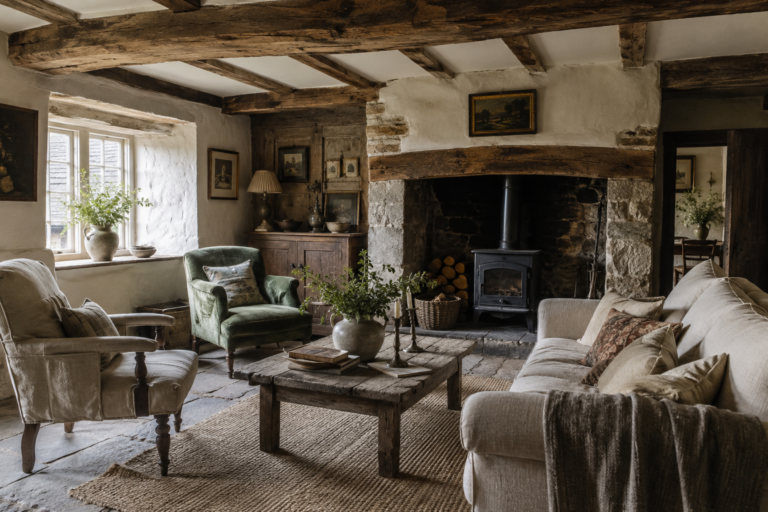
Budapest Interior Design: 7 Looks That Capture the Soul of the City
Budapest is a city that seems made for interiors.
Behind the grand façades of Pest are apartments with soaring ceilings, worn parquet floors and double doors that have survived more than a century. Coffee houses hide behind heavy curtains and gilded entrances. Art Nouveau buildings are covered in ceramics, stained glass and strange botanical details. Cross the Danube into Buda and the mood changes again, with elegant modernist villas climbing into the hills.
The result is a city with no single interior design style.
Instead, Budapest interior design is a mixture of faded Austro-Hungarian grandeur, Hungarian Art Nouveau, old literary cafés, interwar modernism and increasingly clever contemporary renovations.
And that may be exactly why it feels so appealing.
Budapest rarely looks as though everything was purchased at the same time. Old architecture sits beside modern furniture. Burgundy velvet can work with simple timber. Decorative plasterwork can hover above an otherwise restrained room.
It feels collected rather than decorated.
Here are seven Budapest-inspired interior looks — and how to borrow them without turning your home into a nineteenth-century palace.
1. The Grand Budapest Apartment
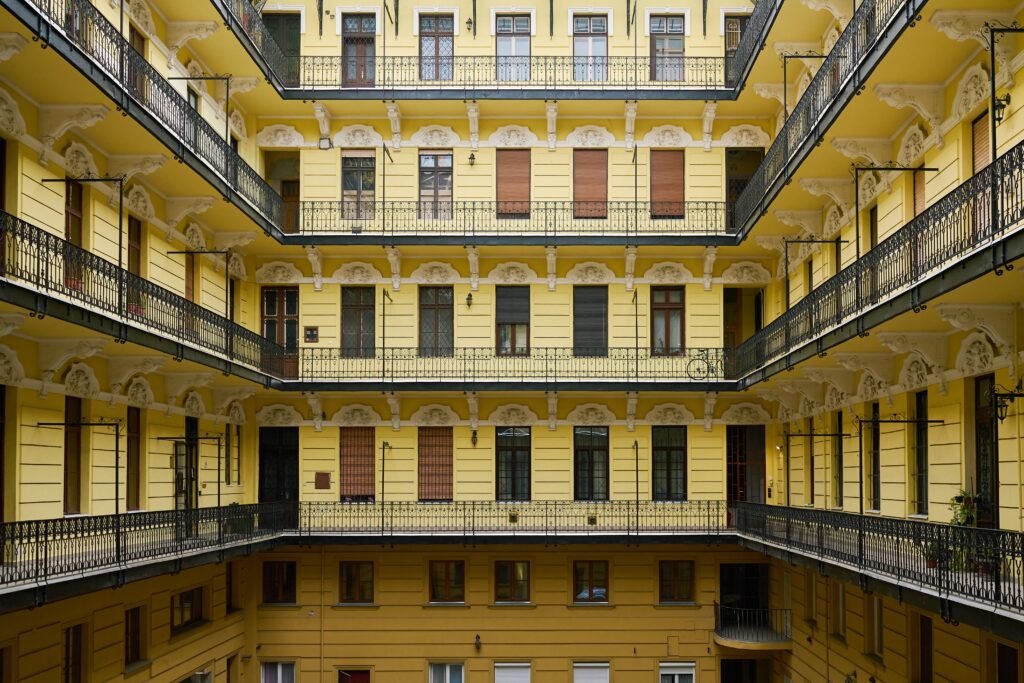
Walk through the older districts of central Budapest and one of the city’s most enduring interior influences is hiding above street level.
These are the apartments built during Budapest’s extraordinary growth in the late nineteenth and early twentieth centuries: high ceilings, tall windows, generous rooms, decorative plasterwork, timber doors and parquet floors.
The architecture is often grand.
The decoration doesn’t need to be.
In fact, some of the most beautiful contemporary Budapest interiors work because the room itself is allowed to provide the drama.
The look
Think:
- warm cream or chalky off-white walls
- original timber floors
- tall internal doors
- ceiling roses and restrained plaster mouldings
- walnut or dark oak furniture
- aged brass
- linen curtains
- burgundy, forest green or muted blue accents
- large-scale artwork rather than lots of small decoration
There’s an elegance to these rooms, but also a slightly imperfect quality.
Floorboards have aged. Doors may show layers of paint. Walls aren’t always pristine.
That patina is part of the appeal.
How to bring it home
You don’t need three-metre ceilings or an apartment overlooking Andrássy Avenue.
Start with the materials.
Choose warm timber over glossy white furniture. Use an oversized rug rather than several small ones. Bring in a deep burgundy armchair, an aged brass floor lamp or a heavy wooden sideboard.
If your home is relatively modern, simple wall moulding can give it a little architectural depth — but stop well before the room starts looking like a wedding venue.
The goal is Budapest apartment, not European palace theme.
2. Hungarian Art Nouveau — Budapest’s Szecesszió
If there is one decorative movement that gives Budapest interiors their own identity, this is probably it.
Known in Hungary as Szecesszió, the Hungarian interpretation of Art Nouveau flourished around the turn of the twentieth century.
It shared Art Nouveau’s love of flowing lines, plants, flowers and craftsmanship, but Hungarian designers often introduced local folk influences, vivid ceramics and highly individual patterns.
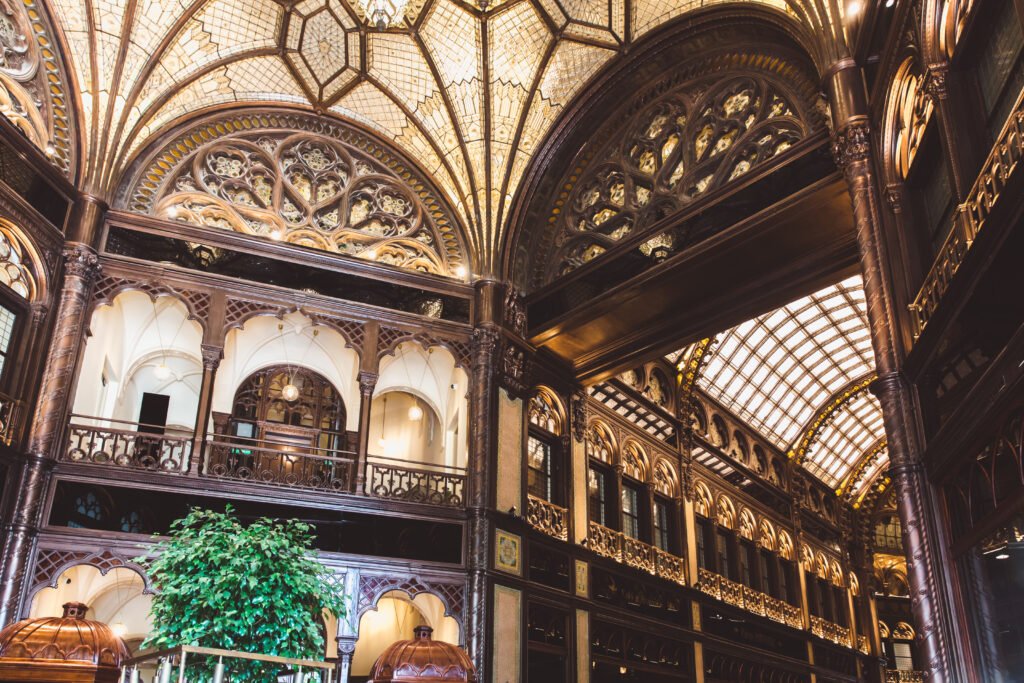
The result could be extraordinarily decorative.
The 1903 Bedő House, designed by Emil Vidor, is a wonderful example. Historical photographs of the original apartment show curved timber detailing, stained glass, dark furniture, patterned wall decoration and rooms designed as a complete ensemble rather than a collection of unrelated objects.
The look
Think:
- curved timber
- botanical patterns
- stained or coloured glass
- peacock greens and blues
- ochre and terracotta
- glazed ceramics
- dark wood
- decorative ironwork
- stylised flowers and leaves
Unlike the softer pastel version of Art Nouveau that sometimes appears in modern interiors, Budapest’s version can feel richer and earthier.
That makes it surprisingly easy to borrow in small amounts.
How to bring it home
The trick is one strong decorative element rather than an entire Art Nouveau room.
Try a patterned rug with botanical shapes, an unusual ceramic lamp, a piece of stained glass, a curved timber chair or tiles in deep green and ochre.
Keep the surrounding room fairly simple.
Hungarian Art Nouveau is powerful enough that you don’t need much of it.
One beautiful object can do more than twenty reproductions.
3. The Budapest Café Interior
Few cities have a stronger relationship with the café than Budapest.
During the late nineteenth and early twentieth centuries, Budapest’s coffee houses became meeting places for writers, journalists, artists and intellectuals.
And they weren’t exactly minimalist.
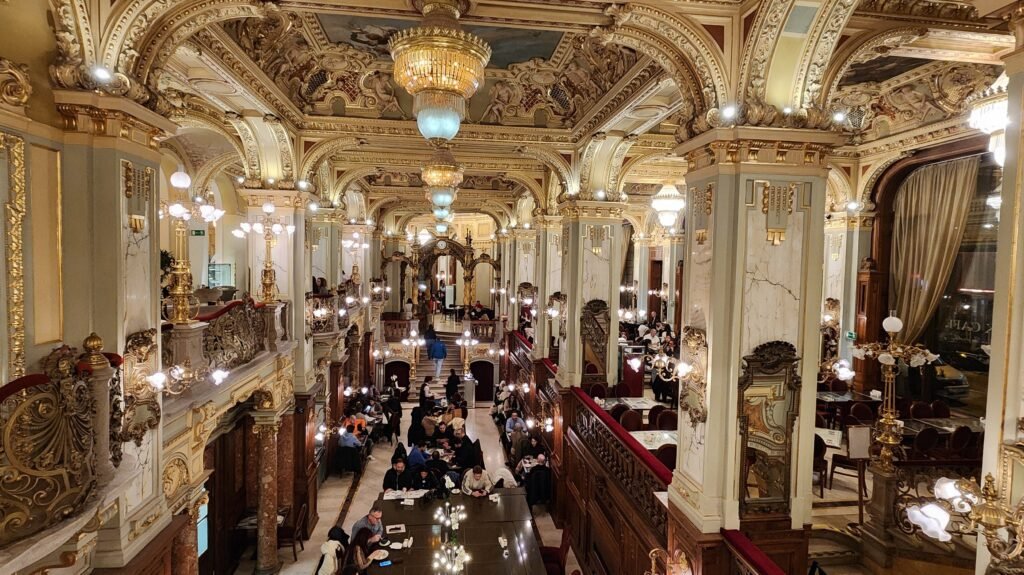
The New York Café, opened in 1894, became one of the most famous examples. Its interior is a theatrical combination of marble columns, frescoes, ornate detailing and chandeliers, while its history is closely connected with Budapest’s literary life.
You probably don’t want your living room to look exactly like it.
But the old Budapest café still provides plenty of inspiration.
The look
Think:
- bentwood chairs
- dark timber tables
- marble
- mirrors
- burgundy or oxblood upholstery
- warm cream walls
- brass details
- books and newspapers
- soft pools of light
- slightly faded elegance
This is perhaps the most atmospheric Budapest look of all.
It’s intellectual without being overly serious. Elegant without being perfectly polished.
There should be somewhere to put a coffee, somewhere to put a book and preferably somewhere to disappear for an hour.
How to bring it home
Create a small café corner rather than redesigning the whole room.
A round marble-topped table beside a window, two timber chairs and a framed print might be enough.
For a reading space, try a burgundy chair with a dark timber side table and a simple brass lamp.
Add books.
Lots of books.
What you don’t need is fake vintage signage, five chandeliers and a framed picture that says Café de Budapest.
Atmosphere works better when it isn’t trying too hard.
4. Budapest Modernism
Budapest doesn’t stop at nineteenth-century grandeur.
The city also has an important interwar modernist heritage, particularly in Buda.
Napraforgó Street is one of the best-known examples: a small experimental residential development completed in the early 1930s by a remarkable group of Hungarian architects.
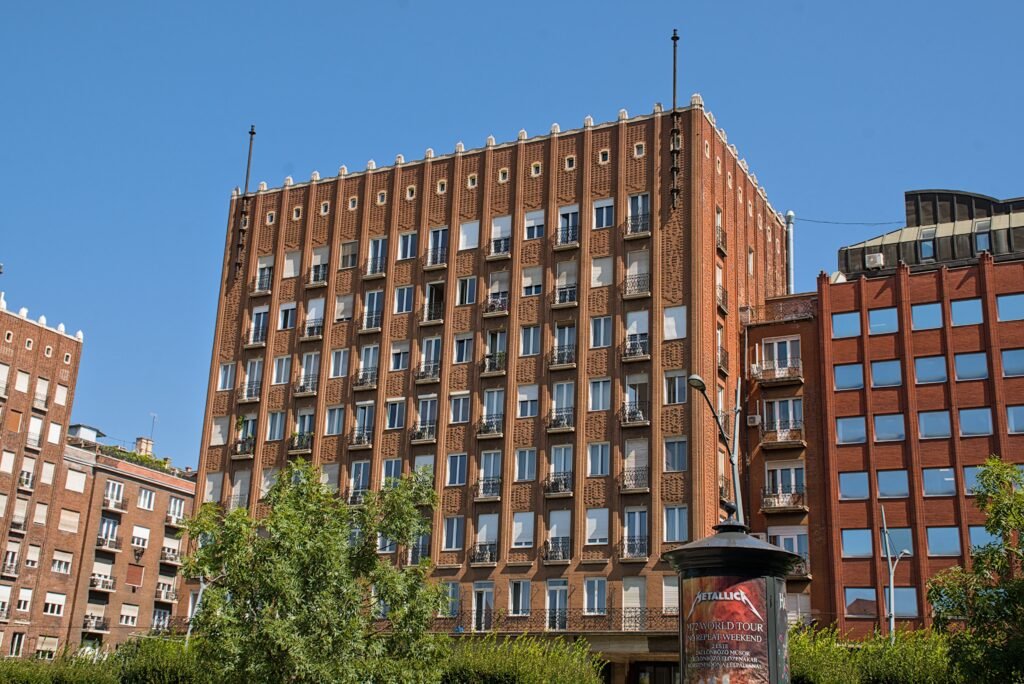
Its houses embraced ideas that were radical at the time — cleaner forms, generous windows, daylight, fresh air and a more functional approach to living. Although many people casually describe Budapest’s interwar villas as “Bauhaus”, architectural historians generally distinguish the broader Hungarian modernist movement from buildings designed directly by Bauhaus-trained architects.
And visually, the contrast with Budapest’s ornate historic centre is fantastic.
The look
Think:
- white or pale walls
- geometric forms
- large windows
- tubular steel
- simple timber furniture
- uncluttered rooms
- black accents
- functional storage
- art used sparingly
- plenty of natural light
This is Budapest with the decoration stripped away.
But it doesn’t have to feel cold.
Timber floors, books, textiles and vintage furniture can soften the geometry.
How to bring it home
This is perhaps the easiest Budapest look to adapt to an Australian home.
Keep walls light. Choose simple furniture with clean lines. Let timber provide warmth.
A classic cantilever chair, an old timber cabinet or a black-framed artwork can give the room a subtle Central European edge without becoming a Bauhaus museum.
And importantly, leave some space empty.
Not every wall needs something on it.
5. Mid-Century Budapest
Budapest’s design story continued long after the interwar modernists.
By the middle decades of the twentieth century, Hungarian homes had become simpler and more practical. Smaller apartments demanded lighter furniture, clever storage and pieces that could perform more than one job.
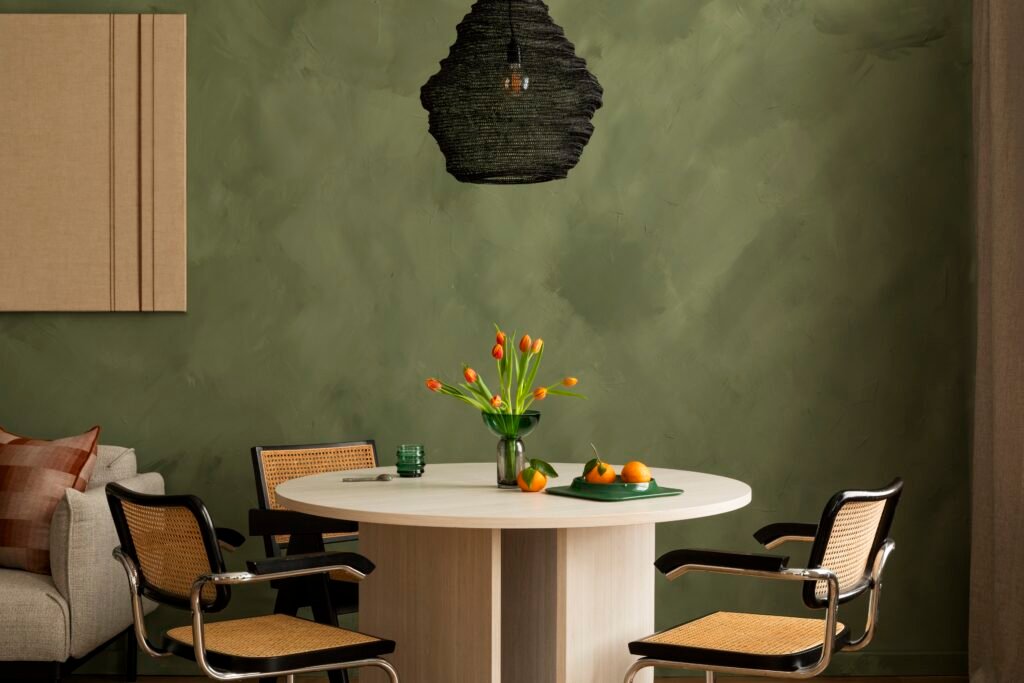
Today, vintage Central European furniture from this period fits remarkably well into contemporary interiors.
It also provides a nice bridge between ornate old Budapest and the city’s current design scene.
The look
Think:
- medium-toned timber
- tapered legs
- compact armchairs
- glass cabinets
- simple sideboards
- muted greens
- rust and burnt orange
- tobacco brown
- cream
- graphic artwork
There’s something particularly appealing about placing this furniture inside an older Budapest apartment.
A simple 1960s chair suddenly looks extraordinary against elaborate nineteenth-century doors.
That contrast is the point.
How to bring it home
Don’t buy an entire matching mid-century furniture suite.
One or two vintage pieces are enough.
Look for a narrow timber sideboard, a small lounge chair or a simple glass-fronted cabinet.
Then mix them with contemporary furniture.
The room should feel as though different generations have contributed to it.
Because in many Budapest homes, they probably have.
6. The Contemporary Budapest Apartment
This might be the most useful style of all.
Across Budapest, architects and designers are taking old apartments and adapting them for modern life rather than trying to recreate the nineteenth century.
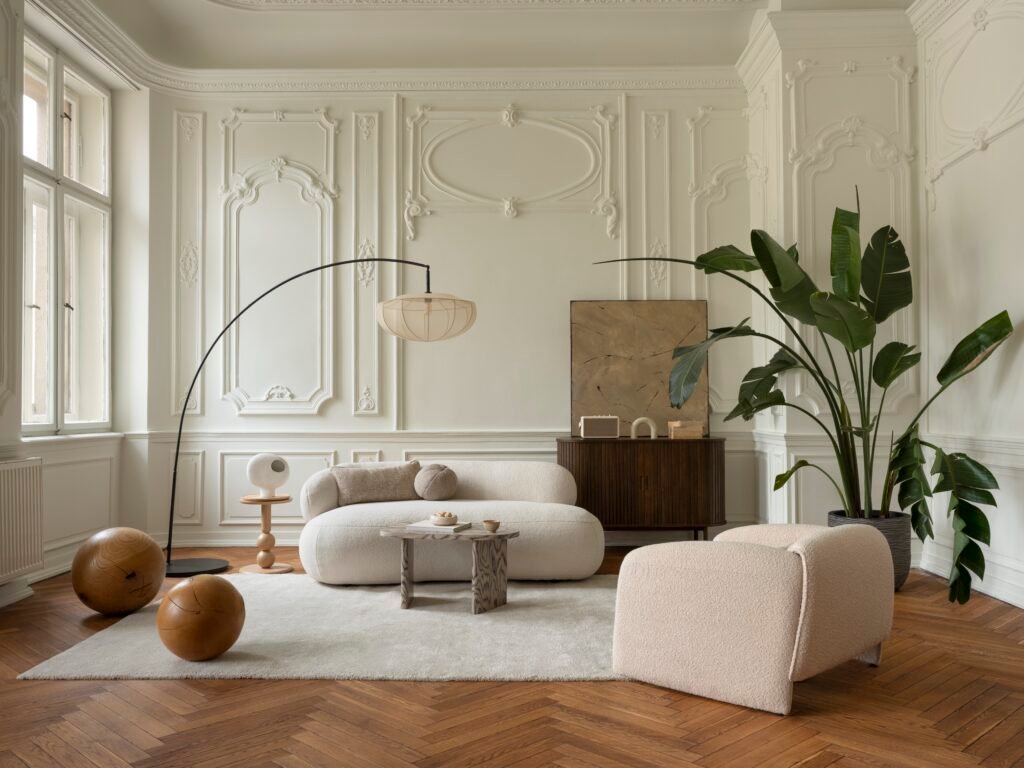
Walls are removed.
Layouts become more open.
Original details are retained where they work.
Modern kitchens and bathrooms are inserted without pretending they’re historical.
A number of documented Budapest apartment renovations show exactly this approach: old urban apartments reorganised into brighter, more flexible spaces while preserving the character of the original building.
This produces an interior style that feels unmistakably European but still very contemporary.
The look
Think:
- original parquet beside modern cabinetry
- historic doors with contemporary lighting
- warm white walls
- natural timber
- sculptural furniture
- restrained colour
- large modern artworks
- old architectural details left visible
- open-plan living within historic shells
There is usually less furniture than you expect.
The architecture gets room to breathe.
How to bring it home
Rather than adding historical decoration, ask what you can keep.
If you have timber floors, don’t immediately cover them.
If your room has an interesting brick wall, old doorway or slightly imperfect plaster, perhaps it doesn’t need to disappear.
Then keep the new pieces simple.
A clean-lined sofa, a contemporary dining table and one strong piece of artwork can sit beautifully beside older architecture.
Budapest proves that old and new don’t need to match.
They just need to respect each other.
7. Literary Budapest
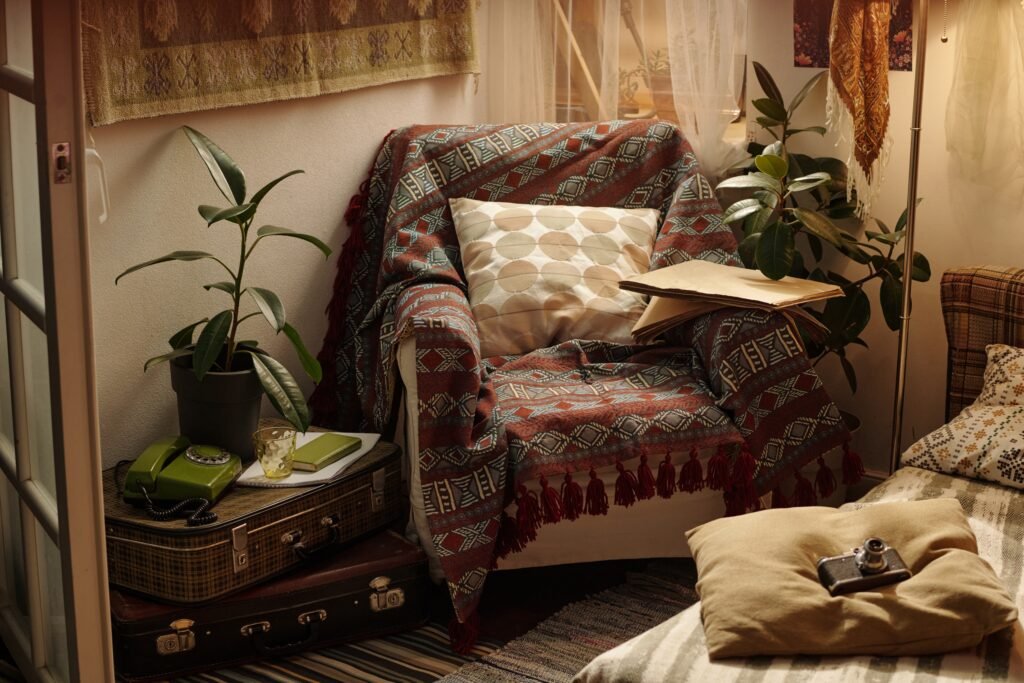
This isn’t an official design movement.
But it may be the Budapest interior we want most.
Imagine taking the warmth of an old apartment, the atmosphere of a literary café and the restraint of a contemporary European home and combining them into one room.
This is Literary Budapest.
And unlike some of the city’s grandest interiors, it’s completely achievable.
The look
Start with:
- cream walls
- walnut bookshelves
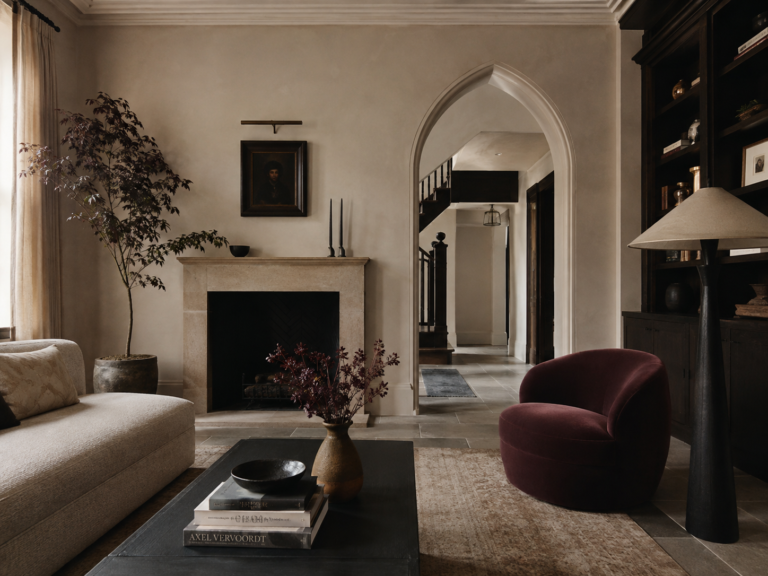
- a burgundy reading chair
- parquet or warm timber floors
- an aged brass lamp
- piles of books
- natural linen
- one dark blue or Danube-blue accent
- perhaps a small marble table
- artwork collected rather than coordinated
Nothing should feel too perfect.
A few books can be stacked horizontally. A chair doesn’t need to match the sofa. Timber can vary slightly in tone.
The room should feel lived in.
How to bring it home
Build the room around somewhere you genuinely want to sit.
Start with the chair.
Add a good lamp and a table large enough for a coffee or a glass of wine.
Then put books within reach.
Everything else is secondary.
If you want colour, burgundy and muted blue work beautifully against walnut and warm cream.
Add a little aged brass rather than polished gold.
And then stop.
Literary Budapest works because there is atmosphere without clutter.
The Budapest Colour Palette
Across all seven looks, certain colours keep appearing.
Budapest is rarely icy white.
Even its paler interiors tend to feel warm.
A Budapest-inspired palette might include:
Habsburg Cream
A warm limestone or parchment shade for walls.
Faded Ochre
Inspired by the weathered façades of Pest.
Danube Blue
A muted blue rather than bright navy.
Oxidised Green
The green of aged copper roofs, ceramics and decorative metalwork.
Walnut Brown
For timber furniture and floors.
Burgundy
A café chair, curtain or reading nook rather than an entire room.
Aged Brass
Best when slightly dull rather than highly polished.
You don’t need all of them.
Choose three or four and allow neutral materials to do the rest.
Materials That Make a Room Feel Like Budapest
Colour helps, but materials probably matter more.
If you’re trying to create a Budapest-inspired interior, concentrate on texture:
Timber
Especially walnut, oak and parquet.
Linen
For relaxed curtains and upholstery.
Marble
Best used sparingly on a small table, benchtop or bathroom surface.
Brass
Preferably aged or brushed.
Ceramics
Particularly coloured or patterned pieces rather than plain mass-produced sets.
Glass
Stained, ribbed or slightly decorative glass can reference Budapest’s Art Nouveau heritage.
Velvet
A little burgundy or deep green velvet goes a long way.
What to Avoid
Budapest has plenty of decorative architecture.
That doesn’t mean every Budapest-inspired room needs to be decorative.
Avoid trying to fit every reference into one space.
You don’t need:
- enormous crystal chandeliers
- fake antique clocks
- elaborate gold furniture
- reproduction palace chairs
- generic “European” décor
- excessive velvet
- faux vintage café signs
- every surface covered in ornaments
Budapest interiors are most interesting when there is tension between ornament and restraint.
A decorative ceiling above a very simple sofa.
A burgundy chair in an otherwise pale room.
A modern table sitting on century-old parquet.
That’s where the character comes from.
How to Create a Budapest-Inspired Interior
If you wanted to recreate the feeling without copying any particular historic style, start here:
Choose a warm cream for the walls.
Bring in walnut or medium-dark timber.
Add one deep colour — burgundy, muted blue or oxidised green.
Use aged brass sparingly.
Include books.
Choose one slightly decorative element.
Then surround it with simpler pieces.
Most importantly, don’t make everything new.
Budapest is a city built in layers.
Its most memorable interiors often feel the same way.
Final Thoughts
Budapest doesn’t offer one neat interior design style that can be copied from a catalogue.
That’s what makes it interesting.
There is the grandeur of the Austro-Hungarian city. The curves and colour of Hungarian Art Nouveau. The romance of the old coffee houses. The clarity of interwar modernism. The practicality of mid-century design. And a new generation of apartments combining all of those layers with contemporary living.
You can borrow almost any part of it.
But perhaps the most Budapest thing you can do is resist making everything match.
Keep the old floor.
Buy the modern sofa.
Find the strange vintage chair.
Put books everywhere.
Add one beautiful lamp.
And let the room collect its own history.
Britt & Tyler
We’re Britt and Tyler, the two Australians behind Cocktails & Cathedrals. We’re drawn to old buildings, beautiful rooms, bookshops and places that seem to hold a story. Our journal brings those interests together, with a fondness for slow afternoons and a well-made cocktail. We hope it helps you find places you’ll want to linger.
Travel slowly. Stay beautifully.
A little more about us →