Streamline Moderne: The Forgotten 1930s Style That Still Looks Surprisingly Modern
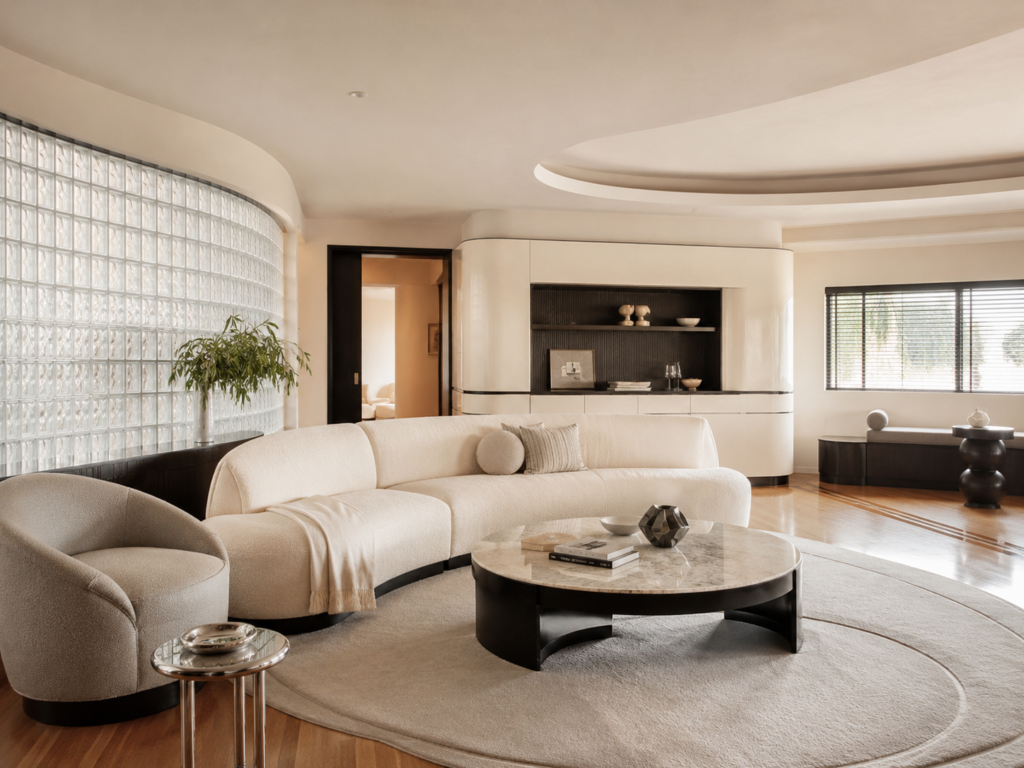
There are some interior styles you recognise immediately, even if you have absolutely no idea what they are called.
A curved wall of glass blocks.
A sweeping built-in banquette wrapping around a corner.
Chrome tubular furniture.
Rounded cabinetry with no sharp edges.
Long horizontal lines, polished surfaces and rooms that somehow look slightly like the interior of an old ocean liner.
You might call it Art Deco.
And you wouldn’t be entirely wrong.
But there is a more specific name for this particular corner of 20th-century design.
Streamline Moderne.
It appeared during the 1930s, when designers became fascinated by speed, machinery, aviation, automobiles and the increasingly futuristic-looking trains and ocean liners of the period.
And while traditional Art Deco could be glamorous, geometric and highly decorative, Streamline Moderne headed in a different direction.
It became smoother.
Lower.
Curvier.
Less ornate.
Everything suddenly looked as though it had been designed inside a wind tunnel.
Oddly enough, nearly a century later, quite a lot of it looks surprisingly contemporary.
So, What Exactly Is Streamline Moderne?
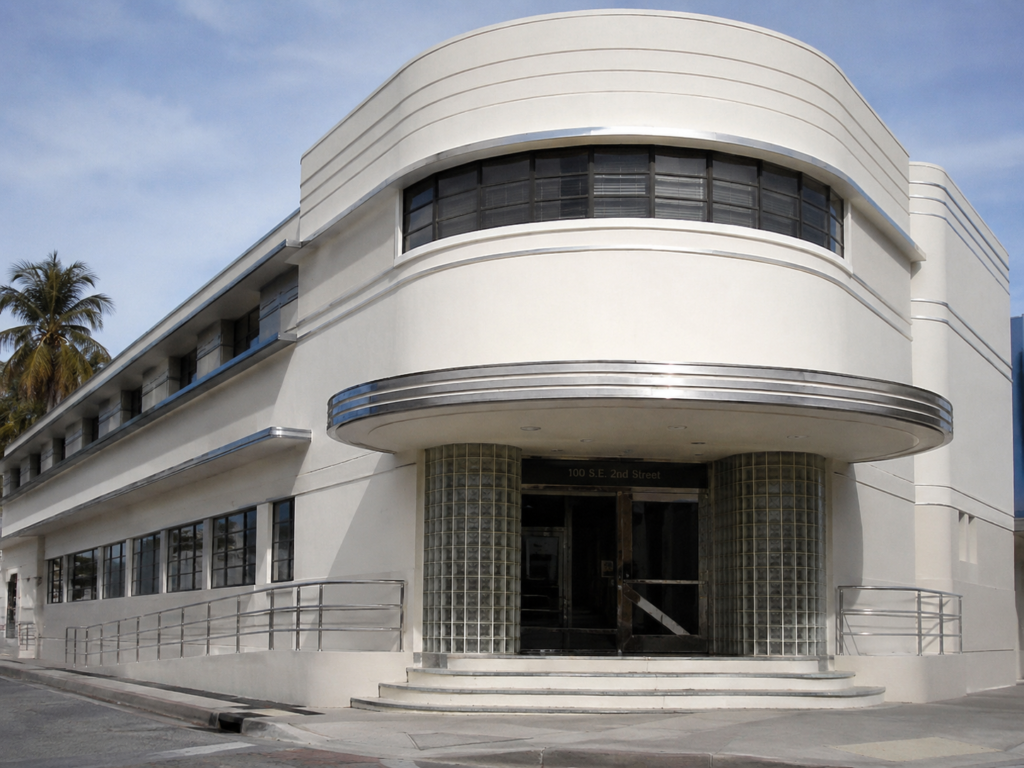
Streamline Moderne developed during the 1930s and is generally considered a later development of Art Deco.
The earlier Art Deco of the 1920s often celebrated luxury.
Think polished exotic woods, elaborate geometric patterns, decorative metalwork, rich materials and the dramatic interiors of grand hotels and cinemas.
Streamline Moderne retained some of Art Deco’s glamour but removed much of the decoration.
The machine itself became the decoration.
Designers were fascinated by the idea of aerodynamics.
Cars became longer and more rounded.
Trains developed smooth noses and flowing bodies.
Air travel represented the future.
Ocean liners were enormous floating symbols of modernity.
Those ideas began appearing everywhere from architecture and furniture to radios, clocks, vacuum cleaners and kitchen appliances.
Suddenly, even something that had absolutely no reason to be aerodynamic was streamlined.
A toaster did not need to look fast.
But apparently it was much more exciting if it did.
Art Deco and Streamline Moderne Are Not Quite the Same Thing
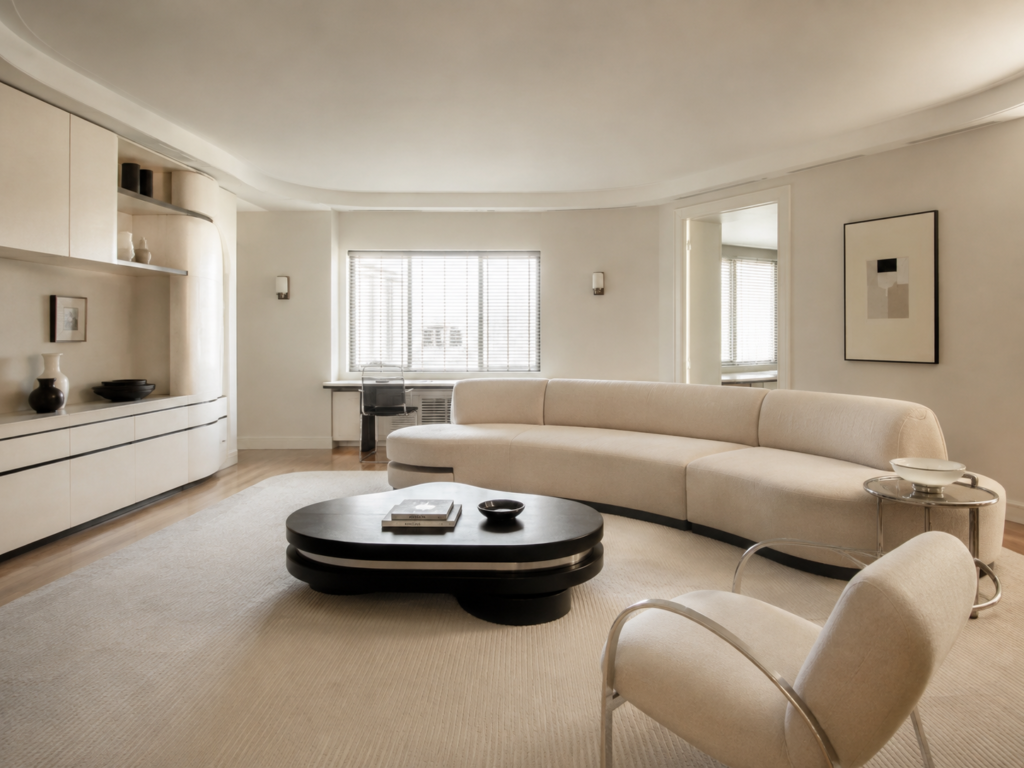
This is probably the easiest way to understand the style.
Imagine traditional Art Deco and remove some of the decoration.
Then stretch everything horizontally.
Round off the corners.
Add some chrome.
Perhaps build a curved glass-block wall.
And park a magnificent 1930s automobile outside.
You’re getting close.
Traditional Art Deco often uses strong vertical geometry: stepped forms, sunbursts, zigzags, chevrons and elaborate symmetrical patterns.
Streamline Moderne tends to run horizontally instead.
Long bands.
Curved corners.
Continuous lines.
Smooth surfaces.
The shapes sometimes resemble ships, railway carriages and aircraft fuselages.
The overall feeling is less Great Gatsby ballroom and more 1938 luxury ocean liner.
Both are glamorous.
They are simply glamorous in very different ways.
The Curves Are Probably the Biggest Clue
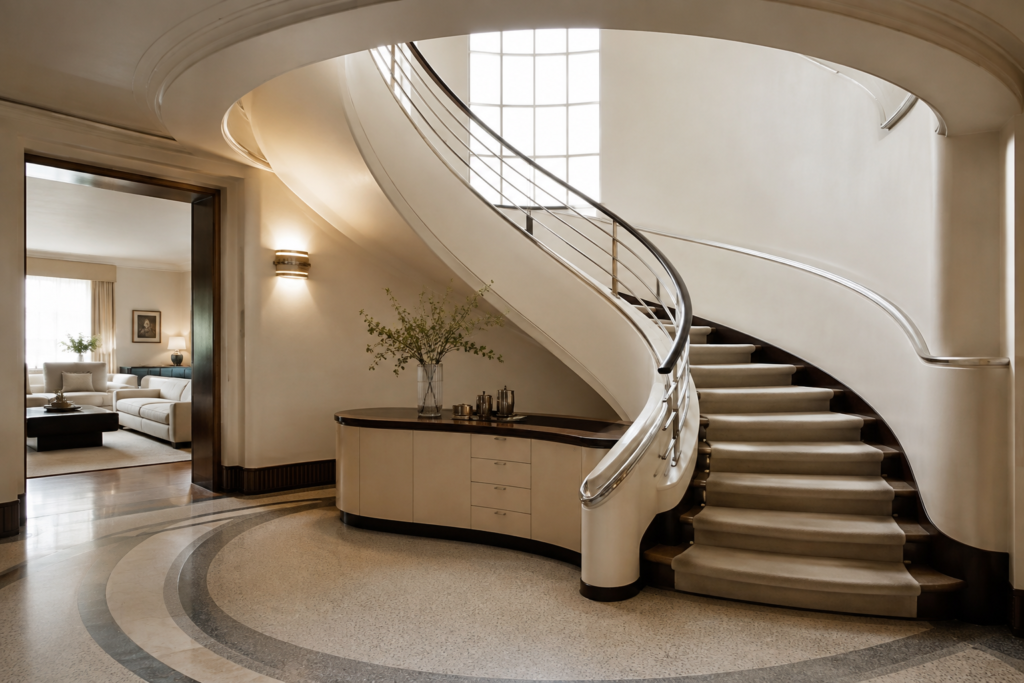
If there is one architectural feature that immediately makes a room feel Streamline Moderne, it is the curve.
Corners rarely want to behave like corners.
Walls gently sweep around rooms.
Cabinetry bends around edges.
Built-in seating follows curved windows.
Staircases spiral rather than march rigidly upward.
Even fireplaces and shelves can have rounded ends.
There is something wonderfully soft about it.
Modern interiors are often dominated by rectangles: rectangular kitchens, rectangular sofas, rectangular islands and rectangular cabinetry all arranged inside rectangular rooms.
Streamline Moderne interrupts all of that.
A single curved wall or rounded piece of cabinetry can completely change how a room feels.
It is architectural without being ornamental.
And Then There Are the Glass Blocks
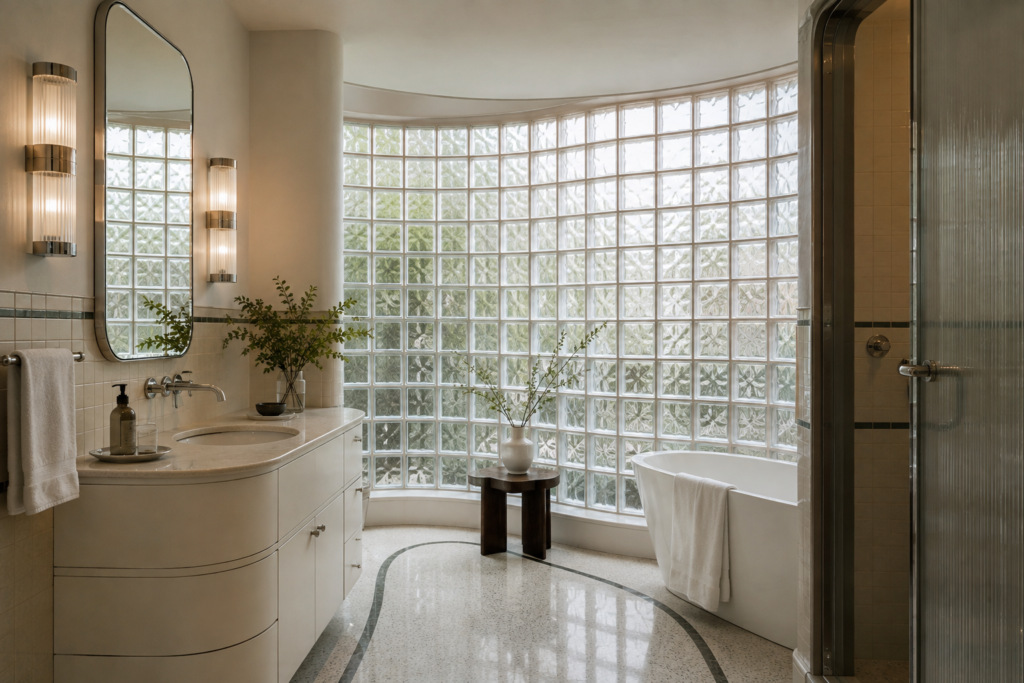
If Streamline Moderne had a signature material, glass block would certainly be competing for the title.
Glass blocks allowed designers to create curved walls while still bringing light into a space.
They could divide rooms without making them feel entirely enclosed.
They appeared in stairwells, entrances, bathrooms, kitchens and dramatic curved exterior walls.
They were practical.
They were industrial.
And in the 1930s, they looked incredibly futuristic.
Of course, glass blocks later endured several decades when they became associated with some fairly questionable renovations.
There was a period when seeing a glass-block shower wall could make you immediately suspect that somebody had renovated the bathroom in approximately 1994.
But good glass block is having something of a rehabilitation.
Used architecturally rather than decoratively — particularly in a curved wall — it can look fantastic.
And suddenly the Streamline Moderne influence becomes very obvious.
Chrome Was the New Luxury
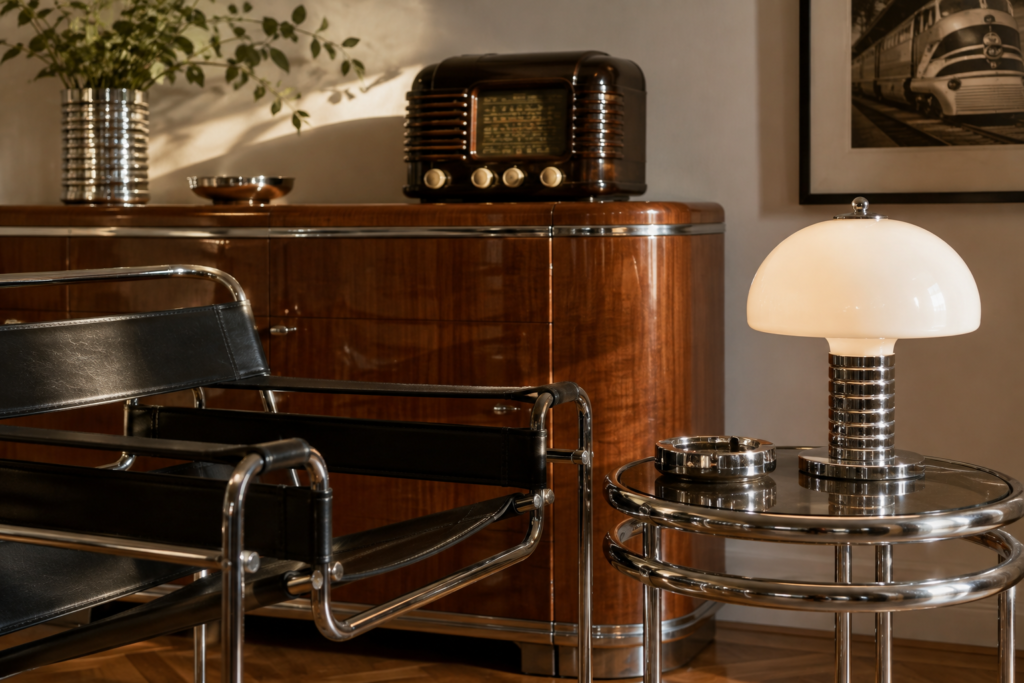
Earlier Art Deco interiors could rely on expensive timber, marble and decorative craftsmanship.
By the 1930s, designers were increasingly interested in industrial materials.
Chrome-plated steel.
Aluminium.
Glass.
Mirrors.
New plastics such as Bakelite.
These materials could be manufactured more efficiently and felt connected to machinery and modern industry.
Chrome was especially important.
Tubular chrome chair frames appeared in living rooms and dining rooms.
Chrome edged tables and cabinetry.
Metal railings evoked the decks of ocean liners.
Mirrored surfaces bounced light around interiors.
The result could still feel luxurious, but it was a very different kind of luxury.
Rather than saying this object required an artisan to carve it for six months, the message was:
Look what modern manufacturing can do.
Furniture Started Looking Like It Was Moving
One of the most charming things about Streamline Moderne furniture is that designers frequently attempted to make completely stationary objects look fast.
Armchairs became sweeping aerodynamic shapes.
Desks developed rounded corners.
Sideboards stretched horizontally along walls.
Tables rested on curved pedestal bases.
Radios looked like miniature locomotives.
Even vacuum cleaners were given streamlined casings.
This was partly because industrial design itself was becoming an increasingly important profession.
Designers realised that objects did not simply need to function well.
They could make consumers want them.
And in the 1930s, modernity sold.
A household appliance that looked like it had arrived from the future was considerably more exciting than one that looked like a wooden box.
The Ocean Liner Influence Is Everywhere
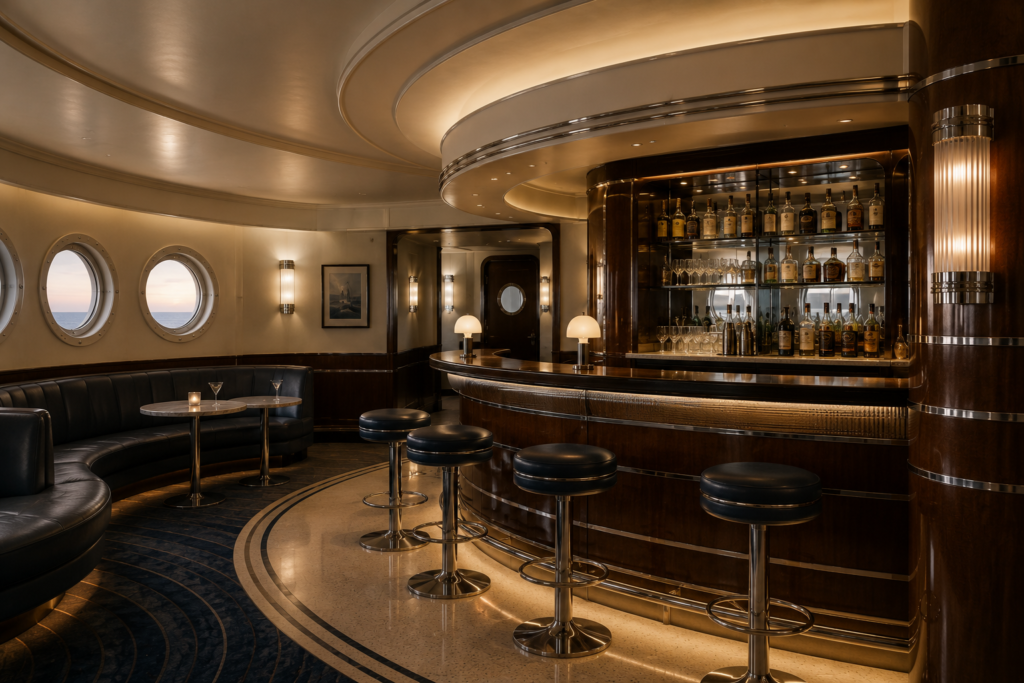
Once you notice the nautical influence in Streamline Moderne, it becomes difficult to unsee.
Rounded corners resemble the stern of a ship.
Horizontal railings look like ship decks.
Circular windows resemble portholes.
Long built-in cabinets run along walls like fitted furniture inside passenger cabins.
Curved bars could easily belong aboard a transatlantic liner.
There is often a very deliberate sense that space has been efficiently engineered rather than simply decorated.
And this is one of the reasons the style works so well in smaller interiors.
Many of its ideas involve built-in furniture, clever storage and efficient use of awkward spaces.
A curved dining banquette tucked against a wall is not only beautiful.
It can be incredibly practical.
The Colour Palette Was Often Surprisingly Restrained
When people think of Art Deco, they often imagine black, gold, emerald green and jewel tones.
Streamline Moderne interiors could be much quieter.
Cream.
Ivory.
Warm white.
Pale beige.
Soft grey.
Muted greens.
Occasional burgundy, navy or dusty pink.
Then chrome, black or darker timber might provide contrast.
There were certainly colourful interiors during the period, but the architecture often did much of the visual work.
A room containing a sweeping glass-block wall, curved staircase and beautifully rounded cabinetry doesn’t necessarily need seventeen colours competing for attention.
Built-In Furniture Matters More Than You Might Expect
One of the most contemporary-looking aspects of Streamline Moderne is its obsession with built-ins.
Banquette seating.
Integrated shelving.
Curved bars.
Long fitted cabinets.
Window seats.
Storage incorporated directly into the architecture.
Rather than filling a room with separate pieces of furniture, designers could shape furniture around the room itself.
That idea feels incredibly relevant again.
We are currently seeing enormous interest in bespoke joinery, integrated storage and furniture that feels almost architectural.
Streamline Moderne was doing much of this nearly ninety years ago.
Only with considerably more chrome.
The Kitchen Is Where Things Become Really Interesting
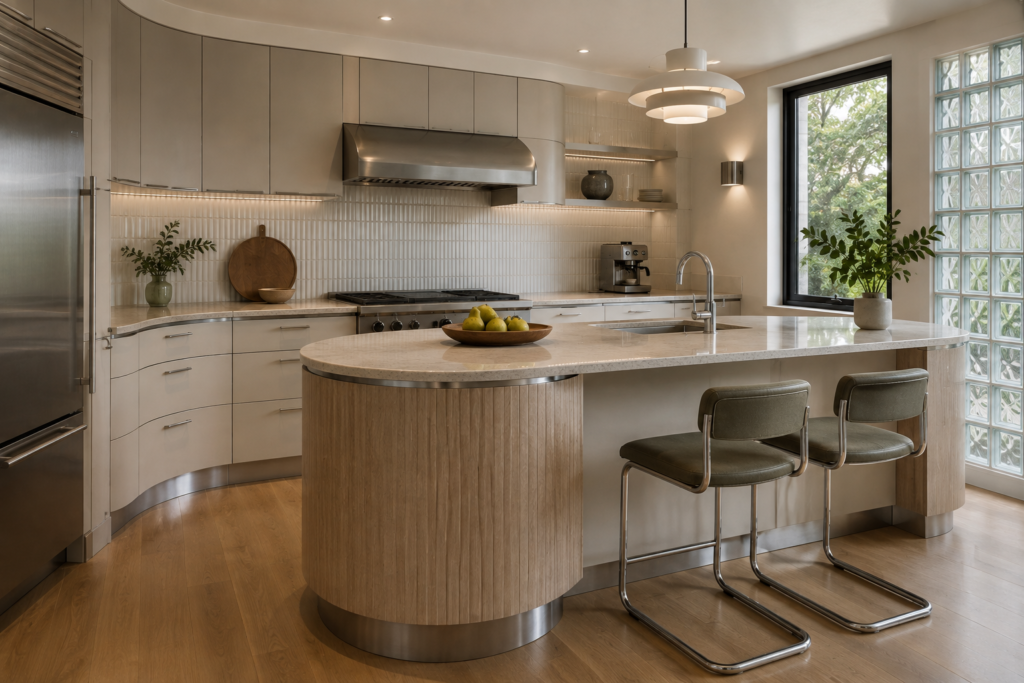
A Streamline Moderne kitchen doesn’t need to resemble a movie set.
In fact, some of the ideas translate beautifully into a contemporary renovation.
Imagine simple cabinetry with gently rounded ends.
A curved island rather than a brutally rectangular one.
Stainless steel or chrome details.
Fluted or translucent glass.
A small section of glass block.
Integrated cabinetry that wraps smoothly around a wall.
Perhaps linoleum, terrazzo or a simple tiled floor.
The key is restraint.
You do not need to install a porthole window and start serving cocktails dressed as the captain of the Queen Mary.
One or two elements are enough.
Bathrooms Are Almost Made for Streamline Moderne
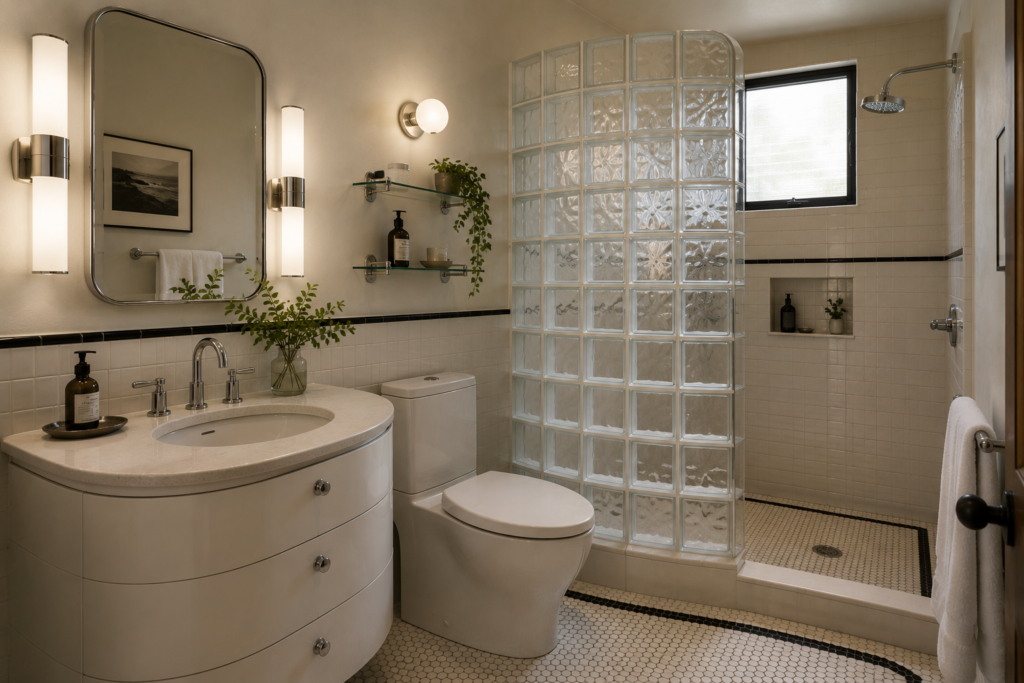
This might be where the style feels most natural today.
Bathrooms already contain many of the materials Streamline Moderne designers loved.
Glass.
Chrome.
Ceramic tile.
Mirrors.
Smooth surfaces.
Add a curved vanity, a rounded shower enclosure or a beautifully designed glass-block partition and the connection becomes obvious.
Small square tiles can work particularly well.
So can chrome fittings and simple globe lighting.
The trick is preventing it from becoming an Art Deco theme bathroom.
Avoid decorating every available surface with period references.
Let the shape of the room create the effect.
Lighting Should Feel Slightly Machine-Age
Streamline Moderne lighting can be wonderfully sculptural without being overly decorative.
Opaline glass globes work beautifully.
So do chrome fixtures.
Simple wall sconces.
Disc-shaped pendants.
Long linear lights.
Anything with a slight sense of engineering or industrial precision can work.
This is not really the place for an enormous crystal chandelier.
Although somebody in 1937 undoubtedly ignored that advice.
Streamline Moderne Was Optimistic Design During a Difficult Period
There is something interesting about when this style appeared.
The 1930s were hardly an uncomplicated decade.
Much of the world was dealing with the economic consequences of the Great Depression.
And yet design became intensely fascinated with the future.
New materials.
New manufacturing methods.
Faster transportation.
Household technology.
Radio.
Aviation.
Industrial design.
Streamline Moderne offered an optimistic visual language for all of it.
A refrigerator could look futuristic.
A cinema could resemble an ocean liner.
A petrol station could look like it was travelling at 100 kilometres an hour while remaining firmly attached to the ground.
Design was selling the idea that tomorrow might be better.
That optimism is a large part of its appeal.
You Don’t Need a 1930s House to Use It
The easiest mistake with historical styles is assuming you need to reproduce them exactly.
You don’t.
In fact, you probably shouldn’t.
A contemporary room can borrow Streamline Moderne ideas without looking like a museum recreation.
Try one curved piece of cabinetry.
Use a rounded kitchen island.
Introduce a curved banquette.
Choose a chrome-framed chair.
Use fluted or glass-block glazing somewhere architectural.
Look for furniture with long horizontal proportions.
Choose a rounded mirror rather than another rectangle.
Even something as simple as continuing cabinetry smoothly around a corner can introduce the idea.
The strongest interiors tend to reference a style rather than impersonate it.
Glass Block Deserves Another Chance
Yes, we are returning to the glass blocks.
Because they deserve it.
There is a huge difference between using glass block because we need something weird beside the spa bath and using it because its transparency, texture and structural quality solve an architectural problem.
A curved glass-block partition separating a bathroom from a dressing area?
Beautiful.
A wall of glass block bringing daylight into a dark hallway?
Excellent.
A sweeping glass-block window wrapping around a dining nook?
Now we’re talking.
Materials rarely deserve the reputations they acquire.
Usually it was what somebody did with them in 1997 that caused the problem.
Streamline Moderne Works Best When You Don’t Overdo It
This is probably the most important rule.
The style has several extremely recognisable ingredients.
Curves.
Chrome.
Glass block.
Porthole shapes.
Horizontal lines.
Ocean-liner references.
Put all of them into one room and you may accidentally construct the set for a Hercule Poirot adaptation.
Choose two or three and things become considerably more interesting.
Perhaps a restrained contemporary room with curved cabinetry and one section of glass block.
Or a simple kitchen with a rounded island and chrome details.
Or an otherwise modern bathroom with a sweeping translucent wall.
The reference should be noticeable without becoming theatrical.
Why Does Streamline Moderne Feel Relevant Again?
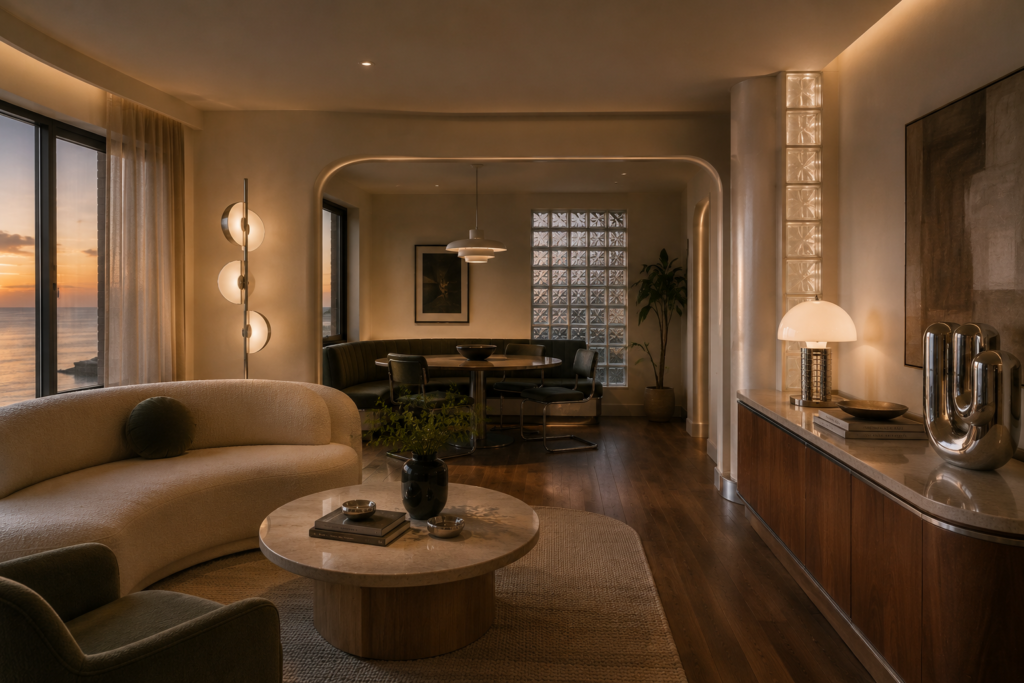
Because many of the ideas currently appearing in interior design were already central to it.
We are moving away from endless hard rectangles.
Furniture is becoming curvier.
Kitchen islands are developing rounded ends.
Built-in banquettes are everywhere.
Chrome and stainless steel are returning.
Glass block is being reconsidered.
Architectural interiors are becoming more sculptural.
Even the renewed interest in 1970s and 1980s design has helped make rounded forms feel exciting again.
Streamline Moderne fits remarkably comfortably into that conversation.
Perhaps the strangest thing is how little of it actually feels old.
Take away the obviously vintage furniture and a beautifully designed 1930s Streamline Moderne room can look astonishingly contemporary.
A Style Designed for a Future That Never Quite Arrived
There is something almost cinematic about Streamline Moderne.
It captures a particular version of the future.
A future of glamorous trains.
Transatlantic ocean liners.
Chrome appliances.
Curved skyscrapers.
Cocktail lounges.
Radios glowing quietly in beautifully designed apartments.
It wasn’t exactly the future we ended up with.
But nearly a century later, designers are once again discovering the curves, materials and architectural ideas that made Streamline Moderne so distinctive.
Perhaps that is why it feels less like a forgotten historical style and more like something we have quietly rediscovered.
And the next time you see a curved glass-block wall, a sweeping built-in banquette or a room full of long horizontal lines and polished chrome, you’ll know what you’re looking at.
Streamline Moderne.
Art Deco’s faster, smoother and rather more aerodynamic younger sibling.
Britt & Tyler
We’re Britt and Tyler, the two Australians behind Cocktails & Cathedrals. We’re drawn to old buildings, beautiful rooms, bookshops and places that seem to hold a story. Our journal brings those interests together, with a fondness for slow afternoons and a well-made cocktail. We hope it helps you find places you’ll want to linger.
Travel slowly. Stay beautifully.
A little more about us →