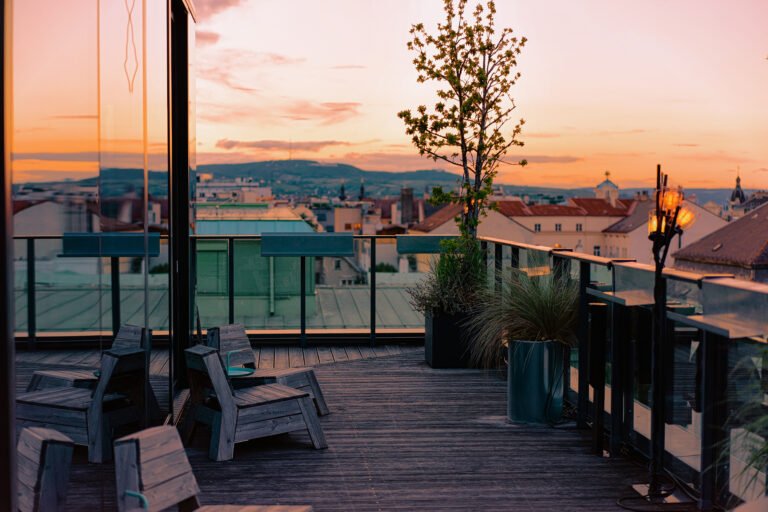
A Literary Traveller’s Guide to Edinburgh: Bookshops, Writers & Gothic Streets
There are cities that have literary histories, and then there is Edinburgh.
Dark stone buildings rise above narrow closes. Medieval lanes disappear beneath archways. Secondhand bookshops seem permanently caught in another century, while Gothic spires puncture a skyline that can turn from golden to brooding grey in the space of an afternoon.
It is difficult to walk through Edinburgh without feeling as though you’ve wandered into the setting of a novel.
And perhaps that’s because, in a way, you have.
Sir Walter Scott, Robert Louis Stevenson and Sir Arthur Conan Doyle all have deep connections to the city. Robert Burns walked these streets. More recently, Ian Rankin transformed modern Edinburgh into the atmospheric backdrop for his Inspector Rebus novels.
For travellers who would happily exchange a packed sightseeing itinerary for old books, historic pubs, quiet cafés and aimless walks through centuries-old streets, Edinburgh might be one of Europe’s perfect cities.
This is our literary guide to experiencing it slowly.
Why Edinburgh Is a City for Book Lovers
Edinburgh’s relationship with literature isn’t simply something packaged for visitors.
Books are woven into the city itself.
Writers appear in monuments, museums and street names. Independent bookshops remain scattered across neighbourhoods. Literary festivals fill the calendar, and Edinburgh became the world’s first UNESCO City of Literature in 2004.
Even the architecture seems designed for storytelling.
The Old Town climbs dramatically towards Edinburgh Castle, filled with narrow closes and towering tenements. Across Princes Street sits the ordered Georgian elegance of the New Town.
And looming above it all is the enormous Gothic monument dedicated to Sir Walter Scott.
The best way to explore literary Edinburgh is therefore not to rush.
Give yourself a day or two, wear comfortable shoes, and allow plenty of time for places that weren’t originally on the itinerary.
Morning: Begin Among the Old Books
Armchair Books
72–74 West Port
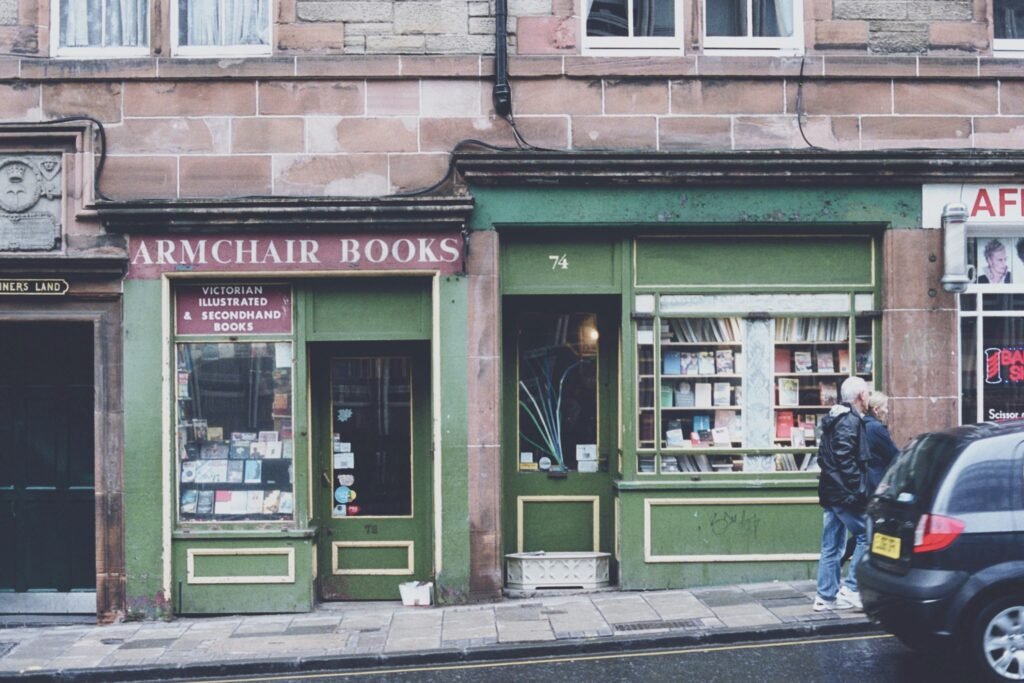
Start your literary day somewhere that feels appropriately chaotic.
Armchair Books sits on West Port, just above the Grassmarket and within sight of Edinburgh Castle.
Inside, books appear to have taken possession of the building.
Shelves stretch towards the ceiling. Narrow passages disappear between towers of secondhand volumes. Rugs cover the floor and books occupy almost every available surface.
The shop itself describes the arrangement as “very nearly alphabetised chaos.”
That seems about right.
Armchair Books specialises in secondhand and antiquarian books, and this isn’t really somewhere to arrive with a five-minute shopping window.
Browse slowly.
Pull something unexpected from a shelf.
Buy an old Scottish novel you had absolutely no intention of buying.
This is exactly the kind of bookshop a literary trip to Edinburgh deserves.
Wander Down into the Grassmarket
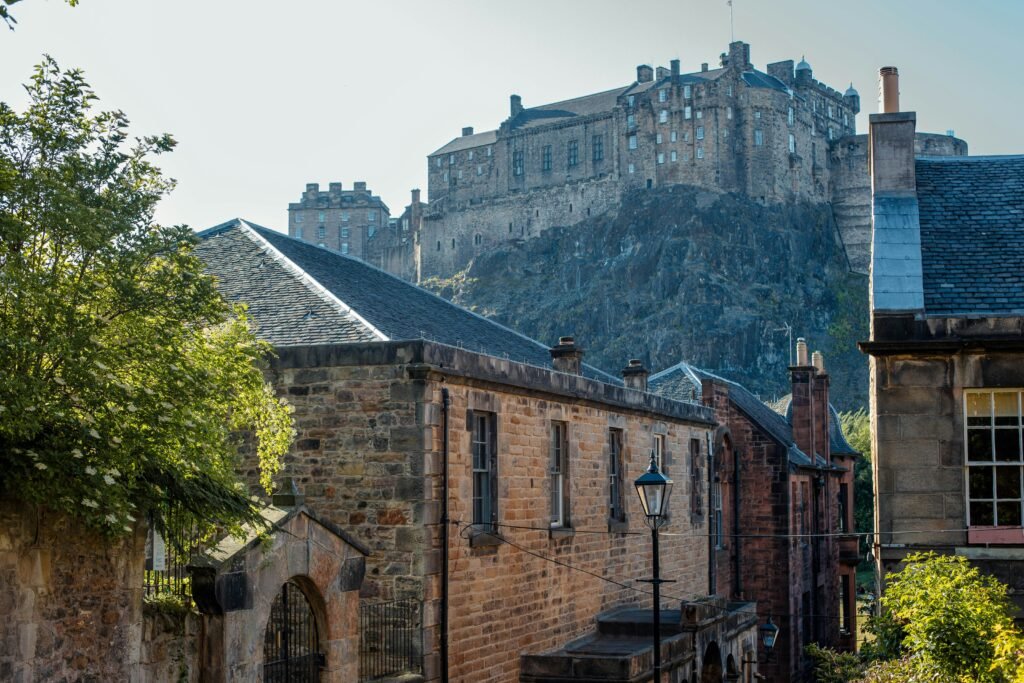
When you eventually emerge, walk towards the Grassmarket.
Edinburgh Castle towers above you from the volcanic rock, and the streets surrounding it contain some of the city’s most atmospheric views.
From here, make a small detour to The Vennel.
Stone steps climb between old walls towards one of the classic views of Edinburgh Castle.
It’s a beautiful introduction to the strange vertical geography of the Old Town — buildings stacked above streets, stairways disappearing between walls and the castle seemingly hovering above everything.
Then begin climbing towards the Royal Mile.
Don’t hurry.
Part of Edinburgh’s appeal lies in the spaces between the landmarks.
Walk the Closes of the Old Town
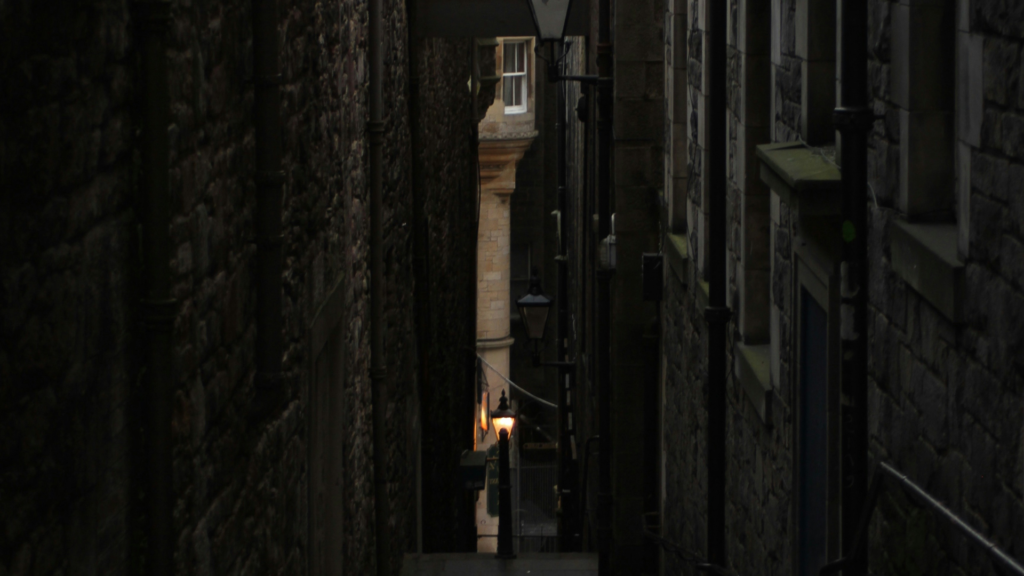
The Royal Mile may be Edinburgh’s most famous street, but the real magic often lies just off it.
Look for the narrow passageways known as closes.
Some lead into tiny courtyards. Others descend steeply towards completely different parts of the city.
Walk through whichever ones catch your attention.
Lady Stair’s Close should definitely be one of them.
Because hidden inside is one of the most important stops on our literary route.
The Writers’ Museum
Tucked inside Lady Stair’s Close is The Writers’ Museum, devoted to three giants of Scottish literature:
Robert Burns.
Sir Walter Scott.
Robert Louis Stevenson.
The collection includes manuscripts, portraits, rare books and personal possessions connected with the writers.
Among the objects are Burns’ writing desk, the printing press used to produce Scott’s Waverley novels and even Scott’s childhood rocking horse.
But the building itself is part of the pleasure.
Lady Stair’s House dates back to the 17th century, and stepping inside feels appropriately removed from modern Edinburgh.
Outside you’ll find Makars’ Court, where quotations from Scottish writers have been set into the paving stones.
Take your time reading them.
This isn’t a museum that needs to be rushed through.
Robert Louis Stevenson’s Edinburgh
Of all Edinburgh’s writers, perhaps nobody captured the city’s darker personality quite like Robert Louis Stevenson.
Stevenson was born in Edinburgh in 1850 and spent much of his early life here.
His most famous works would eventually include Treasure Island, Kidnapped and Strange Case of Dr Jekyll and Mr Hyde.
That final story feels particularly at home in Edinburgh.
The city itself often appears divided into two personalities.
There is the rational, ordered Georgian New Town.
And then there is the older city — shadowy closes, underground vaults and crooked medieval streets.
It’s easy to see why generations of readers have connected Edinburgh’s physical character with the divided personality of Jekyll and Hyde.
As you walk through the Old Town, that contrast is still remarkably visible.
Stop for Coffee Somewhere With History
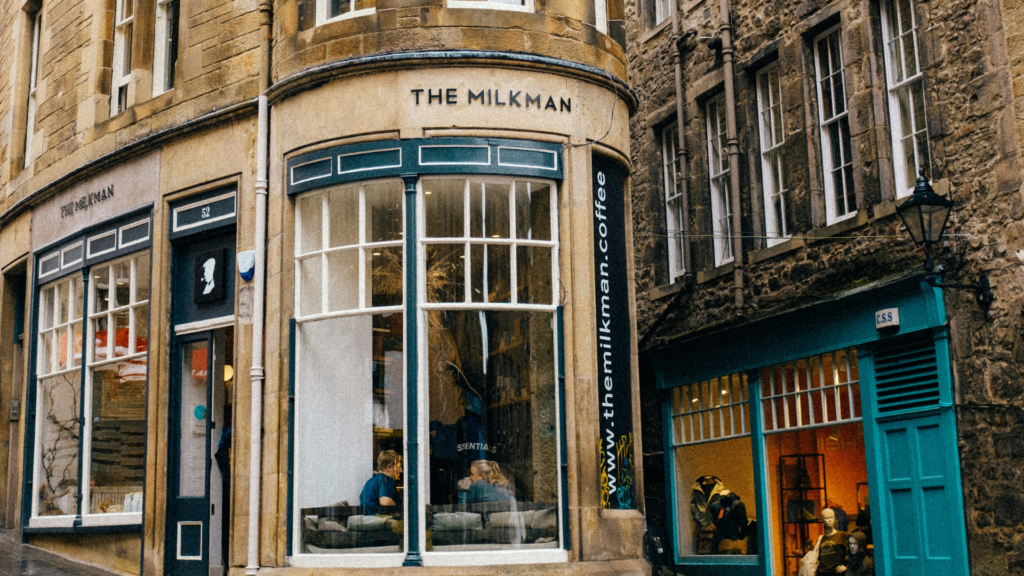
Edinburgh does not lack cafés.
But on a literary weekend, resist the temptation to simply find the nearest chain.
Part of the pleasure here is finding somewhere that encourages lingering.
Order coffee.
Take out the book you inevitably bought earlier.
Watch Edinburgh pass the window.
And don’t feel guilty about spending an hour doing absolutely nothing productive.
Slow travel works particularly well here because Edinburgh rewards sitting still almost as much as sightseeing.
Afternoon: Walk Beneath the Scott Monument
Eventually make your way towards Princes Street.
It is almost impossible to miss what comes next.
The Scott Monument
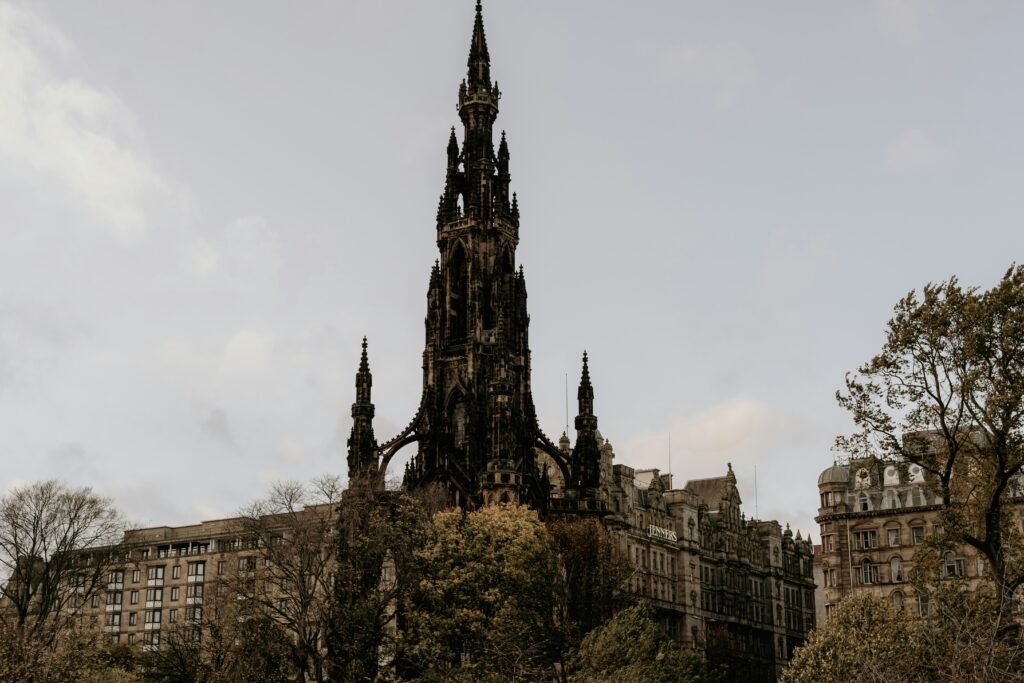
Rising more than 60 metres above Princes Street Gardens, the Scott Monument looks like something designed for a Gothic fantasy film.
The enormous Victorian Gothic structure was built to commemorate Sir Walter Scott, author of novels including Waverley, Ivanhoe and Rob Roy.
Scott’s influence on Scottish literature — and on the romantic image of Scotland itself — is difficult to overstate.
The monument’s dark stone and elaborate spires make it one of Edinburgh’s defining landmarks.
But there’s something especially appropriate about the fact that one of the most dramatic structures in a city full of dramatic architecture is dedicated not to a king or military leader…
…but to a writer.
Another Bookshop Worth Losing an Hour In
Topping & Company Booksellers
2 Blenheim Place

From central Edinburgh, wander towards the top of Leith Walk and eventually you’ll reach one of the city’s great modern bookshops.
Topping & Company opened its Edinburgh shop in 2019 inside a remarkable historic building.
The interior is everything you want from a serious bookshop.
Floor-to-ceiling shelves.
Rolling ladders.
Hand-painted signs.
Rooms filled with books.
Around 85,000 titles line the shelves.
Despite its size, it manages to feel more like an enormous private library than a conventional bookstore.
This is a particularly dangerous place for travellers with limited luggage space.
You have been warned.
Follow the Ghost of Sherlock Holmes
Edinburgh also played an important role in the creation of one of literature’s most famous detectives.
Sir Arthur Conan Doyle was born in Edinburgh in 1859.
He later studied medicine at the University of Edinburgh.
One of his professors, Dr Joseph Bell, became famous for his extraordinary ability to observe tiny details about patients and use them to draw conclusions about their lives.
Sound familiar?
Bell is widely recognised as one of the major inspirations behind Conan Doyle’s Sherlock Holmes.
It adds another layer to walking Edinburgh’s streets.
Holmes may belong to London in the popular imagination, but part of the character’s DNA began here.
The Perfect Literary Detour: Greyfriars
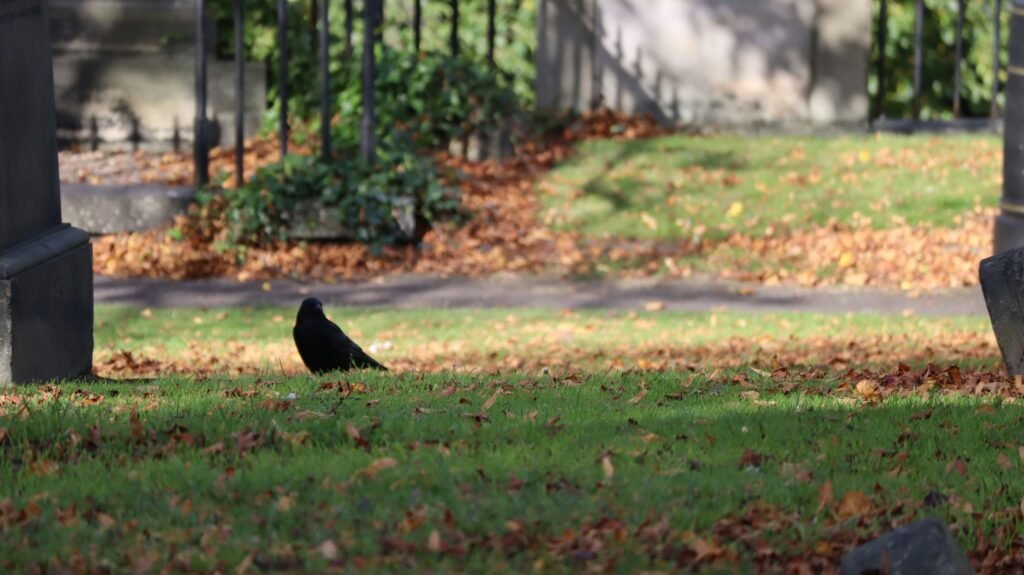
From the Old Town, wander towards Greyfriars Kirkyard.
Even without its literary associations, it deserves a visit.
Old gravestones lean beneath trees. Elaborate monuments crowd against weathered stone walls. Beyond them rise the rooftops and spires of Edinburgh.
It is atmospheric without needing any embellishment.
The surrounding streets have also become closely associated with Edinburgh’s more recent literary mythology, particularly through their connections — some stronger than others — with the creation of the Harry Potter books.
Rather than hunting down every supposed inspiration, simply wander.
Victoria Street curves downhill nearby in a sweep of colourful shopfronts beneath tall Old Town buildings.
Even without the modern literary associations, this entire part of Edinburgh feels made for stories.
Evening: Drink Somewhere Literary
Eventually, every good literary itinerary should end in a pub.
Fortunately, Edinburgh provides options.
The Oxford Bar
Young Street
Readers of Ian Rankin’s Inspector Rebus novels may already know this place.
The Oxford Bar is closely associated with both Rankin and his fictional detective.
It isn’t a themed attraction.
That’s precisely why you should go.
It’s a traditional Edinburgh pub where the literary connection feels incidental rather than manufactured.
Order a whisky or a pint and find a corner.
After spending the day walking through literary Edinburgh, it’s a fitting place to finish.
Or Raise a Glass to Sherlock Holmes
Another option is The Conan Doyle, close to the author’s birthplace.
The traditional pub carries his name and provides an easy final stop for anyone following Edinburgh’s detective-fiction history.
And really, there are worse ways to finish a literary pilgrimage than drinking a Scottish whisky beneath the name of the man who created Sherlock Holmes.
Day Two: Leave the Tourist Centre Behind
If you have another day, move beyond the Royal Mile.
Edinburgh’s literary culture isn’t confined to its historic centre.
The Edinburgh Bookshop
Head towards Bruntsfield and you’ll find The Edinburgh Bookshop, an award-winning independent shop that has become a neighbourhood institution.
Its current home at 176 Bruntsfield Place opened in 2024, just a short distance from the birthplace of Scottish novelist Muriel Spark, author of The Prime of Miss Jean Brodie.
This side of Edinburgh feels different.
Less monumental.
More residential.
And that makes it ideal for the second day of a slow literary weekend.
Browse the shop, walk the surrounding streets and stop somewhere for a long lunch.
For Something Quirkier: Typewronger Books
Another independent worth seeking out is Typewronger Books.
This tiny shop mixes books with independent publications, zines, poetry, art and — wonderfully — typewriters.
There is even a public typewriter visitors can use.
It feels less like a polished retail space and more like a gathering point for people who still believe books, writing and strange little creative communities matter.
Which, frankly, is exactly what a literary bookshop should be.
The Edinburgh Literary Weekend
If we were planning the perfect literary weekend here, we wouldn’t try to see everything.
We’d do something like this:
Saturday morning:
Secondhand books at Armchair Books, followed by the Grassmarket and The Vennel.
Late morning:
Slowly climb through the Old Town closes towards the Royal Mile.
Lunch:
Find a quiet café and read whatever you bought that morning.
Afternoon:
Visit The Writers’ Museum and Makars’ Court, then walk towards Princes Street and the Scott Monument.
Late afternoon:
Spend far too long browsing Topping & Company.
Evening:
Dinner somewhere atmospheric, followed by whisky at The Oxford Bar.
Then on Sunday, leave the busiest part of Edinburgh behind.
Walk through Bruntsfield, visit The Edinburgh Bookshop, find another café, explore Greyfriars and allow the afternoon to unfold without much of a plan.
Because that’s really the point.
Edinburgh Is Better When You Don’t Rush It
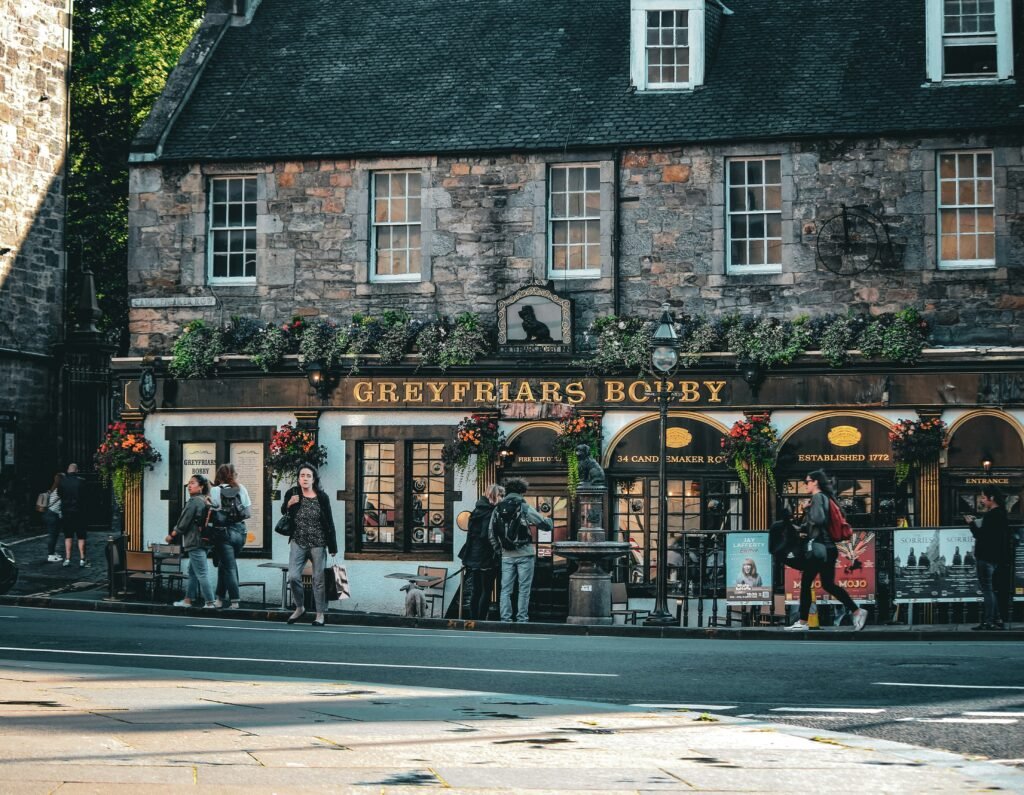
There are plenty of ways to visit Edinburgh.
You can race from the castle to the palace, photograph the Royal Mile, climb Arthur’s Seat and tick landmarks off a list.
But literary Edinburgh asks for something different.
It asks you to notice things.
A quotation carved into stone.
A narrow staircase disappearing between buildings.
An old book with somebody else’s name written inside the cover.
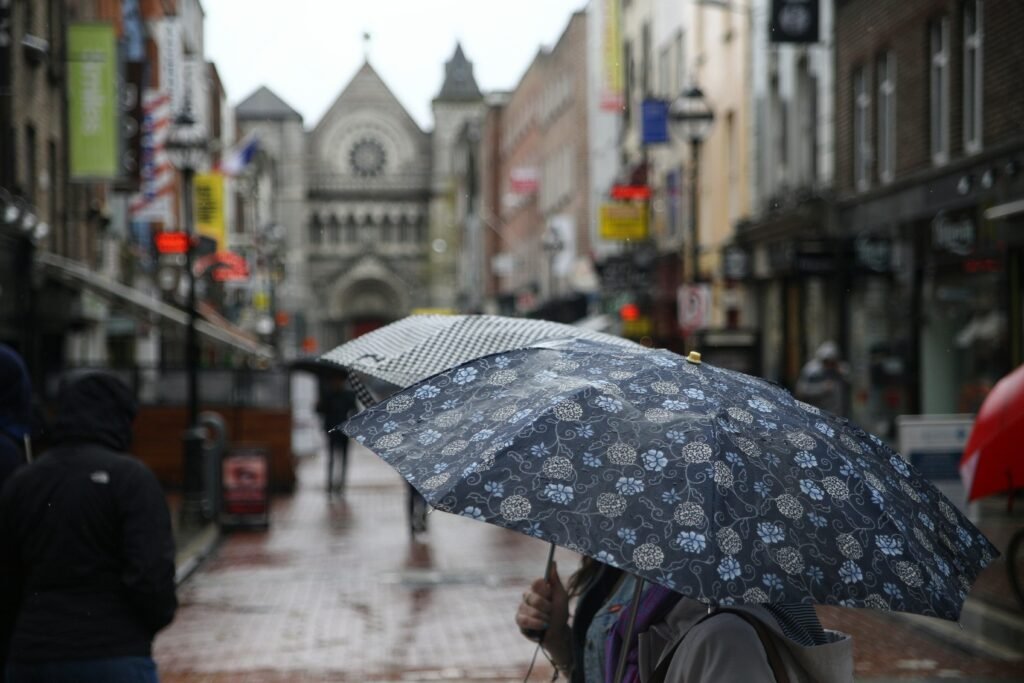
Rain hitting the windows of a pub.
The silhouette of the Scott Monument against a grey afternoon sky.
Edinburgh has produced and inspired writers for centuries, but you don’t need to be particularly interested in literary history to understand why.
Spend enough time wandering these streets and eventually the city begins to feel like a story itself.
And perhaps the best way to experience it is simply to slow down long enough to read it.
If you feel like exploring Paris at the same “literary pace” maybe you’d like our article on Literary Paris…and it’s a lot more than just Hemingway.
Britt & Tyler
We’re Britt and Tyler, the two Australians behind Cocktails & Cathedrals. We’re drawn to old buildings, beautiful rooms, bookshops and places that seem to hold a story. Our journal brings those interests together, with a fondness for slow afternoons and a well-made cocktail. We hope it helps you find places you’ll want to linger.
Travel slowly. Stay beautifully.
A little more about us →