A Literary Traveller’s Guide to Paris: Bookshops, Writers & Left Bank Cafés
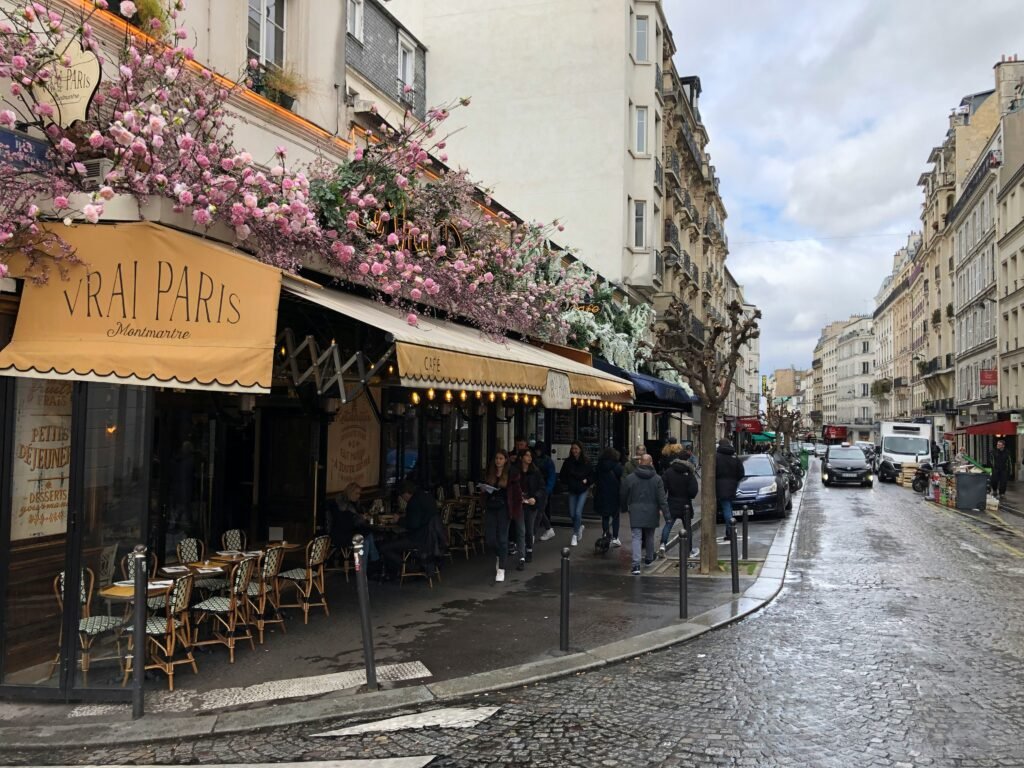
Paris has always belonged to writers. They came for cheap rooms and long afternoons in cafés. They argued over manuscripts, borrowed money from booksellers, drank too much wine and filled notebooks at tiny tables overlooking the street. Hemingway came here. So did Fitzgerald, James Joyce, Gertrude Stein, Oscar Wilde, George Orwell and countless others.
Some were born in Paris. Others arrived from elsewhere and simply never quite escaped its pull. And while much of their Paris has disappeared, enough remains that you can still spend a day wandering between old bookshops, historic cafés, cobbled streets and the places where some of the twentieth century’s most famous books were written. This isn’t a guide to racing between Paris’s biggest attractions.
There will be no frantic dash from the Eiffel Tower to the Louvre. Instead, we’re staying mostly on the Left Bank. We’ll browse old books beside the Seine, drink coffee where writers once worked, wander the streets of Saint-Germain-des-Prés and end the day somewhere that still feels like Hemingway might walk through the door. Welcome to literary Paris.
Why Paris Became a City of Writers
There are plenty of cities with impressive literary histories. Paris is different. For generations, writers didn’t simply visit the city. They came here to become writers. During the early twentieth century in particular, Paris attracted an extraordinary collection of artists, poets and novelists from around the world. Ernest Hemingway arrived in 1921. F. Scott Fitzgerald came and went. James Joyce worked on Ulysses here.
Gertrude Stein’s home became a gathering place for the artistic avant-garde. George Orwell later wrote about his experiences of poverty in the city in Down and Out in Paris and London. And at the centre of much of this literary world were two institutions that Paris still does remarkably well:
bookshops and cafés.
The best literary day in Paris involves plenty of both.
Morning: Begin Beside the Seine
Start early on the Left Bank. Before the streets become crowded, walk towards the Seine and Île de la Cité. Notre-Dame rises across the river. The stone embankments are still relatively quiet. And along the river you’ll begin seeing something that has become almost as much a part of Paris as the cafés themselves.
The Bouquinistes of the Seine
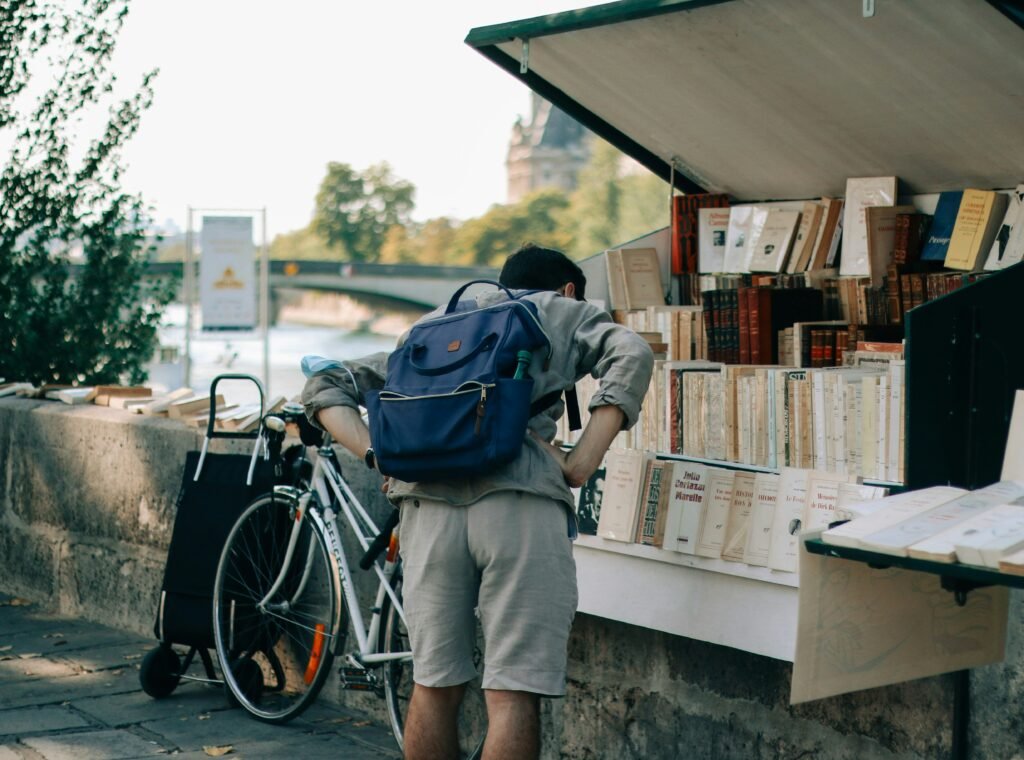
For centuries, booksellers have sold books along the banks of the Seine. Today their distinctive dark green boxes open to reveal secondhand books, old prints, postcards, magazines and pieces of Parisian ephemera.
They are known as the bouquinistes.
Don’t simply walk past them. Stop. Look through the old books. Flip through boxes of vintage prints. Buy something completely impractical to carry home. Literary Paris is at its best when you leave room for discoveries you weren’t looking for. And once you’ve browsed the stalls along the river, one of the world’s most famous bookshops is only a short walk away.
Shakespeare and Company
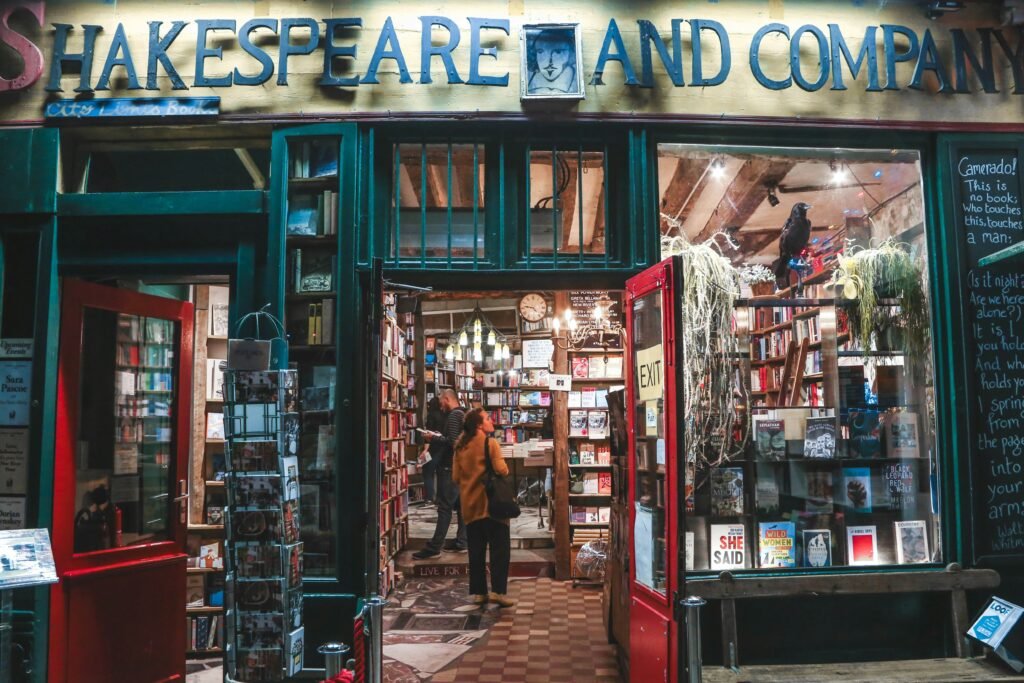
37 rue de la Bûcherie
Few bookshops have acquired a mythology quite like Shakespeare and Company. Its green-and-yellow storefront sits opposite Notre-Dame, only metres from the Seine. Inside, narrow rooms are filled with books. Shelves climb walls. Staircases lead into reading rooms. Handwritten notes and quotations appear throughout the building. It feels less like a modern bookstore and more like somebody’s eccentric private library.
The current Shakespeare and Company was opened by American bookseller George Whitman in 1951, originally under the name Le Mistral.
In 1964 he renamed it Shakespeare and Company in honour of another legendary Paris bookseller: Sylvia Beach.
And that’s where the story becomes particularly interesting.
The Original Shakespeare and Company
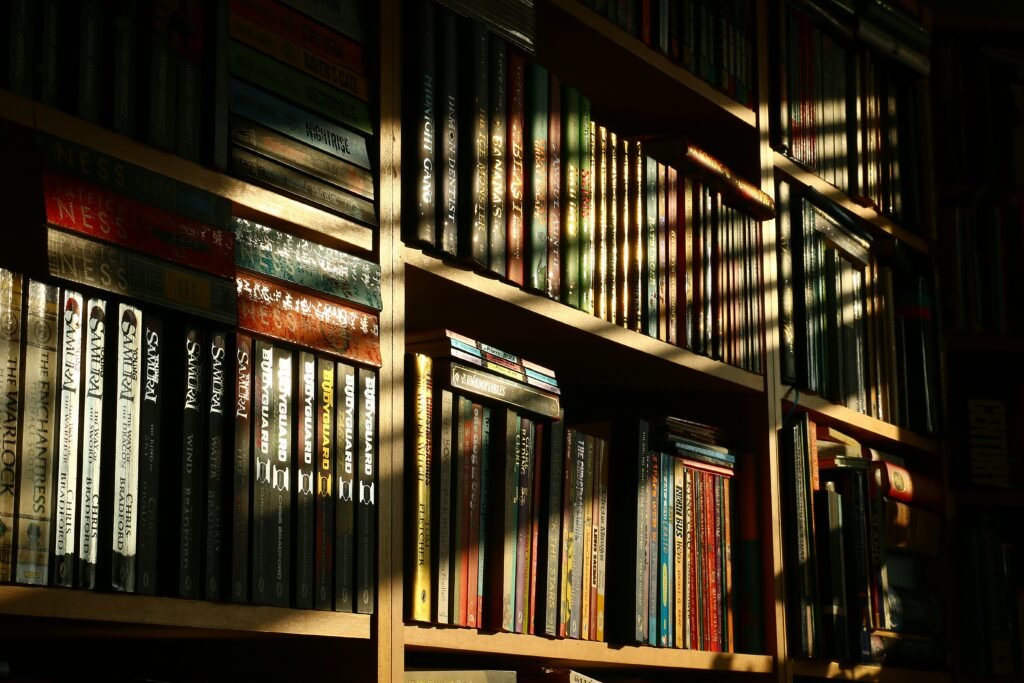
Sylvia Beach opened the original Shakespeare and Company in Paris in 1919.
Eventually located at 12 rue de l’Odéon, her shop became much more than somewhere to buy books.
It was a lending library. A meeting place. A postal address. Occasionally even a source of financial help for struggling writers. The names associated with the shop are extraordinary. Ernest Hemingway. F. Scott Fitzgerald. Ezra Pound. Gertrude Stein. T.S. Eliot.
And most importantly, James Joyce.
When publishers were unwilling to touch Joyce’s controversial novel Ulysses, Sylvia Beach did something remarkable. She published it herself. The first edition appeared in Paris in 1922. The original Shakespeare and Company closed during the German occupation of Paris in 1941 and never reopened. George Whitman’s later shop deliberately carried its spirit forward. That makes today’s Shakespeare and Company more than a beautiful bookstore.
It is a continuation of one of the great stories in twentieth-century literature.
Stay for Coffee
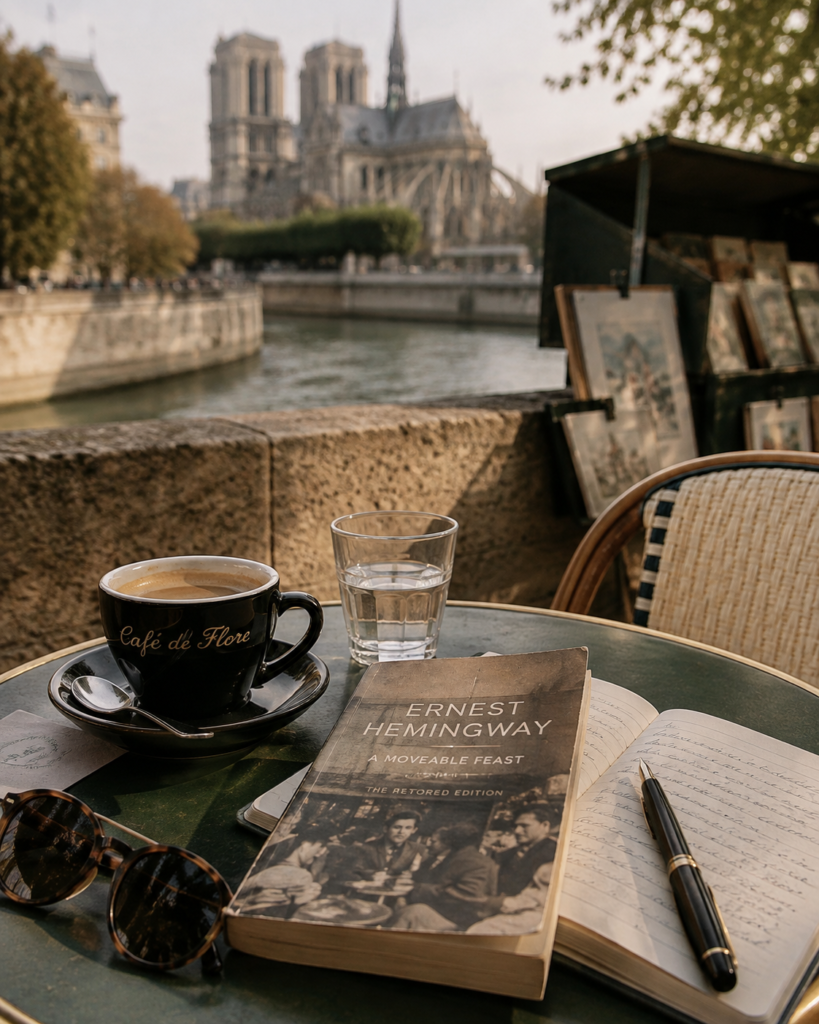
Next door you’ll find the Shakespeare and Company Café. Yes, it’s popular. Yes, there may be tourists. Stay anyway. Find a seat if you can, order coffee and look across towards Notre-Dame. This is one occasion when the obvious choice is still a good one. And if you’ve bought a book, open it. We’re not racing anywhere.
Walk Into the Latin Quarter
From here, wander deeper into the Latin Quarter. This is one of the oldest parts of Paris and has been associated with students, universities, philosophers and writers for centuries. The Sorbonne is here. So is the Panthéon. But don’t make either of those your immediate destination. Take the smaller streets instead. Walk Rue de la Huchette. Turn whenever something looks interesting. Follow old shopfronts.
Look into courtyards. Paris rewards people who are willing to become slightly lost. Eventually, though, we’re heading somewhere very specific.
Follow Hemingway Through Paris
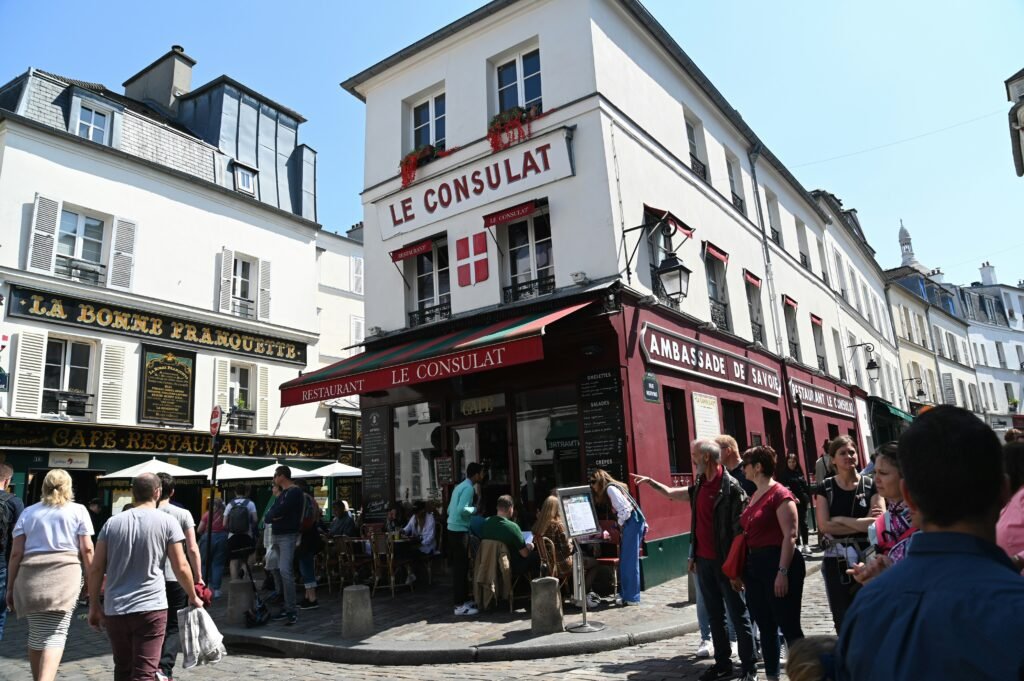
Ernest Hemingway’s relationship with Paris has become so romanticised that separating the writer from the mythology is almost impossible. Perhaps that doesn’t matter. Hemingway arrived in Paris with his first wife, Hadley, in 1921. They lived modestly while he worked as a foreign correspondent and attempted to establish himself as a writer.
Decades later, he returned to those years in his memoir A Moveable Feast. The Paris he describes is one of cold apartments, cheap meals, cafés, books, horse racing, wine and writing. Much of it centres around the streets we’re walking now.
Head towards Place de la Contrescarpe and Rue Mouffetard.
Hemingway and Hadley lived nearby at 74 rue du Cardinal Lemoine.
You don’t need to turn the building into a pilgrimage. Just walk the neighbourhood. The steep streets and older buildings give this corner of Paris a completely different feeling from the grand boulevards north of the river. It’s easier here to imagine the young, relatively unknown Hemingway walking home with notebooks under his arm.
Find a Quiet Café and Write Something
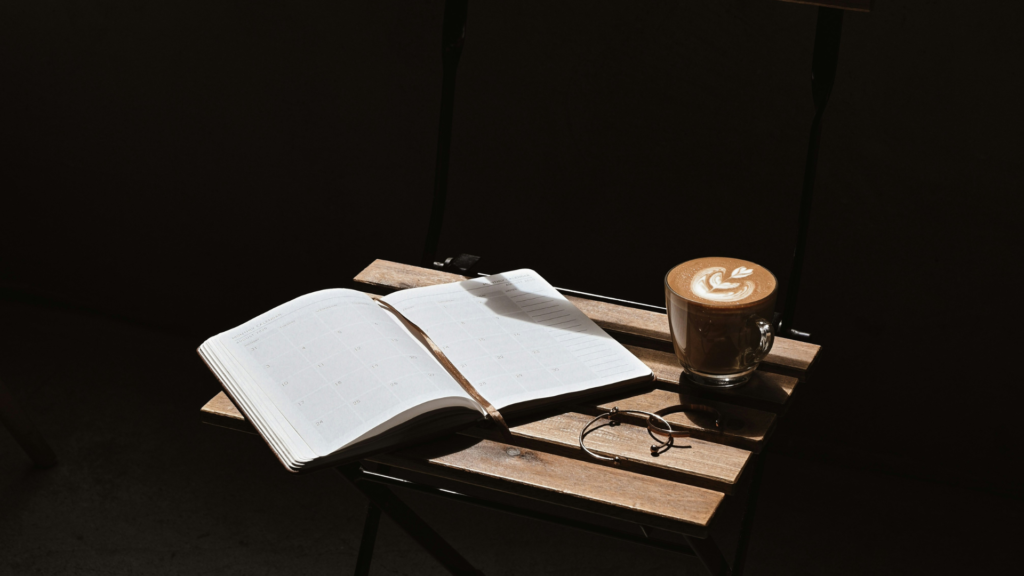
This is an essential part of our literary itinerary. Not because a famous writer necessarily sat at the table. But because you should. Find a café somewhere around the Latin Quarter. Preferably one with tiny tables facing the pavement. Order coffee. Or wine. Take out a notebook. Write something. It doesn’t have to be good. Nobody needs to see it.
The point is simply to spend half an hour participating in one of Paris’s oldest literary traditions: sitting in a café pretending you’re working while mostly watching people walk past.
Afternoon: Saint-Germain-des-Prés
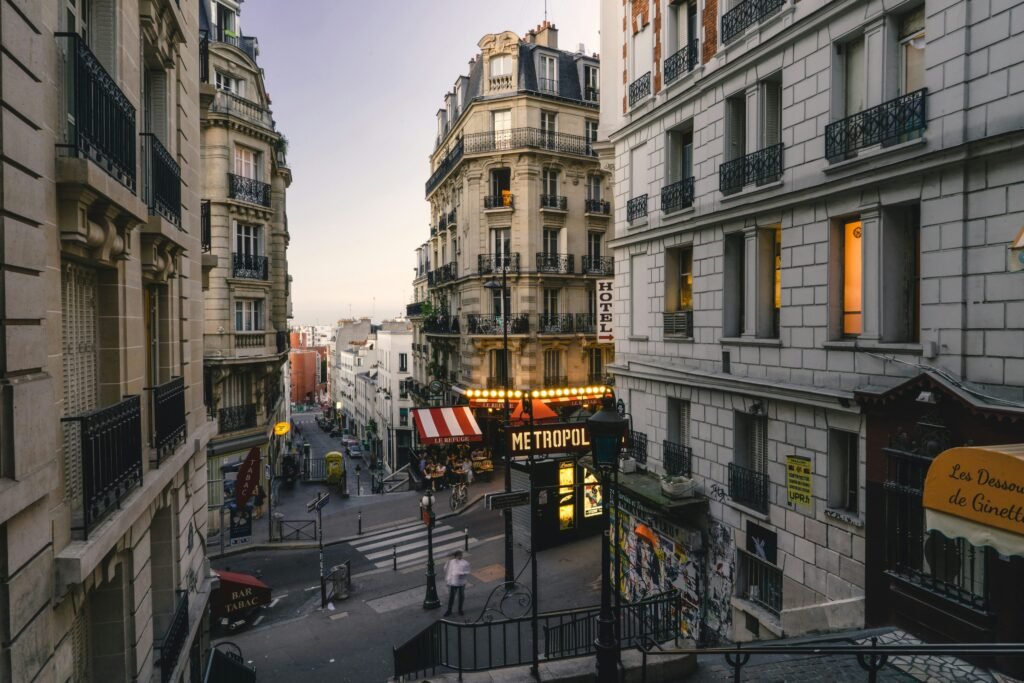
Eventually, begin wandering west towards Saint-Germain-des-Prés. If there is a spiritual centre of literary Paris, this is probably it. Publishers, writers, philosophers and artists gathered here throughout the twentieth century. The neighbourhood became particularly famous for the intellectual life that emerged around its cafés. Two of them still sit almost opposite each other. And yes, they’re famous. They’re also worth visiting.
Les Deux Magots
6 Place Saint-Germain-des-Prés
Les Deux Magots has been operating as a café since the 1880s. Over the decades its tables attracted an almost absurd collection of writers and artists. Paul Verlaine. Arthur Rimbaud. Stéphane Mallarmé. Ernest Hemingway. James Joyce. André Breton. Albert Camus. Jean-Paul Sartre. Simone de Beauvoir. The café became associated first with writers and poets, then with surrealists and later the existentialist movement.
Simone de Beauvoir even worked on The Mandarins here, the novel that won her the Prix Goncourt in 1954. Today Les Deux Magots is hardly a secret. You’ll pay accordingly. But sometimes historic places survive precisely because generations of visitors continue sitting at their tables. Take a seat on the terrace facing the church of Saint-Germain-des-Prés. Order coffee. Watch Paris.
For once, being a tourist is entirely acceptable.
Café de Flore
172 Boulevard Saint-Germain
A few steps away sits its great rival. Café de Flore first appeared in the late nineteenth century and became another centre of Parisian intellectual life. Guillaume Apollinaire worked here. André Breton came here. Albert Camus came here.
But the names most closely associated with the Flore are probably Jean-Paul Sartre and Simone de Beauvoir.
During the 1940s, the pair effectively treated the café as an office. They wrote. They met friends. They debated philosophy. They spent enormous amounts of time sitting at its tables. Sartre later recalled that they would arrive in the morning, work until lunch, return in the afternoon and remain for hours.
There’s something wonderfully Parisian about turning a café into your workplace for most of the day. You don’t necessarily need to visit both Les Deux Magots and Café de Flore. But you should at least walk past both. Then choose whichever table looks better.
Walk Rue de l’Odéon
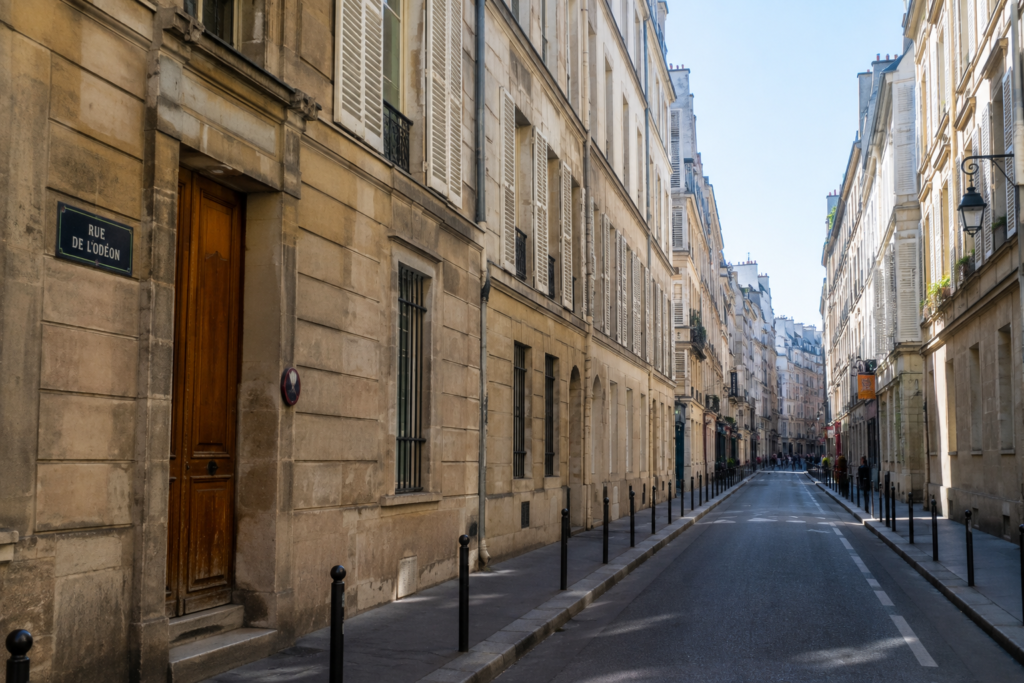
After coffee, continue through Saint-Germain towards Rue de l’Odéon.
This quiet street once sat at the centre of English-language literary Paris. Sylvia Beach’s Shakespeare and Company stood at number 12.
Across the street, Beach’s friend and partner Adrienne Monnier operated the French-language bookshop La Maison des Amis des Livres.
Together, the two shops created an extraordinary literary community. Joyce came here. Hemingway came here. Writers borrowed books, collected mail and met other writers. There is no elaborate reconstruction today. And that’s actually rather nice. You’re simply standing on an ordinary Paris street where something extraordinary once happened.
Oscar Wilde’s Final Paris
Paris also became the final home of Oscar Wilde.
After his release from prison in England, Wilde returned to France and spent his final years largely in Paris. He died in 1900 at the Hôtel d’Alsace on Rue des Beaux-Arts.
Today the building is the luxury L’Hôtel.
You can walk past it while exploring Saint-Germain. Wilde is buried across the city in Père Lachaise Cemetery, where his tomb remains one of the cemetery’s most famous literary monuments. If you have a second day in Paris, we’ll go there.
Evening: Drink Somewhere Hemingway Would Approve Of
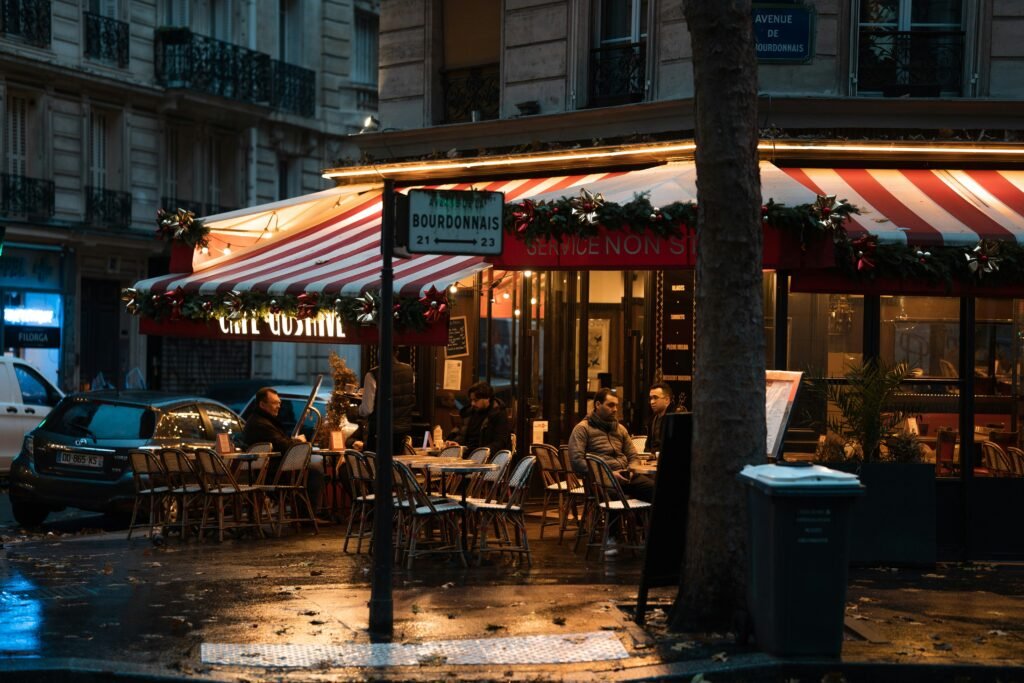
A literary day in Paris should not end at six o’clock. It should drift gradually into evening. Perhaps you’ve bought a book. Perhaps you’ve written three terrible sentences in a notebook. Perhaps you’ve consumed far too much coffee. Good. Now find somewhere for a drink.
One particularly appropriate choice is to stay around Saint-Germain and simply find an old café or wine bar that hasn’t been redesigned to look old. Order a glass of Bordeaux. Or champagne. Sit outside if the weather allows. And resist the urge to immediately search for the next attraction. Paris looks different when the lamps come on. The cream stone turns gold. Café windows glow.
And the streets become much easier to imagine as the Paris Hemingway remembered.
Day Two: Père Lachaise and the Writers of Paris
If you have another day, begin somewhere completely different.
Père Lachaise Cemetery
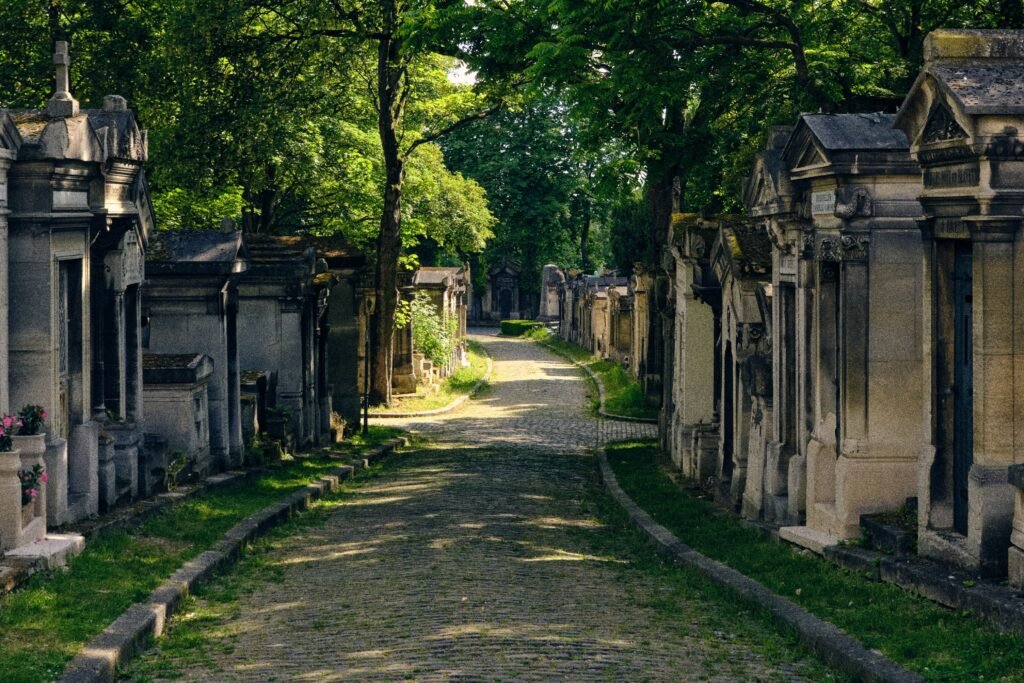
Père Lachaise is enormous. And beautiful. Tree-lined paths wind between elaborate tombs, small chapels and monuments darkened by age. Some of the world’s most famous artists and writers are buried here.
Oscar Wilde.
Marcel Proust.
Honoré de Balzac.
Colette.
Guillaume Apollinaire.
And, of course, Jim Morrison — although we’ll leave him for another guide. Don’t treat Père Lachaise like a celebrity scavenger hunt. Choose a few writers you care about and then wander. Some of the most beautiful corners are the ones you find accidentally.
Find Paris’s Covered Passages
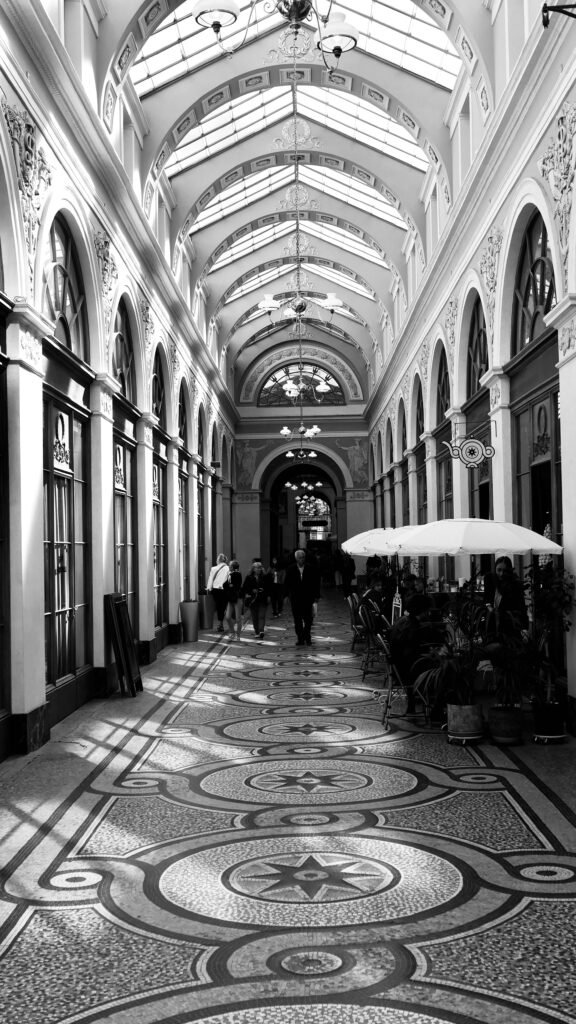
After Père Lachaise, return towards central Paris and spend part of the afternoon exploring the city’s covered passages.
These glass-roofed arcades were built largely during the nineteenth century. Inside you’ll find old shopfronts, book dealers, cafés and antique stores.
Galerie Vivienne is perhaps the most beautiful.
Its mosaic floors, glass roof and elegant storefronts feel almost impossibly Parisian. Nearby passages provide more opportunities for browsing books and prints. It’s another version of literary Paris — less Hemingway and more nineteenth-century novel.
Browse Until Your Luggage Becomes a Problem
One rule of a literary trip: you should return home with too many books. Paris makes this easy. Beyond Shakespeare and Company, independent and secondhand bookshops are scattered across the Latin Quarter and Saint-Germain. Some specialise in art. Others in philosophy. Others in rare and antiquarian books. And many are predominantly French-language shops. Don’t let that stop you.
Even if your French is terrible, browsing old French editions is half the fun. Look at the covers. Find vintage travel books. Buy an old copy of a novel you’ve already read. Books make better souvenirs than miniature Eiffel Towers anyway.
The Perfect Literary Weekend in Paris
If we were planning the ideal literary weekend, we wouldn’t try to cover the whole city. We’d keep it simple.
Saturday morning:
Walk the Seine and browse the bouquinistes before visiting Shakespeare and Company.
Late morning:
Coffee beside the bookshop overlooking Notre-Dame.
Lunch:
Wander through the Latin Quarter towards Place de la Contrescarpe and Hemingway’s old neighbourhood.
Afternoon:
Walk into Saint-Germain-des-Prés, stopping at either Les Deux Magots or Café de Flore.
Late afternoon:
Follow Rue de l’Odéon and the story of Sylvia Beach, James Joyce and the original Shakespeare and Company.
Evening:
Wine and dinner somewhere around Saint-Germain.
Then on Sunday, head to Père Lachaise. Visit Oscar Wilde, Proust and whichever writers mean something to you. Return to central Paris for the covered passages, another bookshop and one final café. And leave some time completely empty. That’s important.
Paris Is Better Between the Landmarks
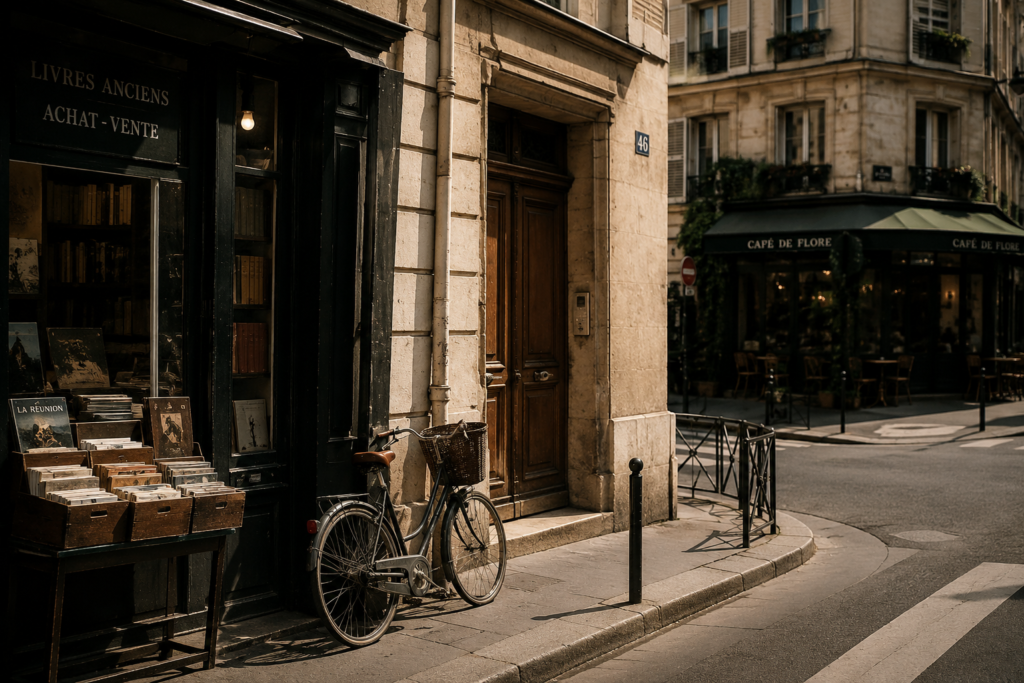
The strange thing about literary Paris is that many of its most interesting places aren’t particularly spectacular. An ordinary doorway. A café table. A street where a bookshop used to stand. A green box beside the Seine. A cheap apartment where an unknown writer once struggled to finish a story. But perhaps that’s precisely what makes them interesting. Literature transforms ordinary places.
Once you know Hemingway walked a street, Sylvia Beach sold books there or Simone de Beauvoir spent afternoons writing at a particular café table, Paris becomes layered with invisible stories. You begin looking beyond the monuments. You notice the booksellers. The old shopfronts. The café windows. The apartments above narrow streets. And eventually you understand why so many writers came here in the first place.
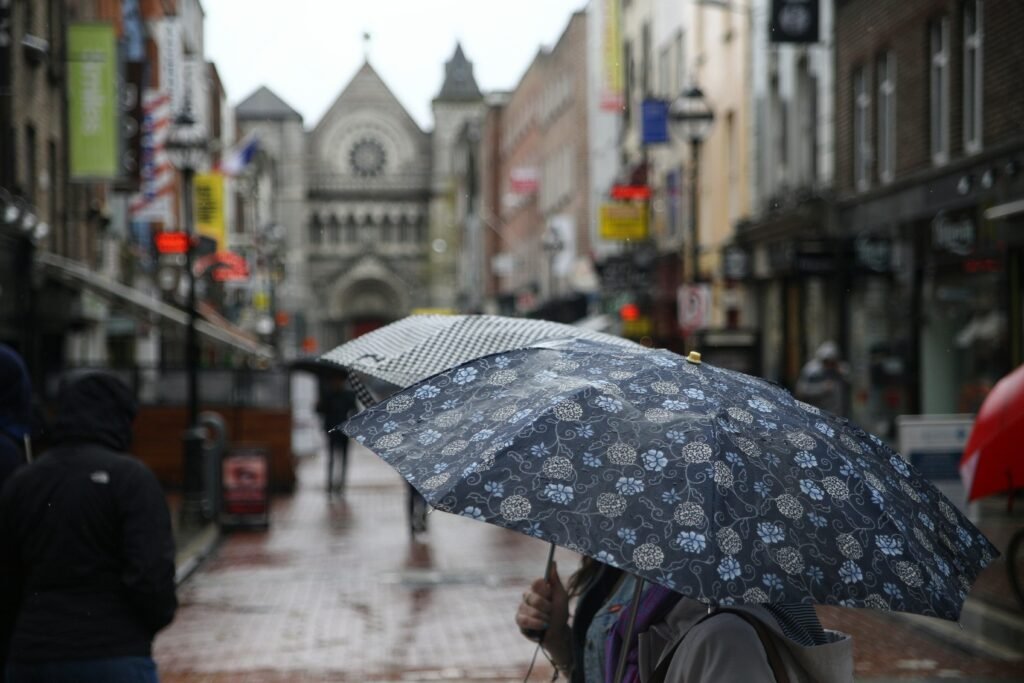
Paris doesn’t simply give you things to see. It gives you somewhere to sit. Somewhere to wander. Somewhere to read. And, if you’re lucky, somewhere to write. If this is your travel tempo you may like the city of Dublin. You can check it out in our deep dive into The Literary City of Dublin.
Britt & Tyler
We’re Britt and Tyler, the two Australians behind Cocktails & Cathedrals. We’re drawn to old buildings, beautiful rooms, bookshops and places that seem to hold a story. Our journal brings those interests together, with a fondness for slow afternoons and a well-made cocktail. We hope it helps you find places you’ll want to linger.
Travel slowly. Stay beautifully.
A little more about us →