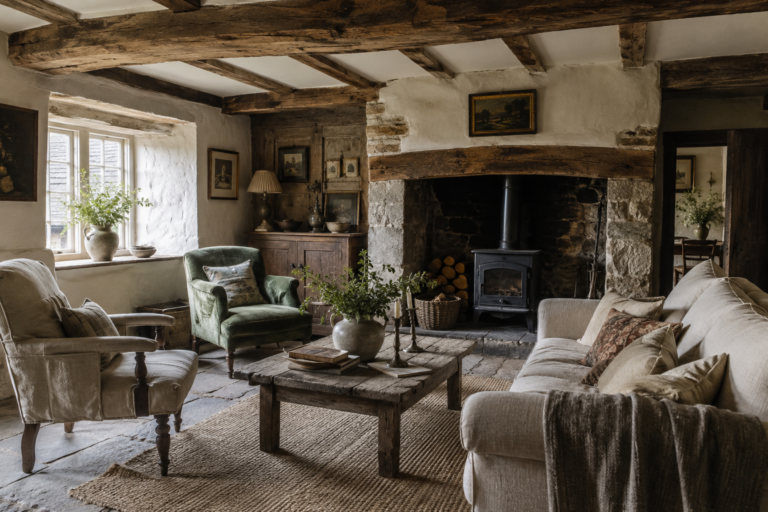
Modern Gothic Interior Design: Dark, Dramatic and Much More Contemporary Than You Think
There is a version of Gothic interior design that involves velvet curtains, gargoyles, candelabras and enough black furniture to make a room feel permanently trapped in November.
Modern Gothic is not that.
At least, it doesn’t have to be.
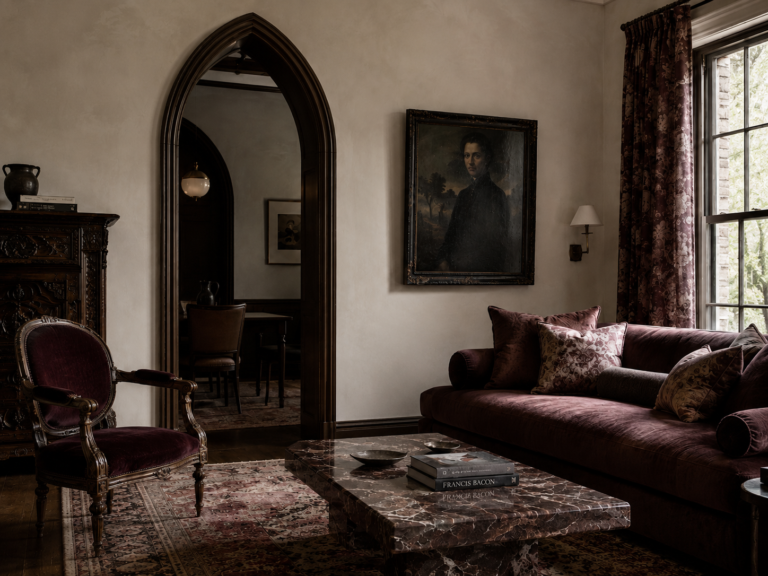
Modern Gothic takes some of the most compelling ideas from traditional Gothic architecture — pointed arches, dramatic proportions, dark timber, carved details, stained glass, shadow, stone and a certain sense of theatre — and strips away much of the historical heaviness.
The result can feel surprisingly contemporary.
Think less Victorian vampire mansion and more beautifully renovated European townhouse with a charcoal kitchen, sculptural lighting and an inexplicably magnificent arched doorway.
Modern Gothic is moody, certainly.
But it can also be warm, elegant, architectural and incredibly restrained.
And right now, it feels strangely relevant.
So, What Actually Is Modern Gothic Interior Design?
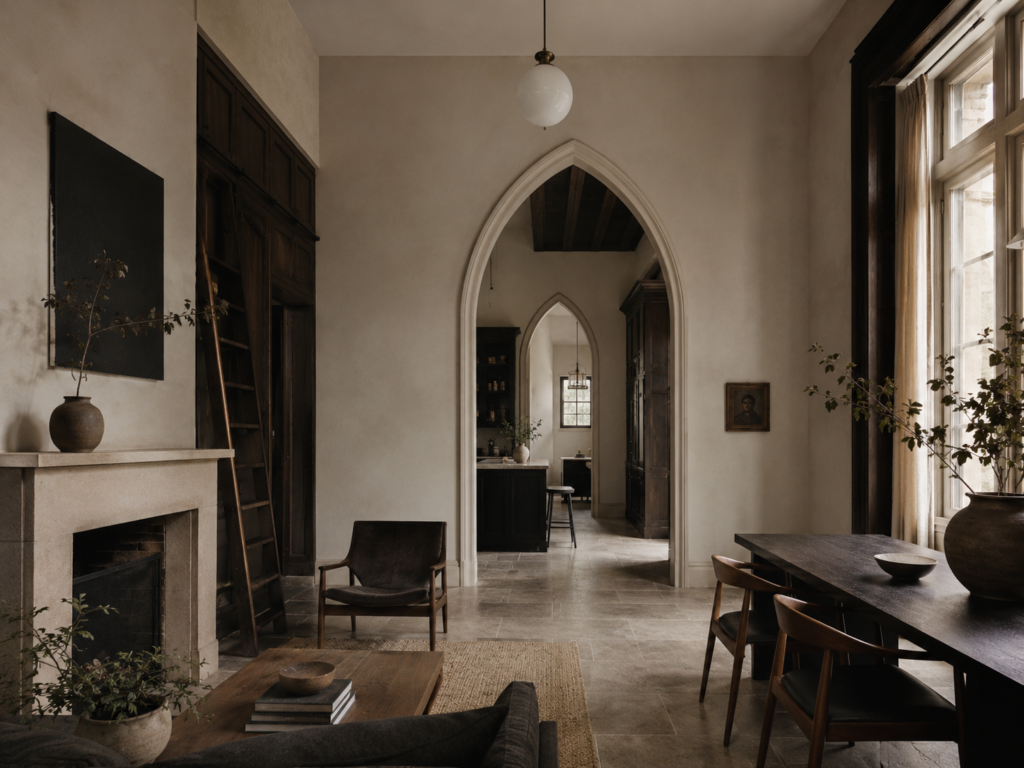
Modern Gothic is essentially a contemporary interpretation of Gothic architecture and decorative design.
Instead of recreating a medieval interior, it borrows from the visual language of Gothic buildings.
You might see:
- pointed or elongated arches
- dark timber
- blackened steel
- carved or panelled walls
- dramatic ceiling heights
- stone
- deep colour
- stained or textured glass
- sculptural lighting
- antique or ecclesiastical-looking furniture
- strong contrast between shadow and light
But the important part is restraint.
A Modern Gothic room doesn’t need all of these things.
In fact, the best examples usually don’t.
One beautifully shaped arch or an enormous dark timber cabinet can do more than twenty Gothic-themed accessories ever could.
That distinction is important because Modern Gothic is not really about decorating a room with Gothic objects.
It is about creating atmosphere through architecture, materials and proportion.
Gothic Design Was Always About Drama
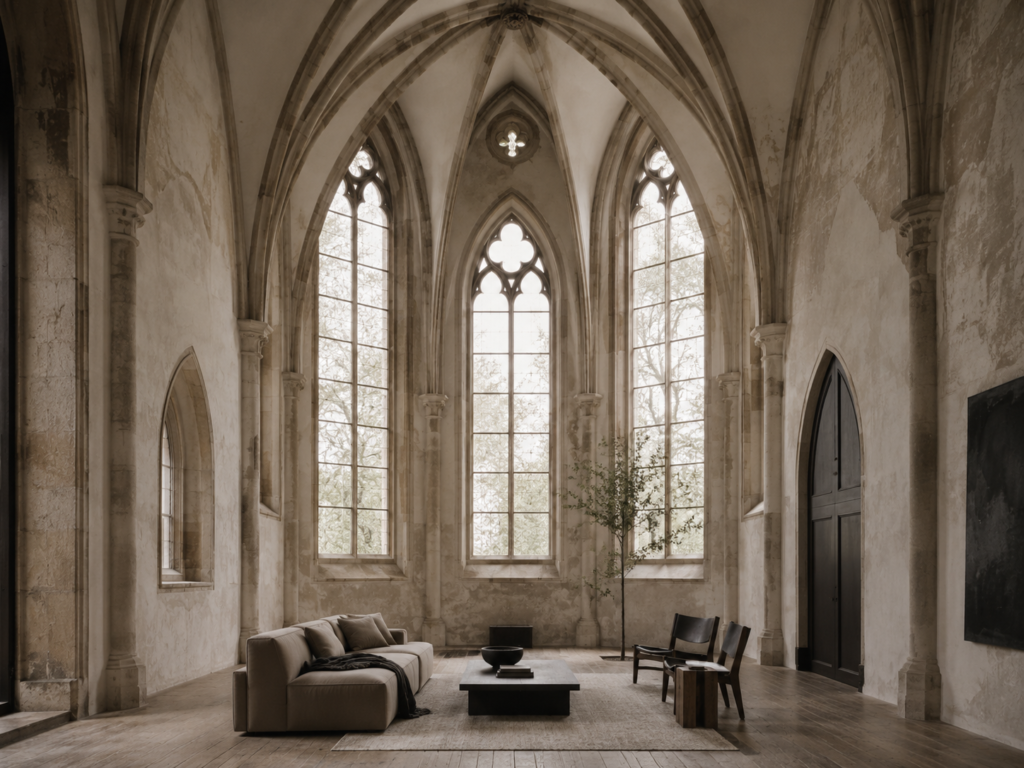
Traditional Gothic architecture was never particularly interested in being subtle.
Medieval cathedrals stretched upwards with impossible-looking vaults.
Windows became enormous.
Stone was carved into elaborate tracery.
Doorways were framed by pointed arches.
Columns seemed to disappear into ceilings.
The entire architectural language was designed to make people look up.
There was drama built into the bones of the building.
Modern Gothic keeps some of that ambition.
But rather than recreating a cathedral inside your lounge room, it uses those ideas selectively.
A tall arched doorway.
A deeply recessed window.
A dramatic black steel staircase.
A long dark cabinet running across an otherwise pale room.
A single piece of furniture with an almost medieval silhouette.
It is Gothic design after somebody turned the volume down.
The Modern Part Matters More Than You Think
The easiest way to ruin Modern Gothic is to forget the word “modern.”
Rooms still need space.
Furniture can be simple.
Walls do not have to be covered in ornament.
Lighting can be contemporary.
And there is absolutely nothing wrong with white plaster.
In fact, contrast is one of the reasons Modern Gothic works so well.
Imagine a room with warm off-white walls, pale limestone floors and almost no decoration.
Then add one enormous dark timber armoire with carved doors.
Suddenly the entire room changes.
That single object introduces age, mystery and tension.
Modern interiors often benefit from exactly that kind of interruption.
Modern Gothic Does Not Have to Mean Black Walls
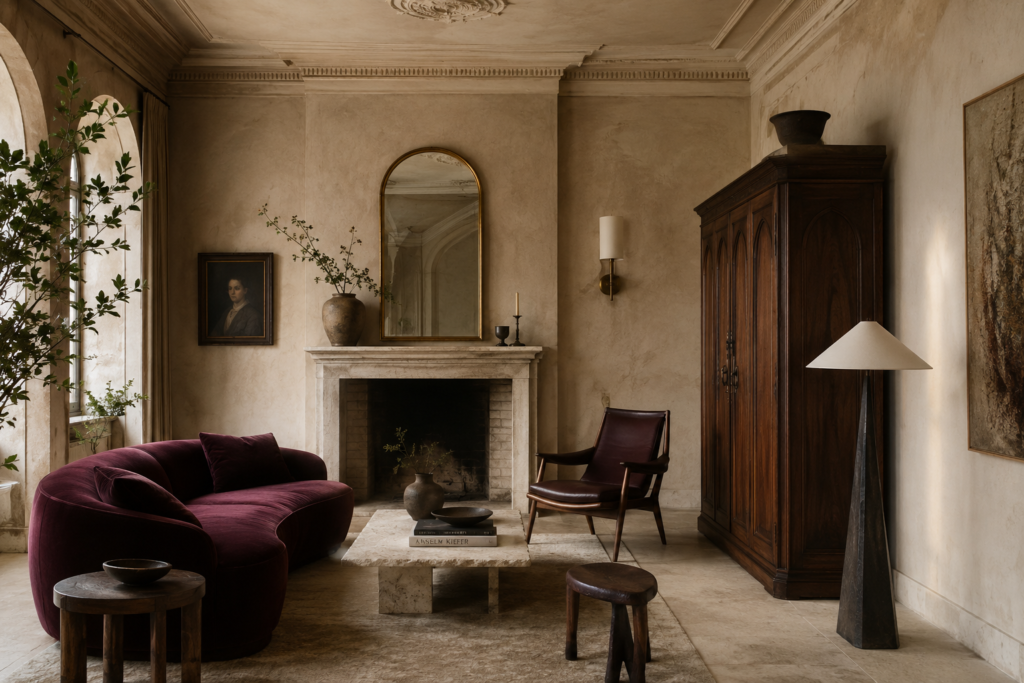
Black rooms photograph beautifully.
They are also one of the reasons people assume Gothic interiors are impossible to live with.
Fortunately, Gothic design has never depended entirely on black.
Some of the most convincing Modern Gothic palettes use colours that feel deep rather than simply dark.
Think:
oxblood.
aubergine.
dirty plum.
forest green.
tobacco.
charcoal.
deep navy.
aged bronze.
dark walnut.
And then balance those colours with quieter materials such as limestone, chalky plaster, warm white, linen and natural timber.
The contrast keeps the room from becoming oppressive.
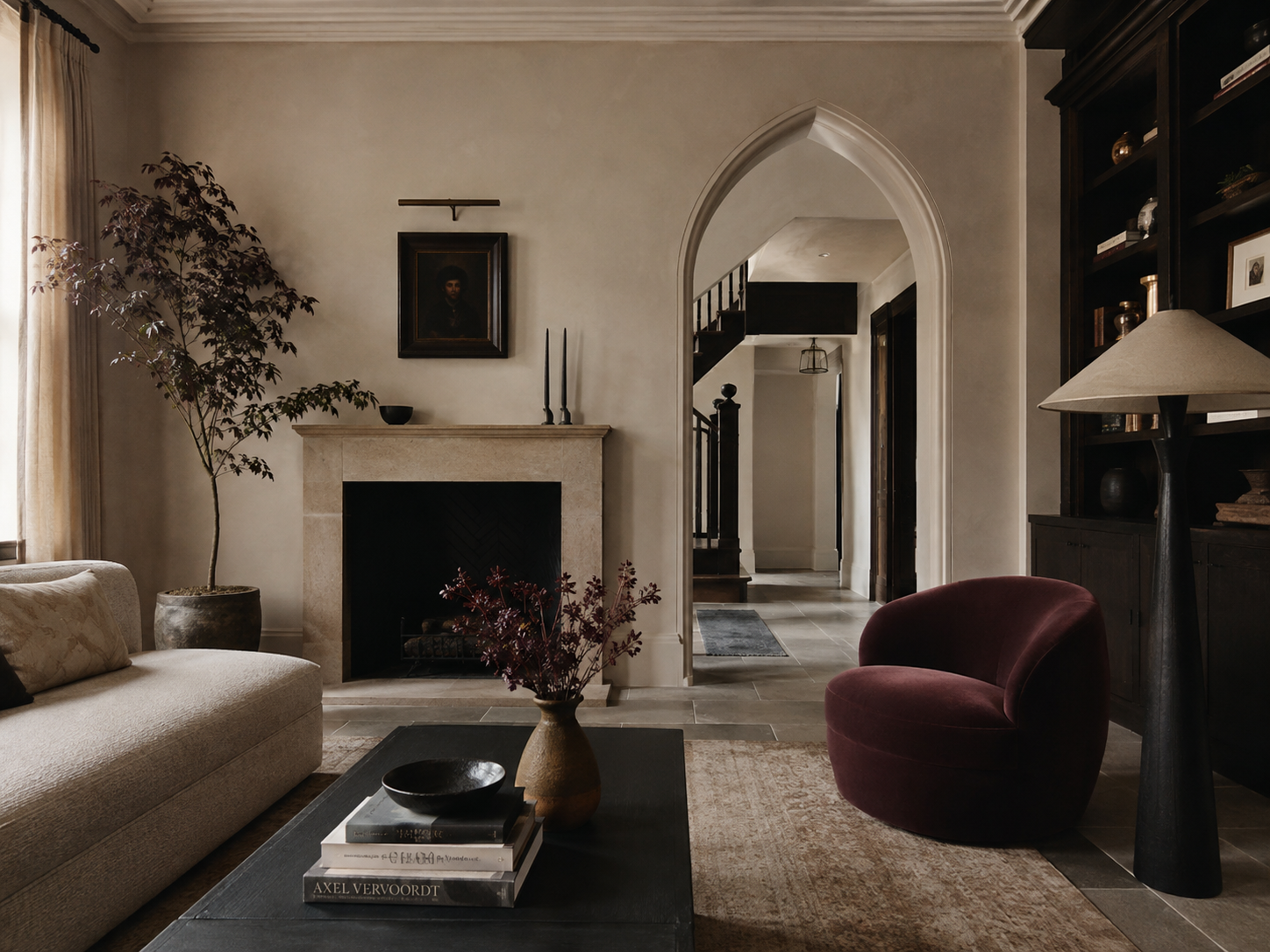
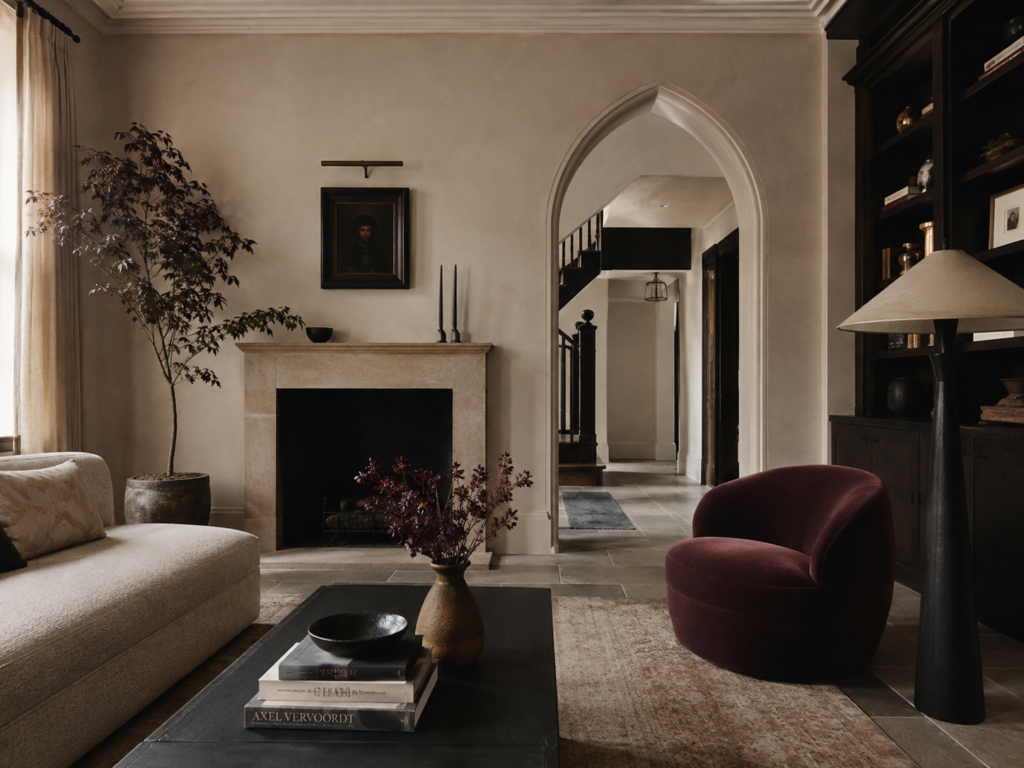
A burgundy chair in a pale room can feel far more Gothic than an entire room painted black.
If colour is where you want to start, we’ve also put together 10 Modern Gothic colour palettes that capture the moody, dramatic feel of the style without drifting into Halloween territory.
The Architecture Should Do Most of the Work
If you are lucky enough to already have arches, high ceilings, decorative plasterwork, old timber or stone walls, Modern Gothic can happen almost accidentally.
The architecture already has presence.
But you can still introduce Gothic ideas into an ordinary contemporary house.
An arched opening between rooms immediately changes the character of a space.
So does an arched built-in bookshelf.
Or an elongated mirror.
Or cabinetry with subtle pointed detailing.
Even the shape of a bedhead can reference Gothic architecture without becoming literal.
This is usually much more effective than adding decorative objects with bats on them.
Modern Gothic works best when the influence feels architectural rather than themed.
Pointed Arches Are the Shortcut
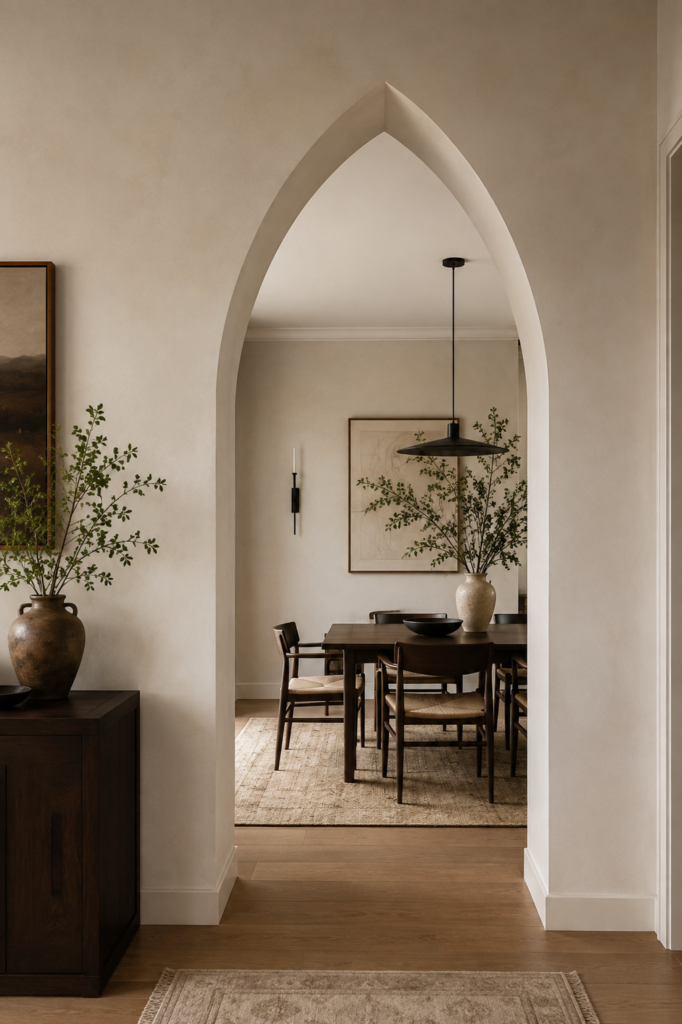
There may be no architectural shape more immediately associated with Gothic design than the pointed arch.
And it still looks incredibly good.
The interesting thing is that pointed arches can actually feel more modern than traditional round arches when used sparingly.
A tall pointed doorway painted the same colour as the surrounding wall can look almost sculptural.
The shape itself becomes the decoration.
You could use the idea in:
- door openings
- internal windows
- cabinetry
- mirrors
- shelving niches
- fireplace surrounds
- shower screens
- bedheads
You don’t need many.
One is usually enough.
Dark Timber Might Be the Most Important Material
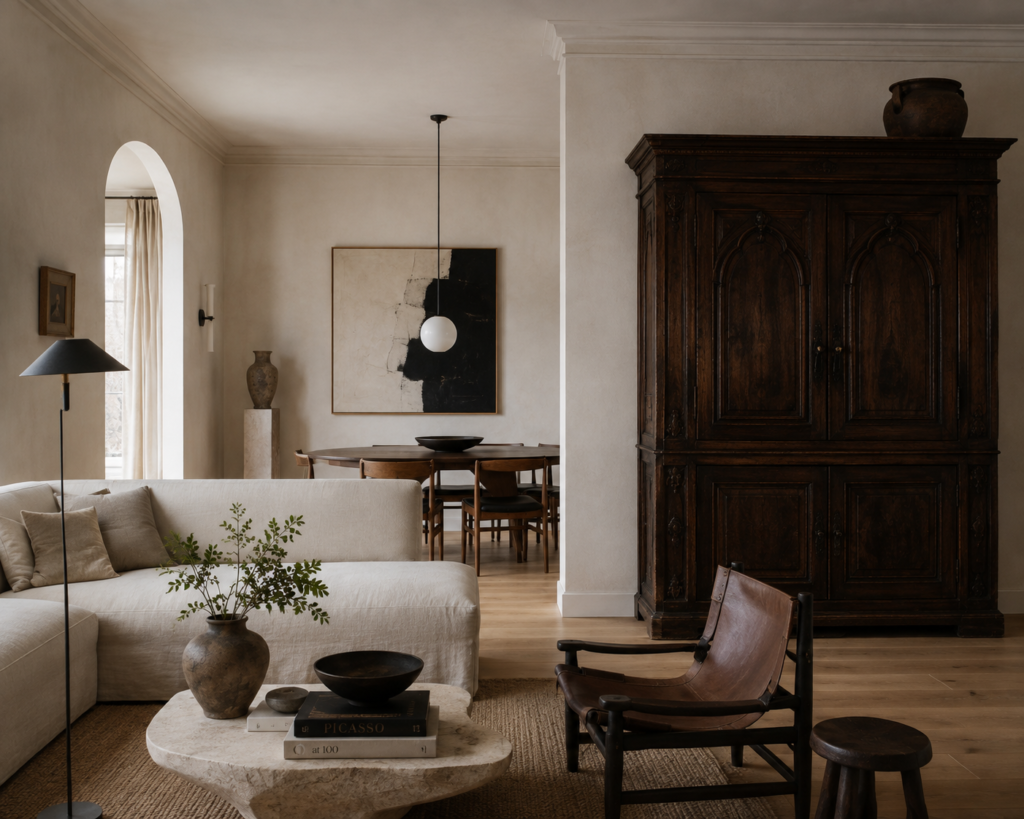
If Modern Gothic has one material that consistently makes sense, it is dark timber.
Walnut.
Stained oak.
Ebonised timber.
Old mahogany.
Even inexpensive furniture painted or stained into a deeper tone can work.
Traditional Gothic interiors were often dominated by carved timber furniture and panelling.
Modern Gothic uses the same visual weight but usually with cleaner forms.
A large walnut dining table.
A dark timber kitchen.
A carved antique cabinet against an otherwise minimal wall.
A very simple room with one enormous dark bookcase.
The timber brings warmth into a style that can otherwise become too cold.
It also gives the room age.
And Modern Gothic almost always looks better when something in the room feels older than everything else.
Stone Keeps It From Feeling Theatrical
Another reason Gothic-inspired interiors can drift into theme-park territory is that too many decorative elements compete with one another.
Stone fixes this remarkably quickly.
Travertine.
Soapstone.
Dark marble.
Limestone.
Slate.
Even rough-rendered plaster can introduce some of the solidity associated with older architecture.
A heavy stone fireplace beneath a simple contemporary light fitting can create exactly the right tension.
The combination feels historical and modern at the same time.
That tension is really the entire point.
Lighting Should Feel Slightly Monumental
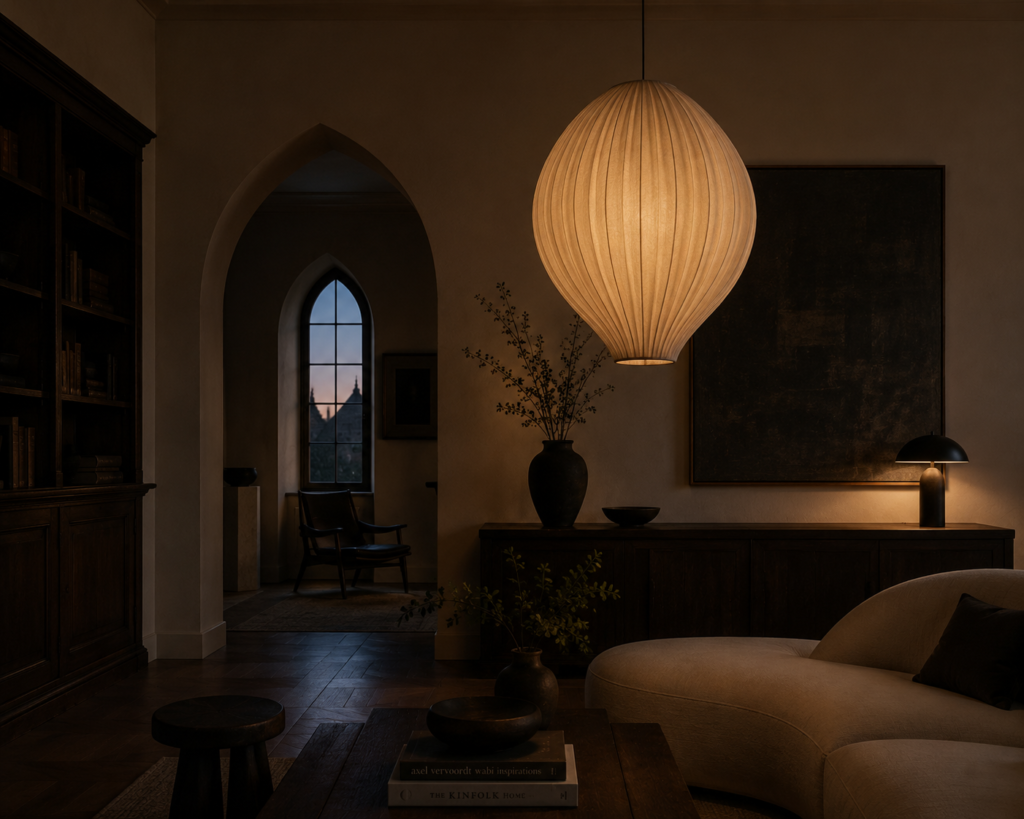
Modern Gothic lighting is not about filling a house with wrought-iron chandeliers.
Although one very good wrought-iron chandelier certainly wouldn’t hurt.
The better approach is to think about scale and silhouette.
A giant pendant hanging in an otherwise simple room.
A severe black wall light.
An opaline globe suspended beneath a vaulted ceiling.
A tall sculptural floor lamp.
Even very modern lighting can work if it feels slightly oversized or architectural.
Gothic rooms were always interested in the relationship between darkness and light.
Modern Gothic should be too.
You want pools of illumination rather than a room that is uniformly bright.
Some corners are allowed to remain shadowy.
That is where half the atmosphere comes from.
Stained Glass Is Surprisingly Easy to Use
Stained glass sounds like one of those things that immediately pushes a house into ecclesiastical territory.
But it can be extremely subtle.
A small panel of amber glass.
A coloured internal window.
Leadlight in a bathroom door.
Textured glass with a faint jewel tone.
Modern designers have started using coloured glass again because it gives a room something digital images can never really capture properly: changing light.
A beam of coloured afternoon light moving across a wall has a kind of accidental drama.
That feels very Gothic.
You certainly do not need a full cathedral window.
Although, admittedly, if you have one, I am not going to tell you to remove it.
The Furniture Should Feel Collected, Not Purchased as a Set
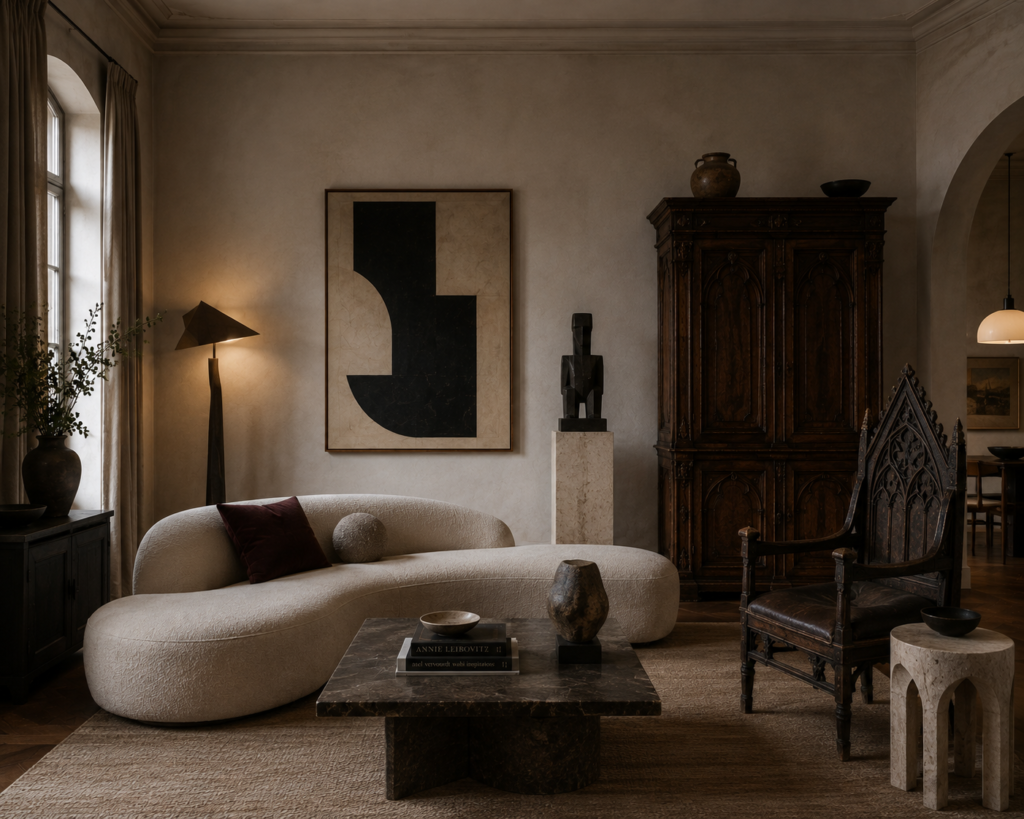
Modern Gothic becomes much more convincing when the furniture looks as though it came from different decades.
A contemporary curved sofa.
An antique side table.
A severe modern steel chair.
A carved wooden cabinet.
A strange lamp from the 1970s.
The room should feel collected rather than coordinated.
This is another reason Gothic influences work so beautifully with contemporary interiors.
Old furniture gives modern rooms tension.
And tension is usually what separates an interesting room from a perfectly nice one.
You Only Need One Slightly Strange Object
There is a particular kind of room that looks completely normal until you notice something that seems to belong somewhere else.
That is often where Modern Gothic becomes really good.
Maybe it is a huge antique portrait.
A carved chair that looks vaguely ecclesiastical.
A brutalist iron lamp.
An enormous dark timber cupboard.
A stone pedestal.
An unusual mirror with an exaggerated pointed frame.
The rest of the room can remain calm.
That one strange decision gives the interior personality.
Beautiful interiors rarely come from choosing everything from the same page of a catalogue.
Modern Gothic Bedrooms Are Almost Too Easy
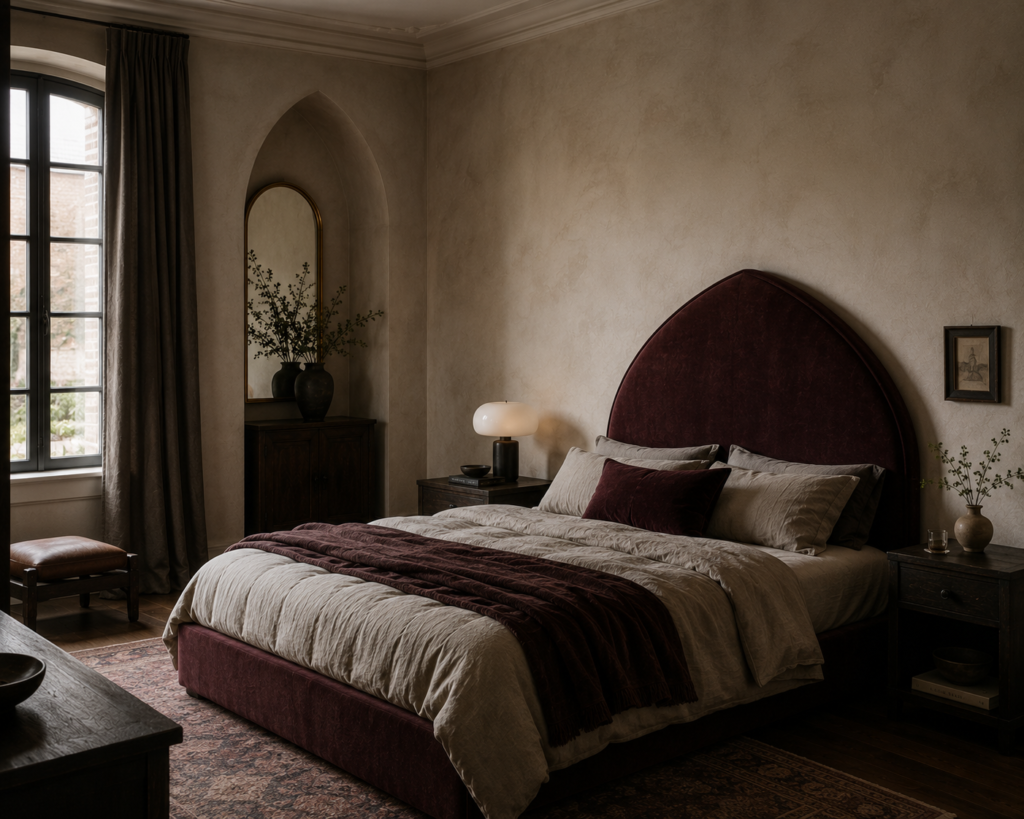
Bedrooms naturally suit the style because they already benefit from lower light and heavier materials.
You could start with an upholstered bed in dark brown, burgundy or tobacco.
Add linen bedding.
A dark timber bedside table.
Maybe a slightly oversized lamp.
Then use architecture to create the Gothic reference.
An arched bedhead.
A pointed wall niche.
Dark timber panelling behind the bed.
A single antique mirror.
You really do not need much more than that.
The trick is making the room feel romantic rather than theatrical.
Which means avoiding anything that looks like it was purchased from a shop called The Vampire Emporium.
Kitchens Are Where Modern Gothic Gets Interesting
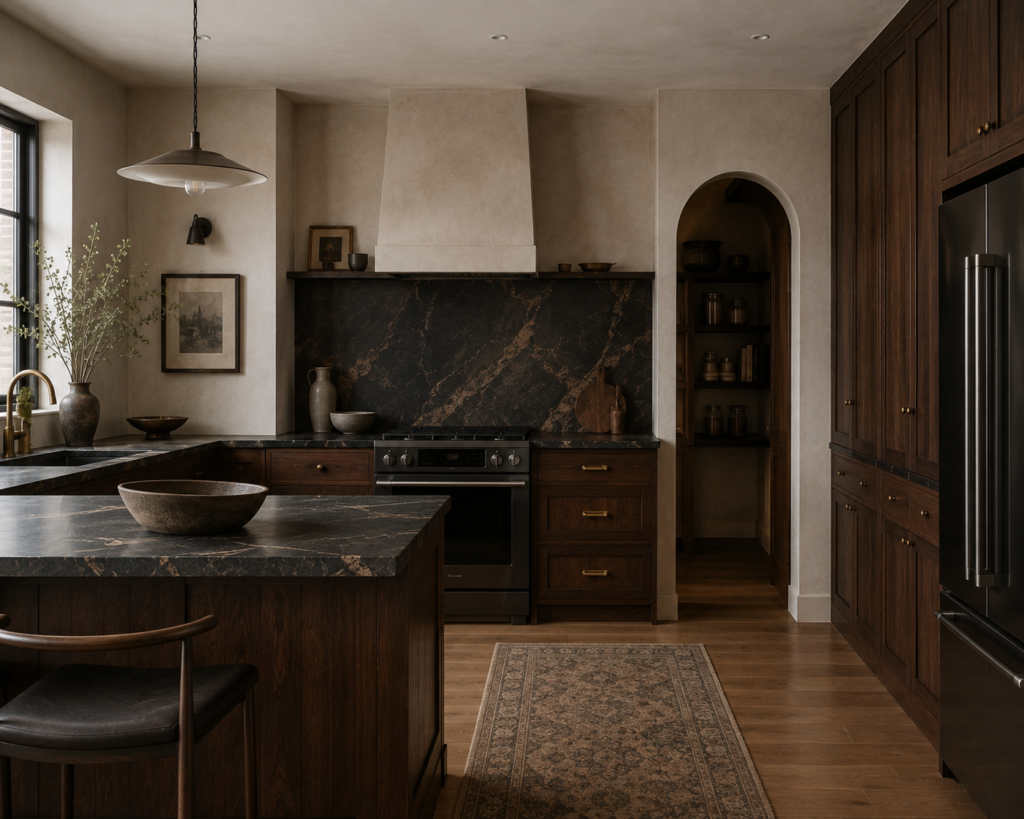
A Gothic-inspired kitchen sounds like it should be ridiculous.
It isn’t.
In fact, kitchens may be one of the easiest places to reinterpret the style.
Dark walnut or charcoal cabinetry already gives you the visual weight.
Then add stone.
Perhaps a heavily veined marble or soapstone benchtop.
Keep the cabinetry simple but introduce one slightly historic element: an arched pantry opening, aged brass hardware, a carved timber detail or ribbed glass.
Modern appliances can remain completely modern.
That contrast is what stops the space from becoming a period reconstruction.
A very good Modern Gothic kitchen should look like somebody renovated a 400-year-old building last year.
Even when the house was built in 2003.
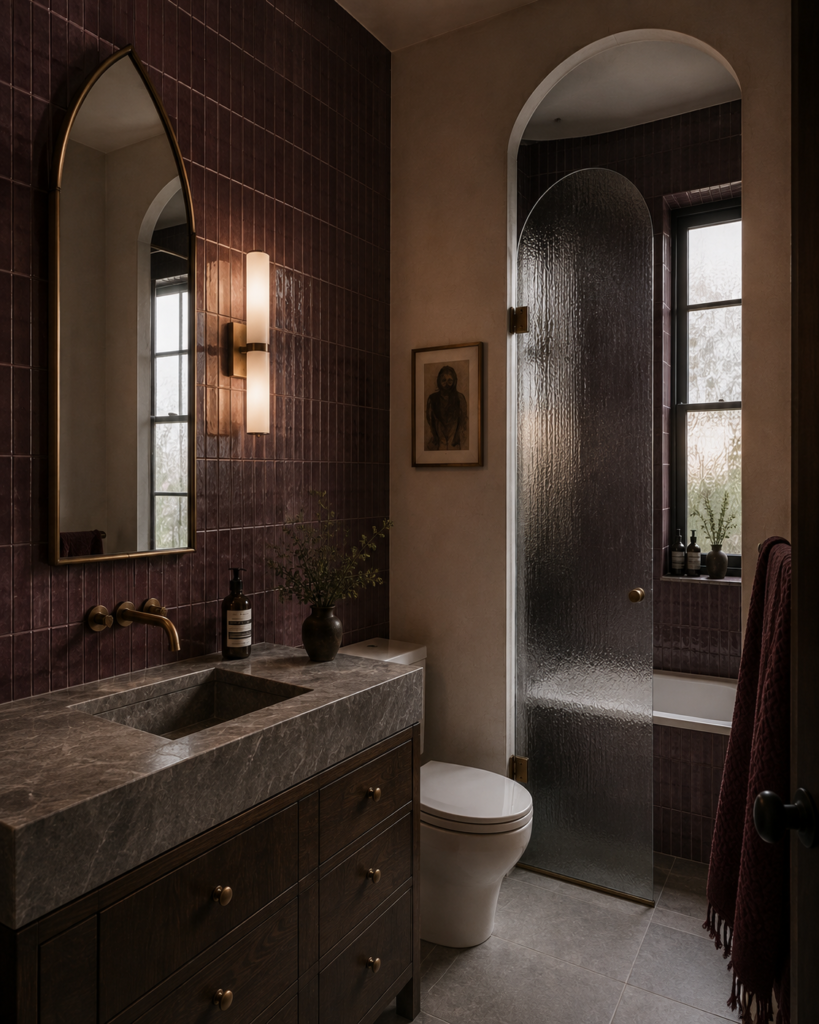
Bathrooms Can Handle More Drama Than Almost Any Other Room
Bathrooms are perfect for Gothic references because they are usually small enough that you can make one big decision without overwhelming the entire house.
Dark stone.
Deep burgundy tiles.
A pointed mirror.
A dramatic wall light.
Textured glass.
A heavy stone vanity.
You could even paint the ceiling.
Because bathrooms are enclosed spaces, stronger colours often feel surprisingly comfortable.
They become immersive.
And if there is one room where being slightly dramatic is allowed, surely it is the room where we already installed a freestanding tub and started pretending we live in a boutique hotel.
Modern Gothic Works Beautifully With Contemporary Art
Traditional Gothic artwork can make the style feel literal very quickly.
Contemporary art does the opposite.
A huge abstract canvas against dark timber panelling.
An unusual photograph in a carved antique frame.
A minimal sculpture sitting on an old stone pedestal.
The contrast creates something much more sophisticated than simply matching the artwork to the architecture.
Again, it comes back to tension.
Old and new.
Heavy and light.
Ornate and minimal.
Bright and shadowed.
Modern Gothic lives somewhere between those opposites.
The Ceiling Is an Underrated Opportunity
Modern interiors often treat ceilings as the part of the room nobody needs to think about.
Gothic architecture did exactly the opposite.
Ceilings were events.
Vaults, beams and ribs became some of the most extraordinary architectural features ever built.
You probably don’t need to install a fan-vaulted ceiling in your suburban renovation.
But you can still borrow the idea.
Exposed timber beams.
A dark painted ceiling.
A vaulted plaster ceiling.
Decorative moulding used in a restrained way.
Even simply painting the ceiling the same deep colour as the walls can make a room feel enveloping.
The ceiling suddenly becomes part of the architecture.
Modern Gothic Is Not the Same as Dark Academia
The two styles definitely overlap.
They both like:
dark timber.
books.
old buildings.
deep colours.
moody lighting.
antique objects.
But Dark Academia is usually more nostalgic.
Libraries, universities, old studies, worn leather chairs and piles of books are central to the look.
Modern Gothic tends to be more architectural.
It can be much cleaner.
There may be fewer objects.
The rooms can even feel minimalist.
If Dark Academia imagines an eccentric professor living inside an old Oxford college, Modern Gothic imagines an architect renovating the abandoned chapel next door.
There is clearly some crossover.
But they are not quite the same thing.
It Is Also Not the Same as Victorian Gothic
Victorian Gothic tends to lean further into ornament.
Patterned wallpaper.
Elaborate timber furniture.
Decorative textiles.
Heavy curtains.
Carved fireplaces.
Busy rooms.
Modern Gothic usually strips most of that away.
The proportions and architectural references remain, but the furniture and styling become much simpler.
That is why the style feels so contemporary.
It takes a design language that is centuries old and removes enough of the decoration that the shapes become visible again.
How to Make Modern Gothic Work in a Normal Home
You absolutely do not need a castle.
Start with one or two elements.
Maybe a deep wall colour.
Or a dark timber cabinet.
Or an arched opening.
Then keep the surrounding room relatively quiet.
Modern Gothic becomes much easier when you think of it as a layer rather than a complete transformation.
A normal living room with pale plaster walls, a linen sofa and timber floors could become subtly Gothic with one huge dark bookcase and a sculptural black light.
A simple bedroom could use an arched timber bedhead and deep plum bedding.
A modern kitchen could introduce dark timber cabinetry and heavily veined stone.
The influence can be incredibly subtle.
That is often when it looks best.
Our article on Gothic Romance delves deeper into how to subtly bring the gothic vision into your home.
What Modern Gothic Should Probably Avoid
There is nothing wrong with theatrical interiors.
Sometimes ridiculous is exactly what a room needs.
But if you are aiming for Modern Gothic rather than full Gothic Revival, there are a few things worth being careful with.
Too many decorative motifs.
Too much fake ageing.
Furniture that looks intentionally “Gothic.”
Cheap reproduction architecture.
Five different kinds of dark patterned wallpaper.
An entire room of black furniture.
And anything that starts making you wonder whether Dracula is about to enter carrying a wine decanter.
The most convincing Modern Gothic rooms rarely look like somebody was trying to create a Gothic room.
They simply contain a few Gothic ideas.
Why Does Modern Gothic Feel So Relevant Again?
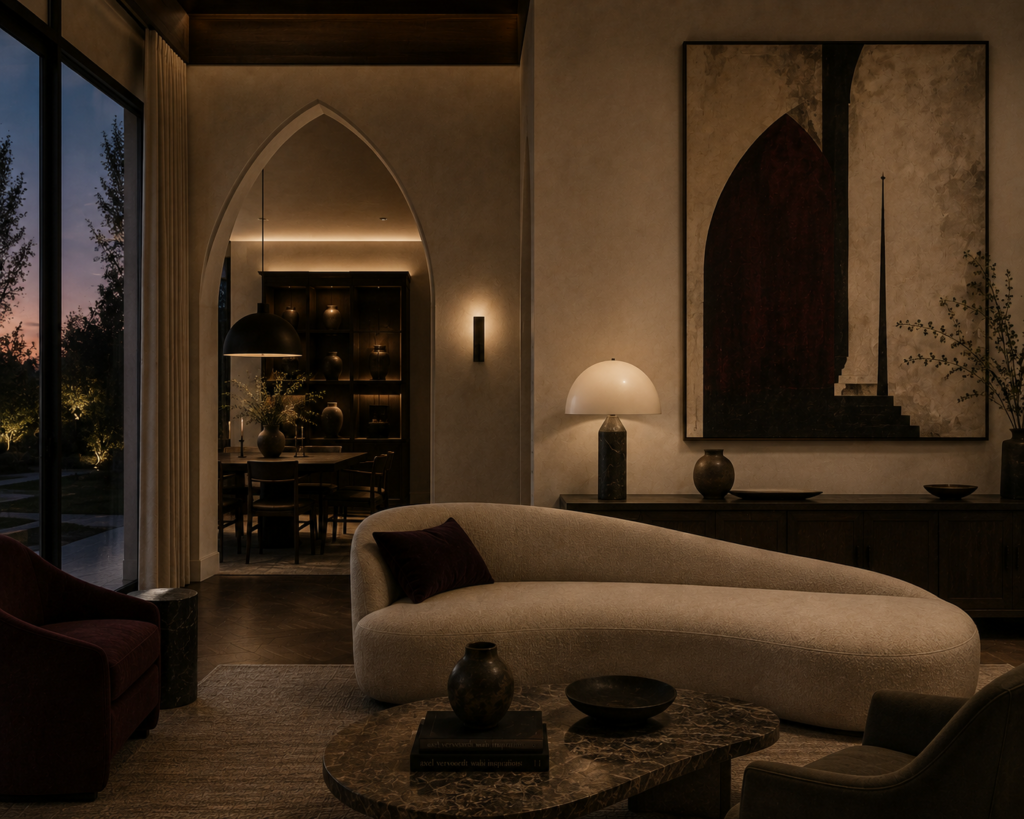
For the last decade, interiors have been moving through a long period of visual calm.
White walls.
Pale oak.
Rounded furniture.
Neutral fabrics.
Minimal styling.
And there is still plenty to love about those rooms.
But eventually, people start wanting something different.
Something with a little more mystery.
More architecture.
More history.
More shadow.
Modern Gothic gives contemporary interiors permission to become dramatic again without returning to decorative excess.
It also fits perfectly with the wider return of dark timber, saturated colour, antique furniture, stone, architectural arches and interiors that feel collected rather than newly installed.
After years of rooms designed to look effortlessly peaceful, maybe we are ready for interiors that feel slightly dangerous again.
Maybe We Never Really Stopped Loving Gothic
Gothic architecture has survived for centuries because it understands something very basic about design.
People respond to atmosphere.
We remember spaces that make us feel something.
The light inside a cathedral.
The scale of an old stone doorway.
The silhouette of an arched window.
The warmth of ancient timber.
The strange quiet of a room where one corner disappears into shadow.
Modern Gothic does not need to reproduce any of those spaces literally.
It simply borrows the feeling.
And perhaps that is why the style suddenly makes so much sense.
You can keep the contemporary sofa.
Keep the clean kitchen.
Keep the white plaster.
Just add an arch.
A dark cabinet.
A little stone.
And one object that looks like it might have a very interesting history.
That is probably enough.
Britt & Tyler
We’re Britt and Tyler, the two Australians behind Cocktails & Cathedrals. We’re drawn to old buildings, beautiful rooms, bookshops and places that seem to hold a story. Our journal brings those interests together, with a fondness for slow afternoons and a well-made cocktail. We hope it helps you find places you’ll want to linger.
Travel slowly. Stay beautifully.
A little more about us →