Postmodern Loft: The Interior Style You’ve Seen but Probably Never Had a Name For
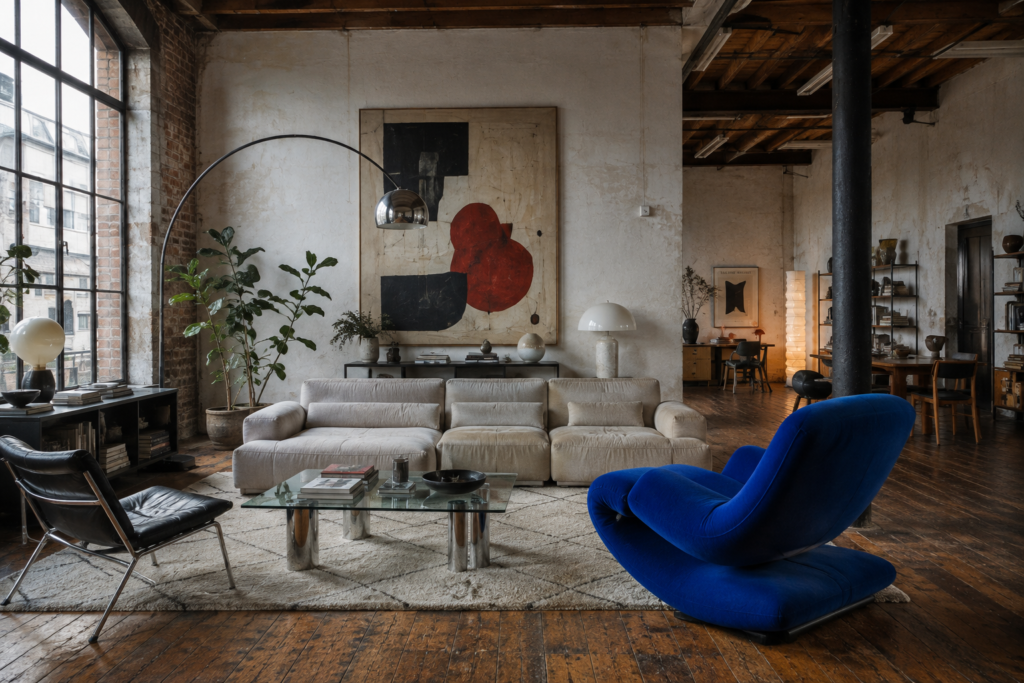
Some rooms seem to take themselves very seriously.
Everything matches. Every colour is carefully restrained. Furniture disappears politely into the architecture. Nothing is allowed to be particularly strange.
A Postmodern Loft is not one of those rooms.
Here, a cobalt-blue chair might sit beside a classical plaster bust. A stainless-steel kitchen could share a room with a curving red sofa. An enormous abstract painting might hang on unfinished concrete. A strange little lamp may exist for no obvious reason other than somebody thought it was brilliant.
And somehow, it works.
Postmodern Loft combines the scale and raw architecture of loft living with the colour, irreverence and experimentation of postmodern design.
It’s industrial architecture that has stopped taking itself quite so seriously.
And after years of carefully restrained interiors, that suddenly feels rather refreshing.
What Is a Postmodern Loft?
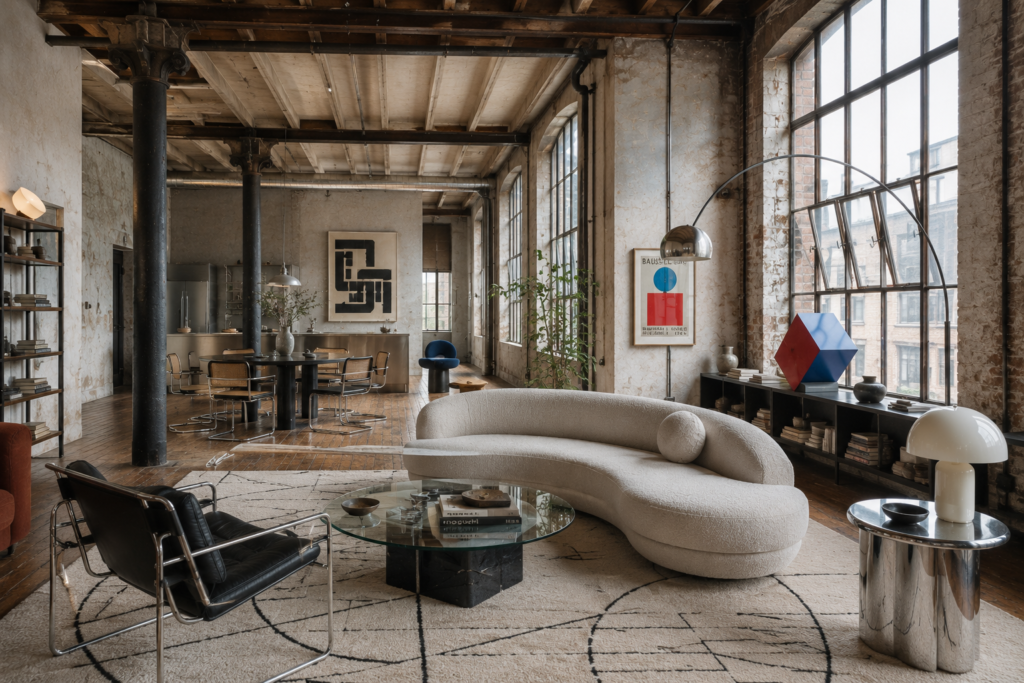
Strictly speaking, Postmodern Loft isn’t one neatly defined historical design movement.
It’s better understood as the meeting point between two ideas.
The first is loft living: warehouses, factories and commercial buildings converted into homes, usually retaining large windows, high ceilings, concrete, brick, steel columns and open floor plans.
The second is postmodern design, which emerged partly as a reaction against the seriousness and rigid functionalism of modernism.
Modernism often argued that form should follow function.
Postmodernism occasionally seemed to respond:
Yes, but couldn’t the form also be a giant red squiggle?
Designers began playing with historical references, exaggerated geometry, unexpected colour and objects that deliberately blurred the line between furniture, sculpture and joke.
Put those ideas inside an old warehouse and something interesting happens.
The raw building becomes a stage.
The Loft Is the Quiet Part
This might sound strange considering lofts aren’t particularly quiet spaces visually.
But in a Postmodern Loft, the architecture often acts as the neutral background.
Concrete floors.
White or unfinished walls.
Exposed columns.
Old brick.
Steel-framed windows.
Visible structure.
Instead of decorating every architectural surface, much of it can remain relatively untouched.
That gives the objects inside the room permission to become much more expressive.
A bizarre chair doesn’t seem quite so bizarre when it has six metres of empty wall around it.
A bright red table becomes surprisingly sophisticated against concrete.
The architecture provides restraint.
The furniture provides personality.
Colour Arrives in Unexpected Places
Unlike Quiet Luxury, where colour tends to arrive politely and in muted tones, Postmodern Loft interiors can be considerably less well behaved.
Cobalt blue.
Tomato red.
Mustard yellow.
Forest green.
Powder pink.
Burnt orange.
Even purple.
But the trick isn’t necessarily to use all of them.
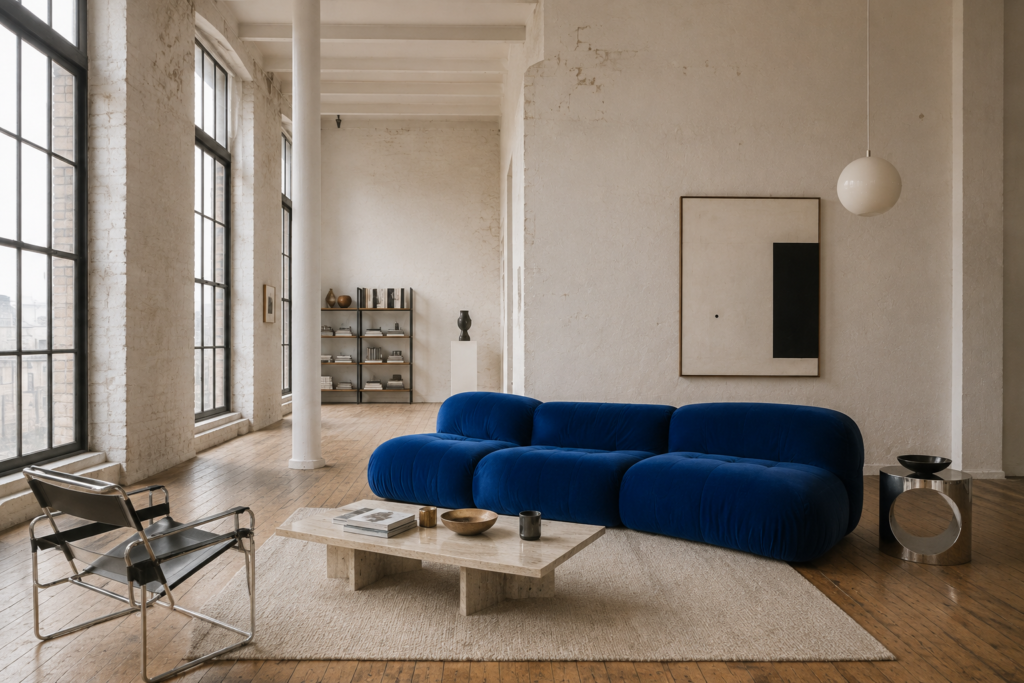
One of the most sophisticated approaches is to keep much of the architecture neutral and introduce one or two surprisingly strong colours.
Imagine a mostly white loft with timber floors and enormous windows.
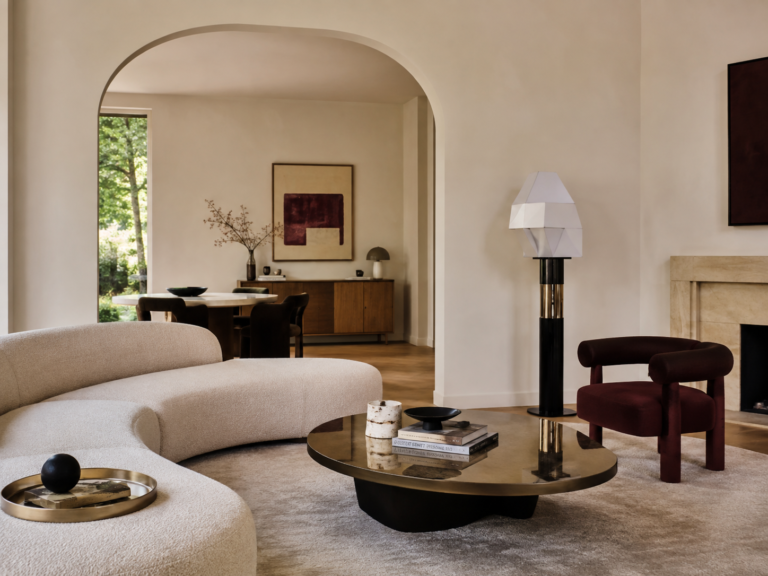
Then place one deep-blue sculptural sofa in the middle of it.
Suddenly the room has an identity.
Colour becomes an object rather than simply a palette.
Furniture Can Be Slightly Weird
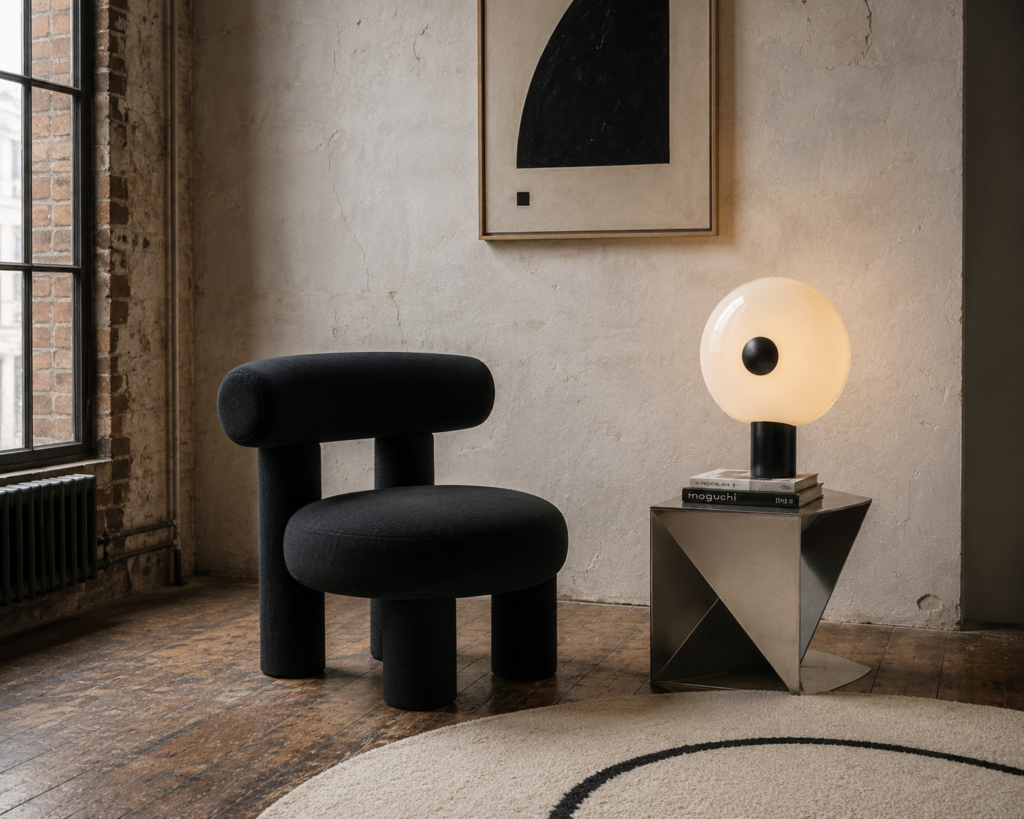
This is where Postmodern Loft becomes fun.
Furniture doesn’t always need to disappear quietly into the room.
A chair can look almost architectural.
A table might have strangely oversized legs.
A sofa can curve when every sensible instinct suggests it should be straight.
A lamp might resemble a sculpture.
A bookshelf may appear slightly impossible.
Postmodern designers often questioned why everyday objects needed to look the way they traditionally had.
That spirit translates beautifully into contemporary interiors.
You don’t need an entire room of eccentric furniture.
In fact, you probably shouldn’t have one.
One strange chair is interesting.
Seven strange chairs begin to look like the waiting room of an experimental dentist.
Geometry Is Everywhere
Circles, arches, cylinders, grids, triangles and exaggerated curves frequently appear in postmodern interiors.
Sometimes they’re architectural.
An oversized circular doorway.
A curved partition.
A tiled column.
A geometric staircase.
Other times they appear through furniture and objects.
A spherical lamp.
A triangular side table.
A cylindrical pedestal.
A rug covered in simple graphic shapes.
Again, restraint matters.
The goal isn’t to fill the room with geometry.
It’s to introduce shapes that feel slightly unexpected against the straightforward industrial architecture of the loft.
Old Architecture Makes New Furniture Better
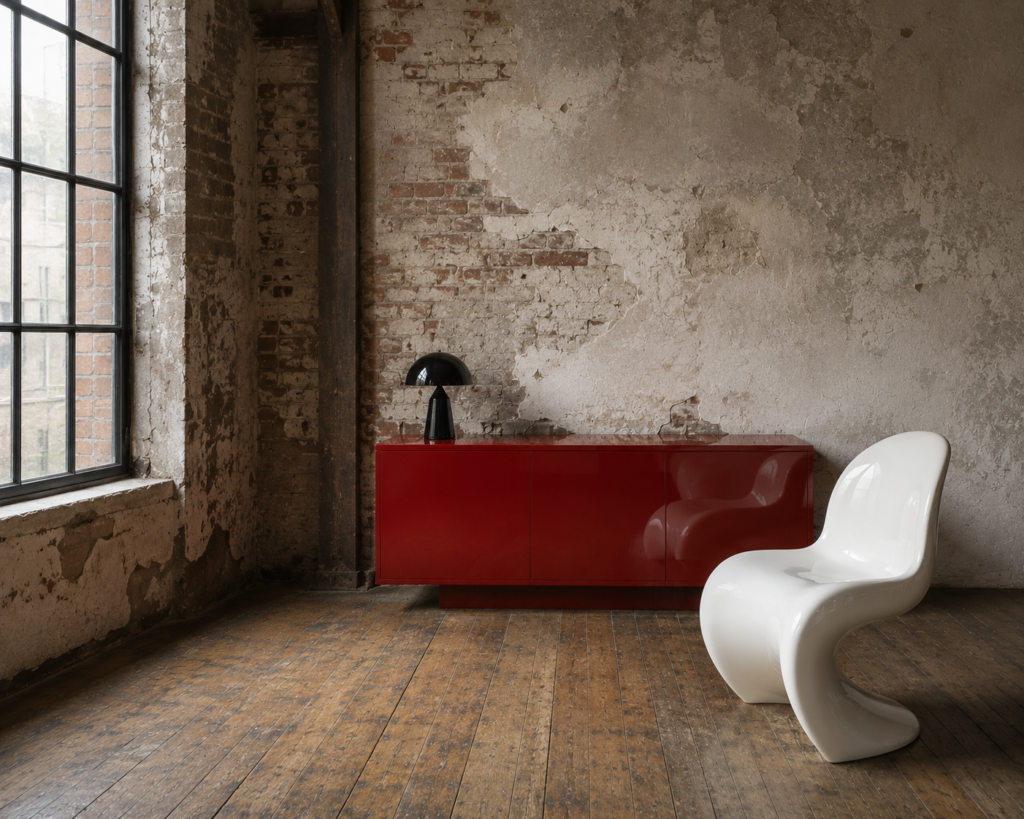
One reason this combination works so well is contrast.
A pristine contemporary chair becomes more interesting against a battered brick wall.
A brightly lacquered table looks sharper on an old timber floor.
A highly polished stainless-steel kitchen feels less clinical when surrounded by century-old factory windows.
Neither side needs to pretend to be the other.
The old building remains old.
The contemporary furniture remains contemporary.
The tension between them becomes part of the design.
It’s a similar principle to Industrial Romanticism, but the emotional effect is completely different.
Industrial Romanticism softens old architecture.
Postmodern Loft provokes it.
Art Doesn’t Need to Match the Sofa
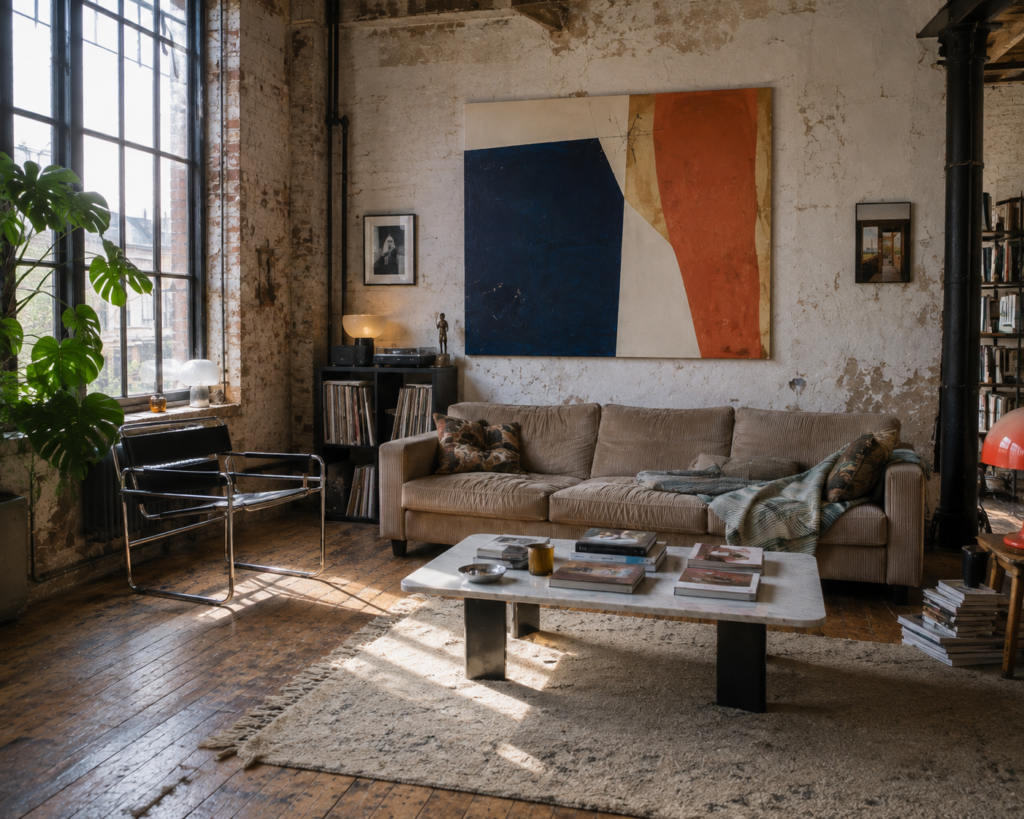
Postmodern interiors tend to be comfortable with art that has a strong personality.
Large abstract paintings work particularly well in lofts because the architecture can accommodate their scale.
Photography can work beautifully too.
So can graphic prints, sculpture and objects that aren’t immediately identifiable as either art or furniture.
The important thing is to avoid turning everything into a coordinated colour exercise.
If the painting contains blue, you don’t necessarily need three blue cushions underneath it.
Art can simply exist because you like it.
That sounds obvious.
Interior design occasionally needs reminding.
The Kitchen Can Go Industrial Again
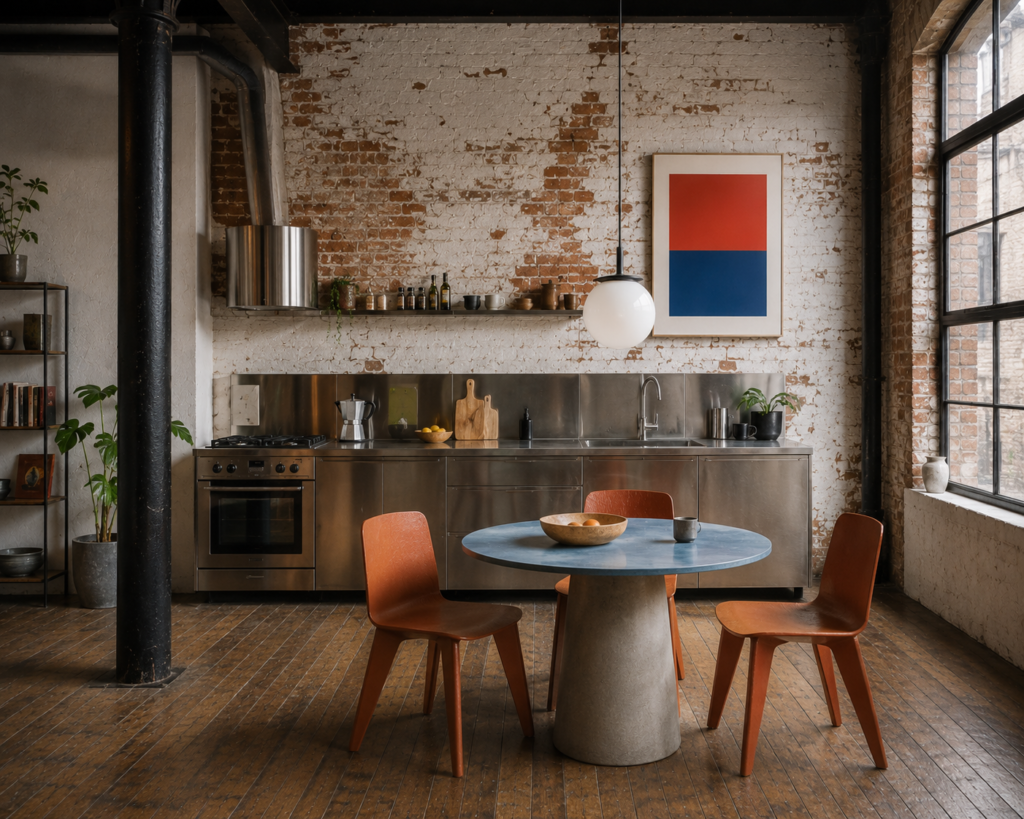
Postmodern Loft kitchens don’t necessarily need to hide.
Stainless steel can work exceptionally well.
So can polished aluminium, timber veneer, laminate and boldly coloured cabinetry.
A stainless-steel kitchen against old brick can feel almost professionally utilitarian.
Then introduce something unexpected.
A sculptural pendant.
Bright dining chairs.
A strange ceramic object.
A vivid artwork nearby.
Suddenly the kitchen stops feeling commercial and becomes part of the composition.
Even relatively ordinary cabinetry can take on a postmodern character through unusual handles, colour or proportion.
You don’t need a kitchen designed by an Italian architect in 1987.
Although admittedly, that wouldn’t hurt.
Lighting Is Allowed to Be an Object
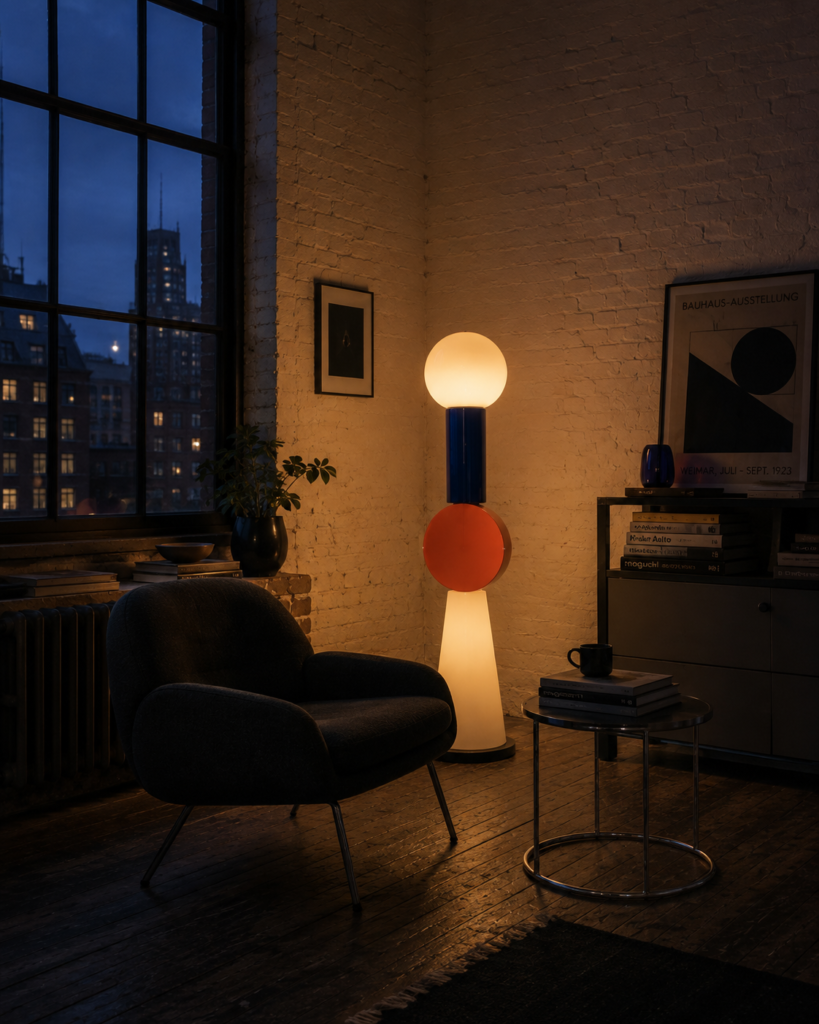
Lighting is one of the easiest ways to introduce postmodern character without redesigning an entire room.
An oversized spherical pendant.
A colourful table lamp.
A strange geometric floor lamp.
A classic 1970s or 1980s design.
Lighting can almost function as sculpture during the day and illumination at night.
This is particularly useful in loft spaces because their scale allows larger objects to breathe.
But bigger isn’t automatically better.
A small, peculiar lamp sitting on an otherwise ordinary sideboard can sometimes do more for the room than an enormous statement fixture.
It’s the surprise that matters.
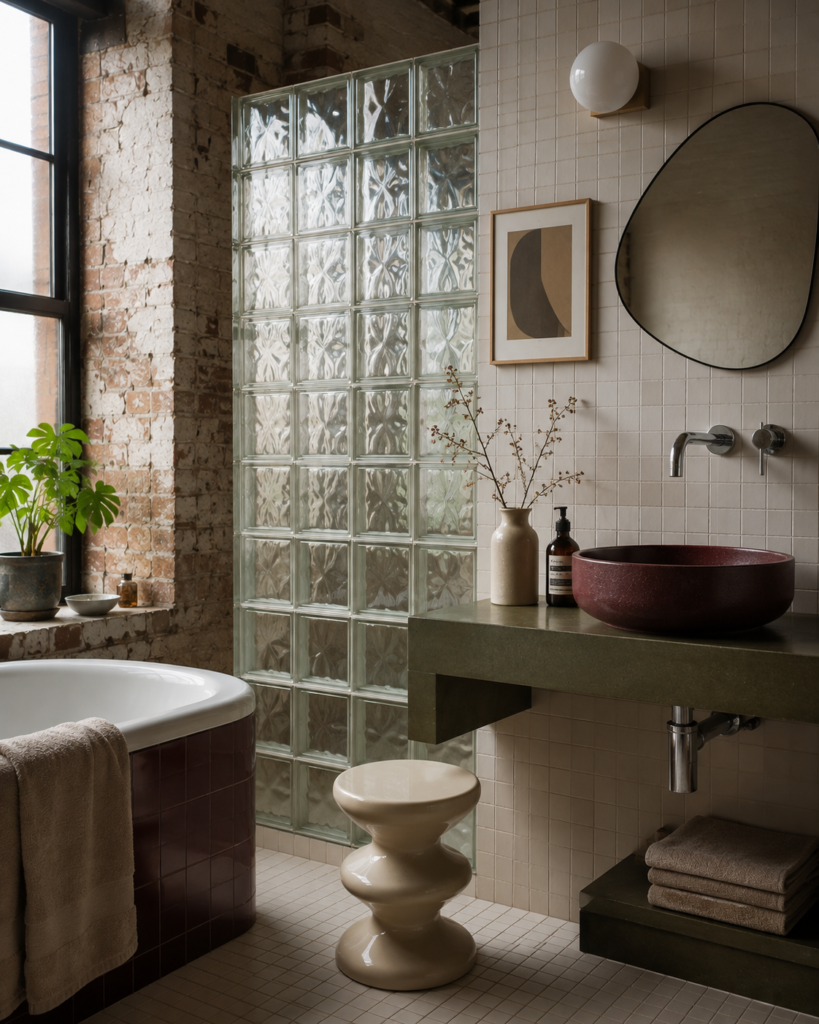
The Bathroom Is Where You Can Get Away With More
Bathrooms are small enough that experimentation feels less intimidating.
Coloured tiles.
A strange mirror.
A chunky basin.
Chrome.
Terrazzo.
Graphic flooring.
A single saturated wall.
Even glass block—one of those materials that spent decades being considered hopelessly dated—can suddenly feel interesting again in the right context.
The danger is crossing from postmodern into novelty.
If the toilet, basin, mirror, tiles and taps are all screaming for attention simultaneously, nobody wins.
Choose the moment.
Let everything else support it.
It Doesn’t Need to Look Like 1987
This is important.
Postmodern Loft isn’t about recreating a period interior.
You don’t need Memphis-patterned laminate covering every surface or a collection of furniture that looks as though it escaped from an Italian design exhibition.
Contemporary postmodern interiors tend to borrow ideas rather than recreate entire rooms.
Playfulness.
Unexpected colour.
Sculptural form.
Historical references.
Unusual materials.
A willingness to let something be slightly strange.
Combine those with contemporary furniture and genuine industrial architecture and the result can feel remarkably current.
Why Postmodern Design Suddenly Feels Relevant Again
Interior design moves in cycles.
After years dominated by minimalism, neutral palettes and highly coordinated spaces, it’s perhaps inevitable that people begin wanting something with more personality.
We’re seeing colour return.
Chrome and stainless steel are appearing again.
Furniture is becoming more sculptural.
1980s and 1990s references are being reconsidered.
Objects don’t necessarily need to be timeless anymore.
Sometimes they can simply be interesting.
Postmodernism offers permission to make choices because they’re enjoyable rather than because they’re universally tasteful.
That can be surprisingly liberating.
How to Try It Without Turning Your House Into an Art Gallery
You don’t need a converted warehouse.
And you certainly don’t need to replace everything you own.
Start with one thing that’s slightly outside your normal comfort zone.
A strange lamp.
A sculptural chair.
An oversized artwork.
A vivid side table.
A geometric rug.
Then give it space.
Postmodern design becomes much easier to live with when unusual objects aren’t competing with dozens of other unusual objects.
Keep some ordinary things.
Let your sofa just be a sofa.
Let the walls remain relatively quiet.
Then allow one or two pieces to behave badly.
That’s often enough.
A Home Is Allowed to Have a Sense of Humour
Perhaps that’s what makes Postmodern Loft particularly appealing right now.
It doesn’t reject good materials or beautiful architecture.
It simply rejects the idea that good design must always be serious.
A room can be elegant and strange.
Sophisticated and colourful.
Historic and futuristic.
Expensive and slightly ridiculous.
The loft provides space.
Postmodernism provides permission.
And somewhere between the concrete floor, the enormous old window and that completely unnecessary bright-red chair, the room begins to feel like it actually belongs to somebody.
Not a trend.
Not a showroom.
A person.
And perhaps that’s something interiors could use a little more of.
Britt & Tyler
We’re Britt and Tyler, the two Australians behind Cocktails & Cathedrals. We’re drawn to old buildings, beautiful rooms, bookshops and places that seem to hold a story. Our journal brings those interests together, with a fondness for slow afternoons and a well-made cocktail. We hope it helps you find places you’ll want to linger.
Travel slowly. Stay beautifully.
A little more about us →