Gothic Romance Interior Design: When Gothic Gets a Little Softer
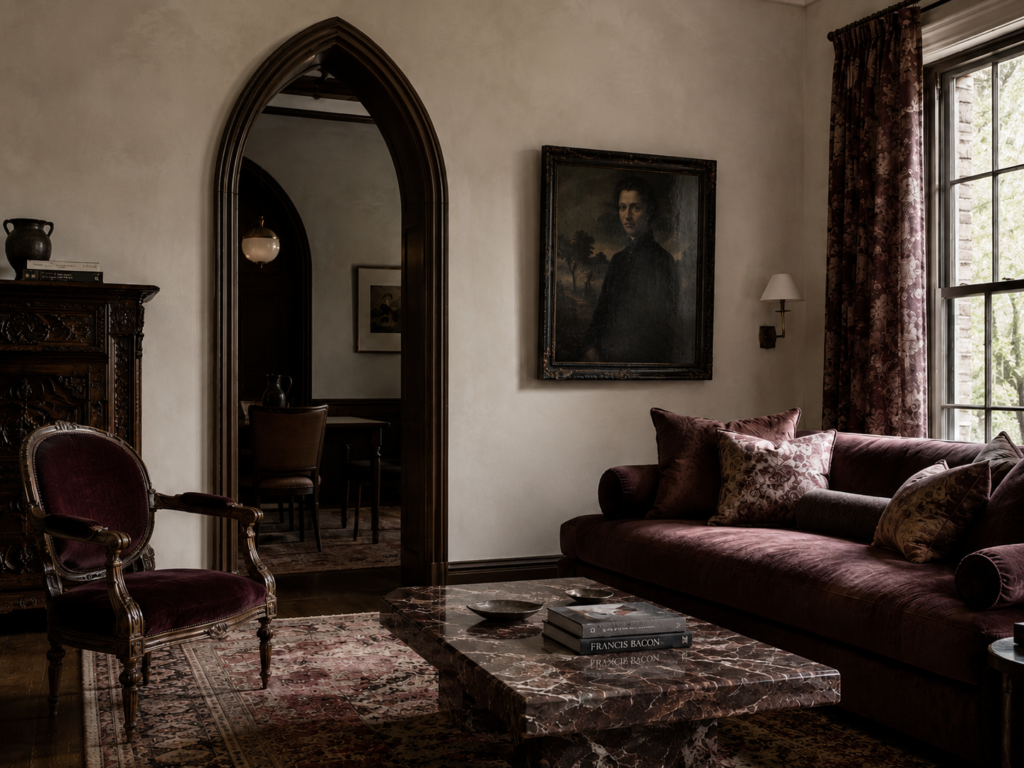
There is a version of Gothic interior design that seems to exist almost entirely on the internet.
Everything is black. There are ravens. There are skulls. There is usually an alarming quantity of velvet. And somewhere, almost inevitably, there is a four-poster bed that looks as though Dracula has recently checked out.
Gothic Romance is much more interesting than that.
This is Gothic architecture after somebody has brought flowers into the room.
It is dark timber beside faded pink. Pointed arches softened by curtains. Burgundy velvet sitting against old plaster. A slightly ridiculous antique mirror above a beautifully simple stone basin.
There can still be drama.
Actually, there should be drama.
But Gothic Romance is less interested in making a room look frightening than making it feel mysterious, intimate and just a little bit decadent.
And when it is done well, it can be surprisingly beautiful.
So, What Exactly Is Gothic Romance Interior Design?
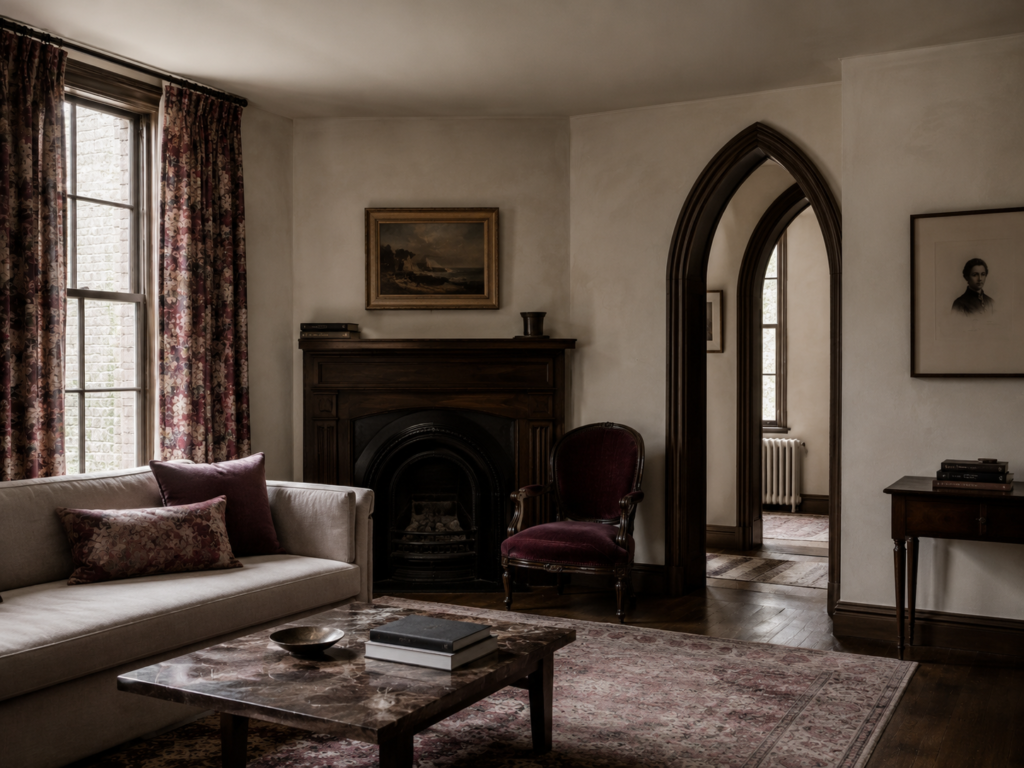
Gothic Romance sits somewhere between traditional Gothic architecture, Victorian interiors and the softer side of Romanticism.
The Gothic part gives us the structure.
Pointed arches. Carved timber. Leaded glass. Stone. Dark colours. Architectural detail. Furniture with a little weight to it.
The romance comes from everything we put around those things.
Faded florals. Soft upholstery. Pattern. Old paintings. Linen curtains. Dusty colour. Objects that look collected rather than ordered in one terrifyingly efficient afternoon.
It is the difference between a medieval chapel and an old country house that happens to contain a medieval chapel.
One feels monumental.
The other feels like somebody might actually live there.
That distinction matters.
Because the best Gothic Romance interiors never feel like sets.
They feel as though they have slowly become beautiful.
Gothic Romance Does Not Have to Be Black
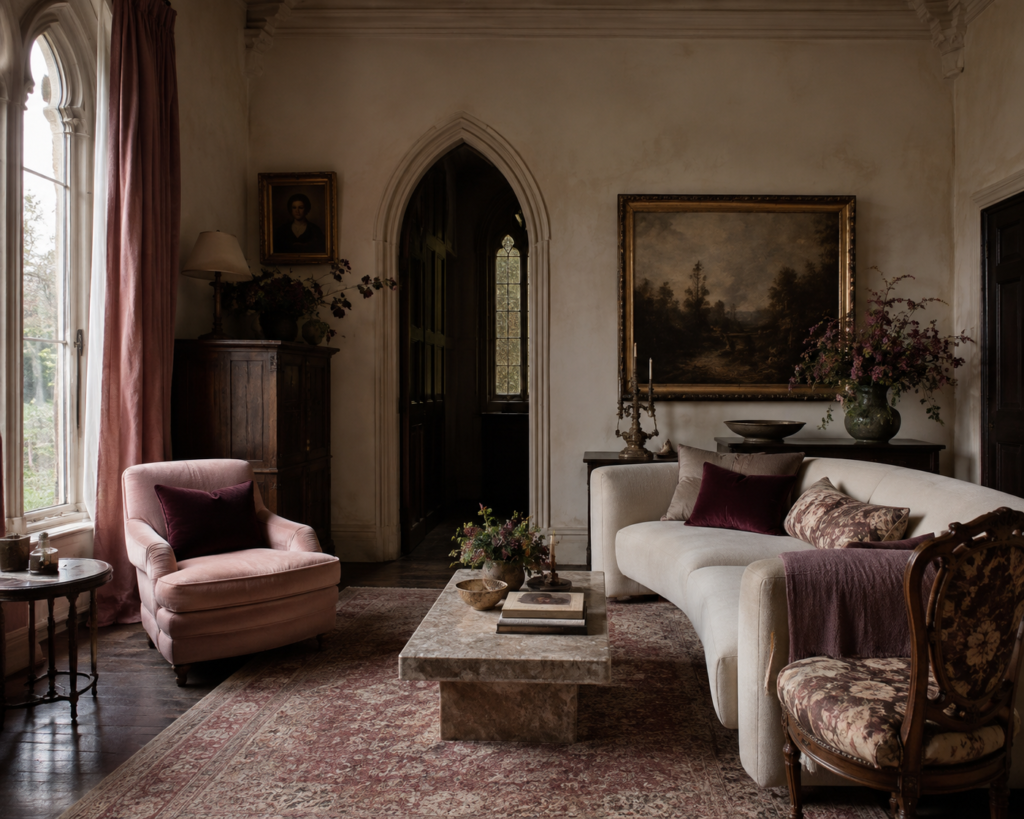
This is probably the first rule worth breaking.
A Gothic Romance room can contain black, obviously.
But covering every surface with it is usually the fastest way to make the style feel theatrical rather than romantic.
The more interesting colours are often slightly softened ones.
Think oxblood rather than bright red.
Aubergine rather than purple.
Dusty rose rather than pink.
Moss rather than emerald.
Mushroom rather than white.
Burgundy, tobacco, faded blue, dirty cream, plum, olive and old plaster all work beautifully.
Even pale rooms can feel Gothic.
A warm chalky plaster wall beside dark walnut furniture and an antique burgundy chair can have far more atmosphere than a room painted entirely black.
Gothic Romance is really about contrast.
Dark and pale.
Hard and soft.
Ancient and comfortable.
Beautiful and ever so slightly unsettling.
The Architecture Should Do Some of the Work
You absolutely do not need to live in a Victorian manor house.
Although admittedly that would help.
The trick is choosing one or two architectural ideas rather than attempting to turn a suburban house into Notre-Dame.
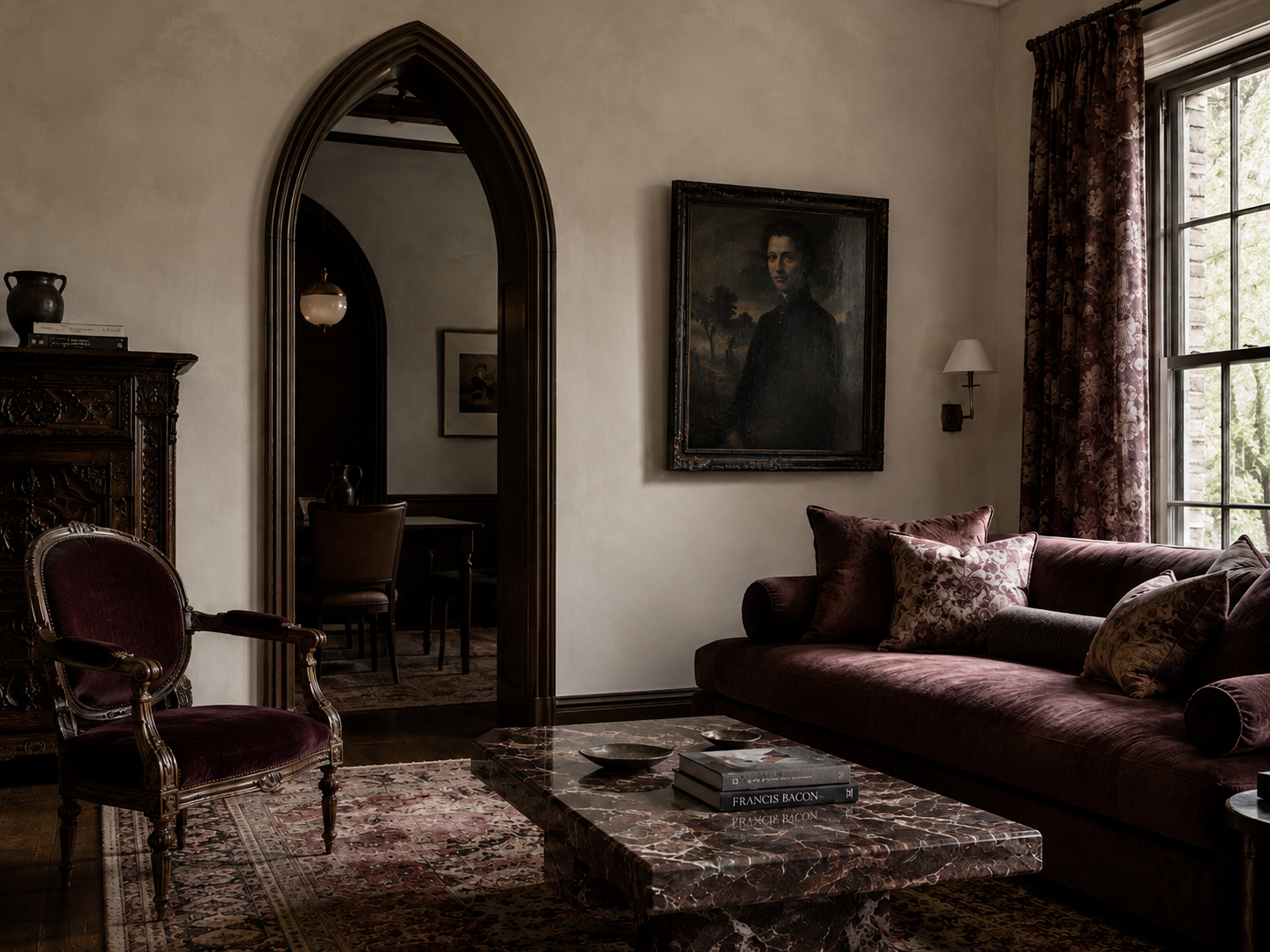
An arched doorway can be enough.
So can a tall narrow mirror that echoes the shape of a Gothic window.
Timber panelling, decorative mouldings, old floorboards, stone, textured plaster and leaded or textured glass all introduce the right architectural language without becoming costume.
This is also where restraint becomes surprisingly important.
If you have an arched doorway, you probably do not also need Gothic arches carved into the sofa, painted onto the wall and repeated across twelve decorative objects.
Let the architecture have its moment.
Then make the rest of the room comfortable.
Florals Change Everything
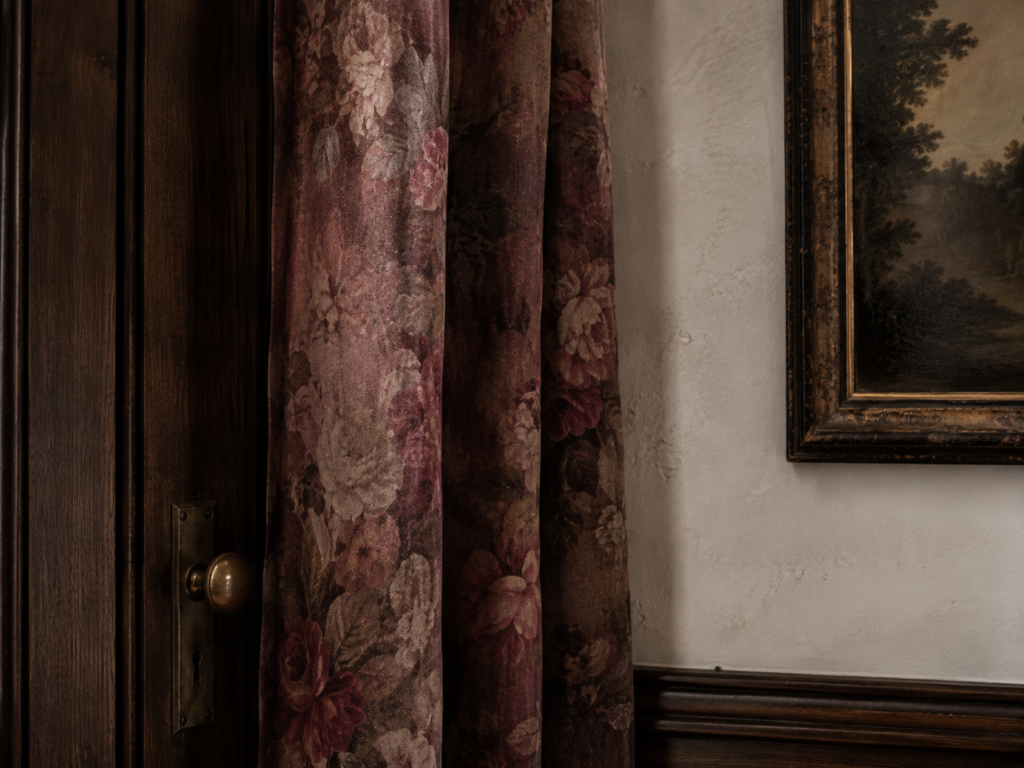
This might be the thing that separates Gothic Romance most clearly from Modern Gothic.
Flowers.
Not necessarily fresh flowers sitting obediently in a vase.
Patterned flowers.
Faded roses on an old armchair.
A slightly moody floral wallpaper.
A tapestry.
A painted botanical screen.
An old still-life.
Perhaps curtains with an enormous traditional floral print that would look faintly absurd in a minimalist room and completely wonderful here.
The floral element introduces softness without making the room sweet.
And the best patterns are rarely pristine.
Look for colours that seem slightly faded, browned or muted.
A floral containing dusty pink, burgundy, tobacco, olive and cream is infinitely more interesting here than something crisp and cheerful.
It should feel closer to an old oil painting than a spring catalogue.
Old Furniture Helps — But Matching Sets Do Not
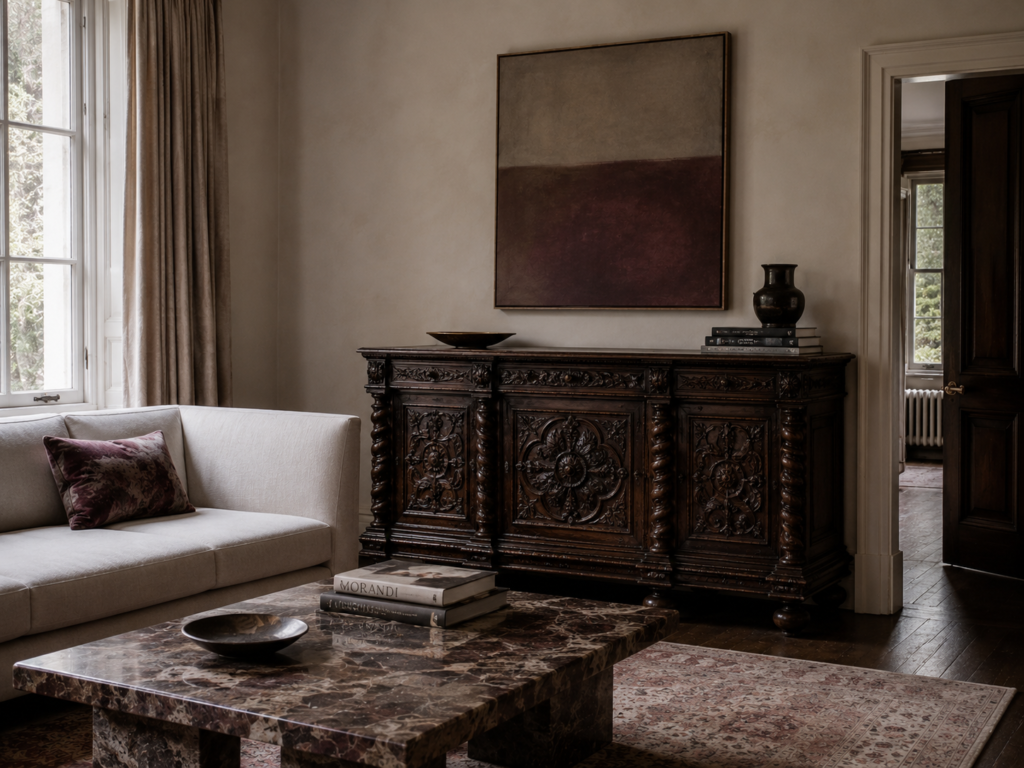
Gothic Romance loves furniture with history.
A carved timber cabinet.
An old writing desk.
A slightly battered side table.
A wonderfully dramatic headboard.
A Victorian chair upholstered in something unexpected.
But buying an entire matching suite of reproduction Gothic furniture is almost always too much.
Rooms need tension.
Pair the antique cabinet with a very simple contemporary sofa.
Put a modern stone table beside the elaborate armchair.
Hang an enormous contemporary artwork above an old fireplace.
The contrast stops the room becoming historical recreation.
It also makes the old things look better.
A heavily carved piece of furniture surrounded by equally ornate furniture simply disappears into the noise.
Give it something quieter to argue with.
Romantic Gothic Bedrooms Are Almost Too Easy
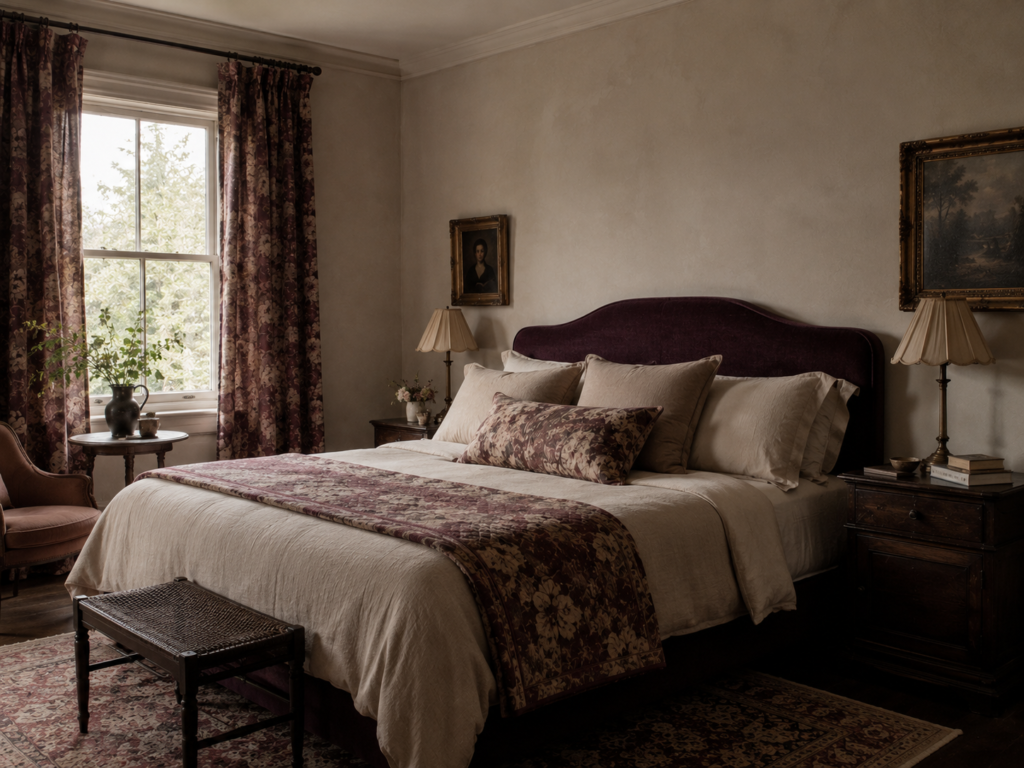
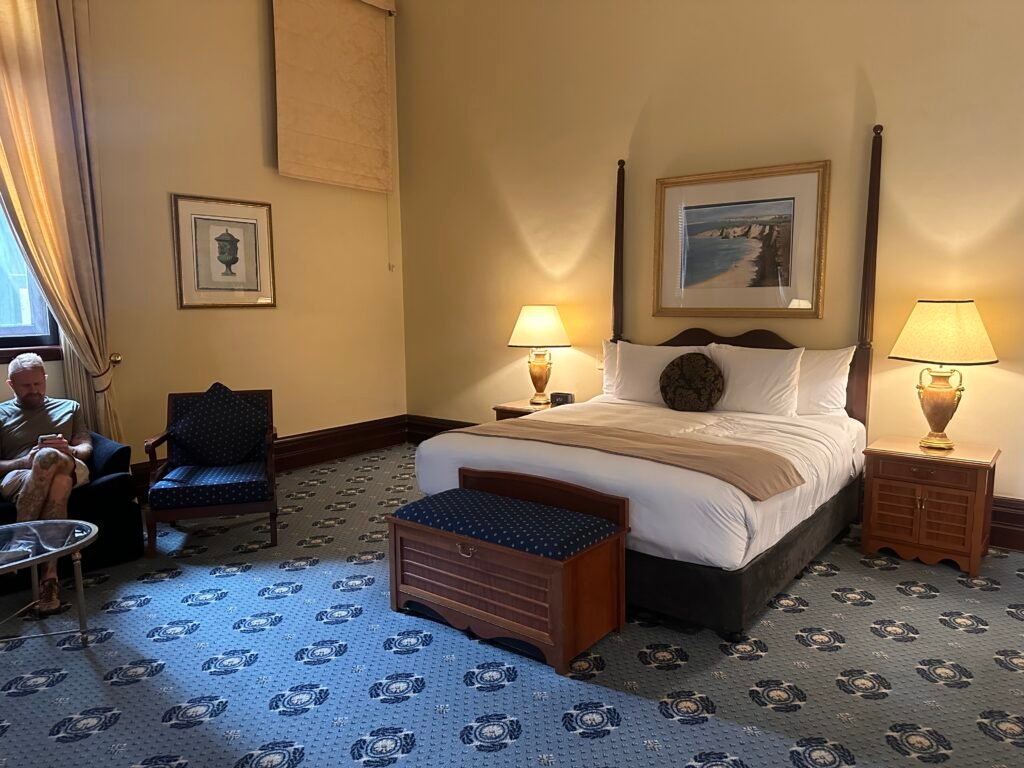
If there is one room that seems naturally suited to Gothic Romance, it is the bedroom.
Bedrooms already want softness, privacy and mood.
You are halfway there.
Start with a strong bed.
It could be dark timber, upholstered in burgundy or plum, or perhaps have a simple canopy rather than a heavily carved frame.
Then soften it.
Rumpled linen.
A patterned coverlet.
A faded rug.
Curtains that reach the floor.
An antique bedside table that does not quite match the one on the other side.
The palette does not need to be relentlessly dark either.
Mushroom plaster with an aubergine bedhead can be extraordinary.
So can warm cream walls with oxblood curtains and dark walnut furniture.
Perhaps the most important thing is avoiding the temptation to make every object Gothic.
You do not need a raven statue on the bedside table.
The architecture, palette and materials are perfectly capable of explaining themselves.
We dig deeper into what really makes the gothic bedroom vibe in our sister article on Romantic Gothic Bedrooms. It may surprise you…
Lighting Should Feel Like Atmosphere, Not Theatre
Gothic interiors are often depicted almost completely in darkness.
Which is dramatic.
It is also slightly inconvenient if you would like to find your shoes.
Gothic Romance works beautifully with low, warm light, but there should be layers.
Wall lights.
A shaded table lamp.
Perhaps a beautiful pendant.
Soft indirect lighting around architectural details.
Daylight matters too.
A pale room with sheer curtains and dark timber furniture can feel incredibly romantic in the afternoon.
In fact, sunlight hitting faded wallpaper or worn wood often creates more atmosphere than artificially making the room dark.
The objective is shadow.
Not blindness.
The Living Room Should Feel Collected
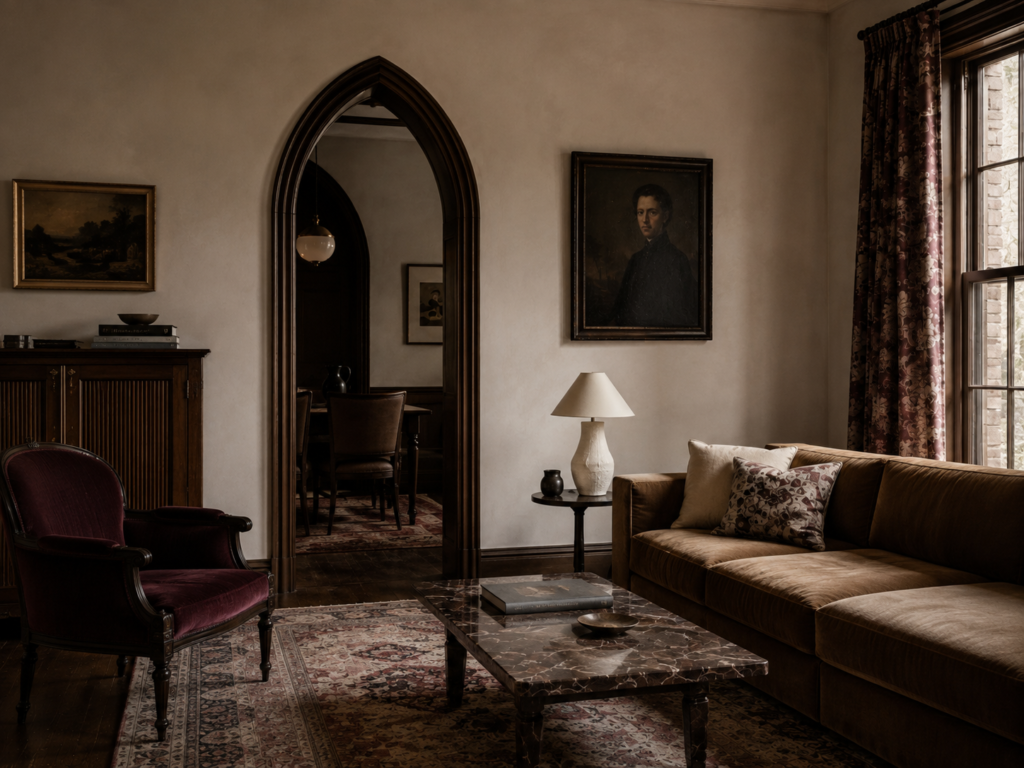
This is where Gothic Romance can become genuinely sophisticated.
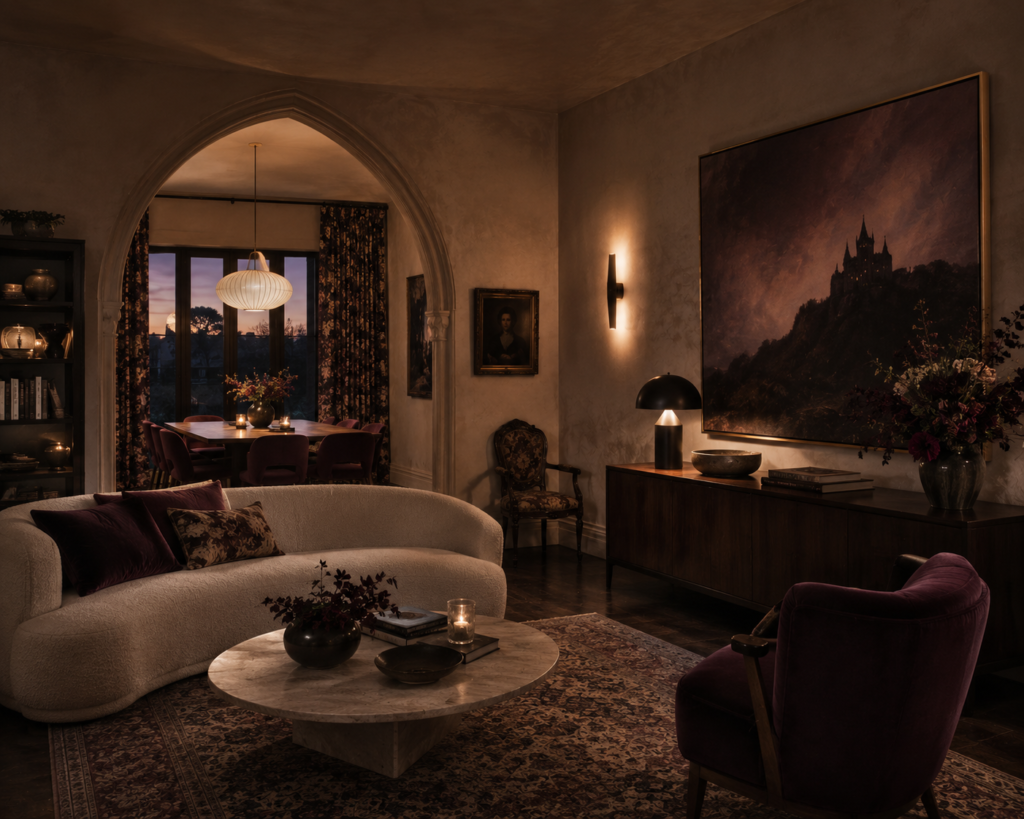
Imagine a fairly restrained living room.
Warm plaster walls.
Dark timber floors.
A modern sofa in tobacco or mushroom.
Then begin introducing the strange things.
A huge antique portrait.
A carved cabinet.
An oxblood velvet chair.
A faded Persian rug.
A marble or stone table.
Perhaps an enormous patterned curtain disappearing from ceiling to floor.
Nothing needs to match perfectly.
Actually, it probably should not.
Some of the most beautiful interiors look as though their owners have been acquiring things for decades and have never once worried about whether they all belong to the same “style”.
That is exactly the feeling Gothic Romance needs.
Kitchens Are Better When Gothic Is Just an Accent
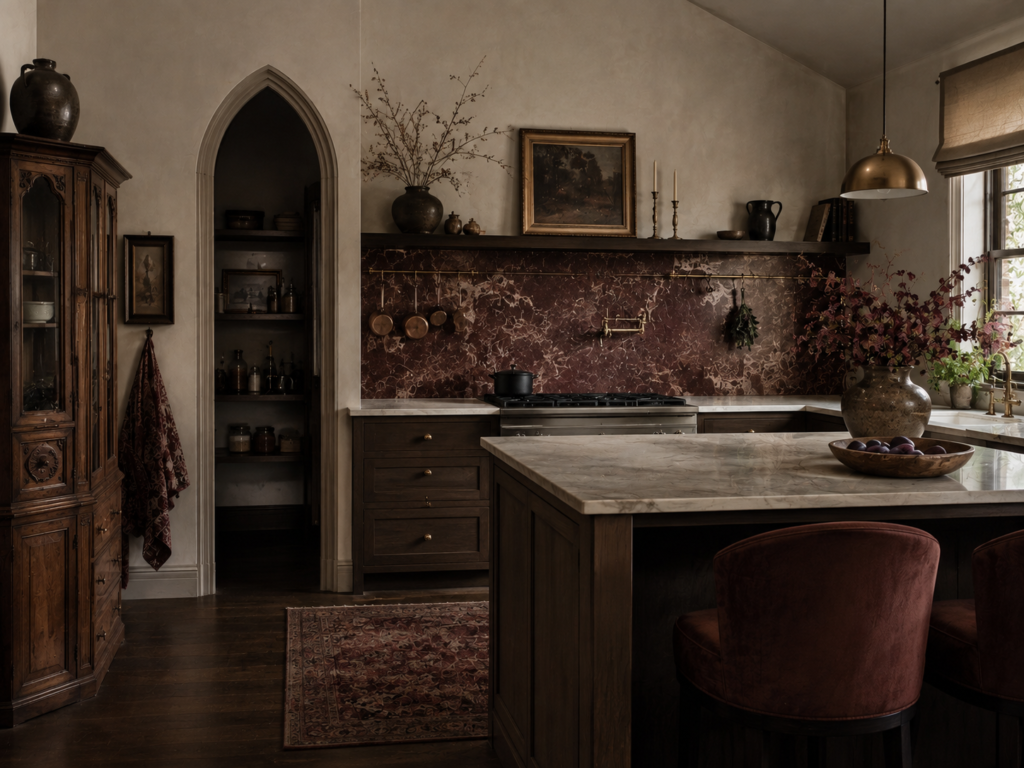
A fully themed Gothic kitchen could become exhausting remarkably quickly.
The better approach is borrowing the materials and proportions.
Dark oak or walnut cabinetry.
Natural stone.
Aged metal hardware.
A traditional range or beautifully simple modern appliances.
Perhaps an arched pantry opening.
Maybe a burgundy stone splashback.
Perhaps one extraordinary antique cupboard standing beside extremely restrained cabinetry.
This gives you the mood without sacrificing the fact that kitchens need to function.
And there is something wonderfully Gothic about a kitchen that looks mostly contemporary until you notice the enormous dark timber cabinet looming quietly in the corner.
Bathrooms Might Be Even Better
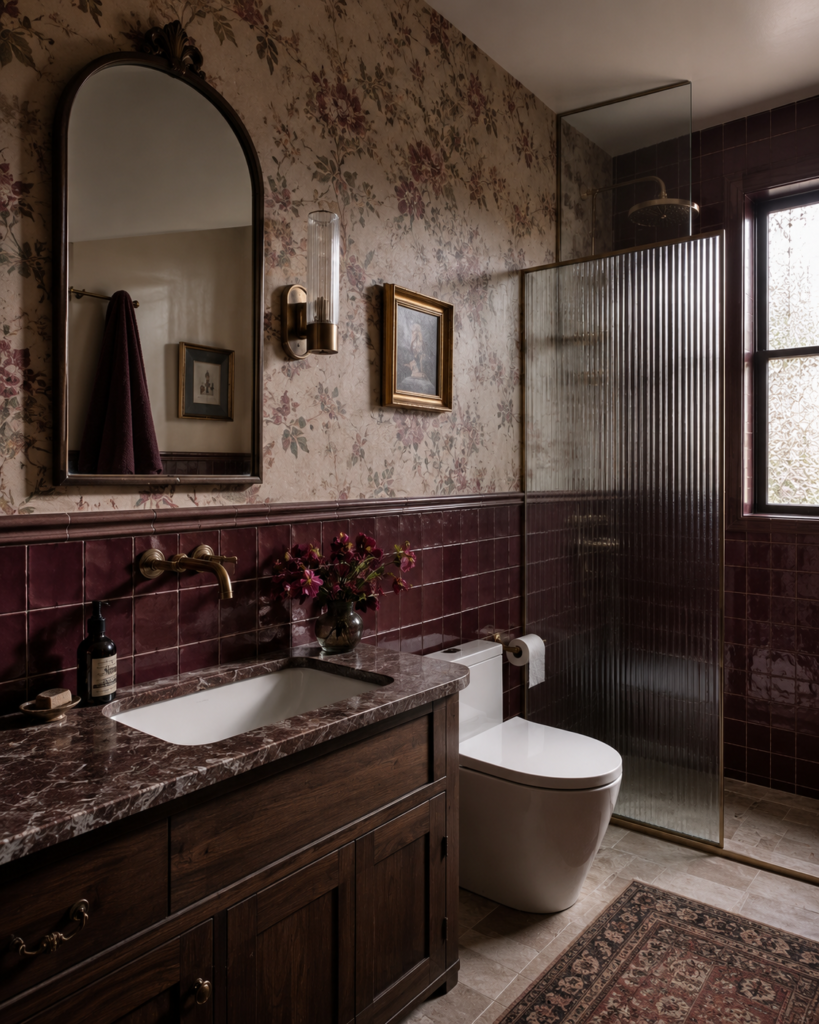
Bathrooms can take Gothic Romance surprisingly well because stone, metal, glass and dramatic colour already belong there.
Imagine plum or oxblood tile.
A stone vanity.
An elongated arched mirror.
Aged brass or blackened metal.
Textured glass.
Perhaps wallpaper above the tiled section if ventilation allows it.
Then stop.
The danger is always adding one thing too many.
You do not need a claw-foot bath, Gothic wallpaper, black marble, elaborate sconces, carved cabinetry and a stained-glass window simultaneously.
Choose the hero.
Let everything else support it.
Art Is Where Gothic Romance Gets Personal
This style absolutely loves art.
Old portraits are an obvious choice, particularly when they are slightly severe.
Landscapes can be even better.
Stormy skies.
Ruins.
Forests.
Botanical paintings.
Still lifes.
Religious paintings can work beautifully when appropriate to the house and the person living there.
But Gothic Romance does not need exclusively historical artwork.
Contemporary art can create one of the best contrasts in the entire style.
A huge abstract canvas above antique furniture immediately tells you that this is a contemporary home interested in history rather than trapped inside it.
Photography can do the same thing.
Especially something architectural, slightly surreal or beautifully gloomy.
You Need Something Slightly Wrong
This is probably my favourite part.
Perfect rooms are forgettable.
Gothic Romance needs an object that feels just slightly too strange.
An enormous portrait.
A lamp that is far too big.
A peculiar marble table.
A tiny antique chair upholstered in violently coloured fabric.
A sculpture you cannot quite explain.
A ridiculous curtain.
Something should interrupt the prettiness.
Because Gothic Romance has never really been about prettiness.
It is about beauty with tension.
Romance with darkness lurking somewhere behind it.
Remove that tension and you simply have a traditional room painted burgundy.
Gothic Romance Is Not the Same as Dark Academia
The two absolutely overlap.
Both like old books, timber, historical architecture and atmosphere.
But Dark Academia usually feels intellectual.
Libraries. Studies. Universities. Leather chairs. Desks. Books everywhere.
Gothic Romance is more sensual.
Textiles matter more.
Colour matters more.
Bedrooms suddenly become very important.
So do flowers, drapery, paintings and slightly decadent furniture.
Dark Academia asks whether you have finished reading that nineteenth-century philosophy book.
Gothic Romance wants to know why you disappeared into the garden at midnight wearing a silk dressing gown.
Different energy entirely.
It Is Also Not Quite Modern Gothic
Modern Gothic tends to simplify.
The arch remains, but the ornament disappears.
The colours become more restrained.
Furniture becomes sculptural and contemporary.
Gothic Romance moves in the opposite direction.
It allows some pattern back in.
Some softness.
Some clutter.
Some history.
Maybe even a little excess.
You could think of Modern Gothic as the architecture edited down to its bones.
Gothic Romance puts the curtains back up.
How to Bring Gothic Romance Into a Normal Home
You do not need a turret.
Start with colour.
A burgundy chair against mushroom walls.
A plum bedroom.
A deep olive dining room.
Then introduce one historic shape.
An arched mirror.
A carved cabinet.
An old picture frame.
After that, add softness.
Patterned curtains.
A faded rug.
Linen bedding.
An upholstered chair.
Then introduce something genuinely old if you can.
This style benefits enormously from furniture that has already had a life.
Facebook Marketplace, antique centres and auctions are probably more useful here than expensive interiors stores.
And finally, add one thing that makes absolutely no sense.
That may be the most important part.
Why Does Gothic Romance Feel So Relevant Again?
Perhaps because interiors have been very sensible for quite a while.
Neutral palettes.
Clean lines.
Carefully curated shelves.
Rooms in which every cushion seems to understand its responsibilities.
Gothic Romance is considerably less well behaved.
It allows beauty to become emotional again.
It allows old things and new things to coexist without requiring them to match.
It gives us colour without demanding cheerfulness.
Pattern without cuteness.
Darkness without turning the house into a cave.
And perhaps most importantly, it gives rooms a sense of story.
Not the artificial kind created by scattering antiques around a new-build.
The slower kind.
The feeling that a house might change with the people living inside it.
That the chair could be reupholstered.
The walls could become darker.
A strange painting could appear because somebody fell in love with it.
Nothing is quite finished.
And somehow that makes the room more romantic.
Maybe Gothic Was Never Really About Darkness
Perhaps that is the misunderstanding.
The things we associate with Gothic interiors — shadows, stone, arches, dark timber, dramatic colour — are only the ingredients.
The real appeal is atmosphere.
Mystery.
History.
Imperfection.
The sense that there might be another room beyond the arch.
Gothic Romance simply adds softness to that story.
A faded flower.
A velvet chair.
A curtain moving beside an open window.
And suddenly Gothic stops feeling like something from the past.
It feels strangely alive.
Britt & Tyler
We’re Britt and Tyler, the two Australians behind Cocktails & Cathedrals. We’re drawn to old buildings, beautiful rooms, bookshops and places that seem to hold a story. Our journal brings those interests together, with a fondness for slow afternoons and a well-made cocktail. We hope it helps you find places you’ll want to linger.
Travel slowly. Stay beautifully.
A little more about us →