Quiet Luxury: The Interior Design Style That Doesn’t Need to Show Off
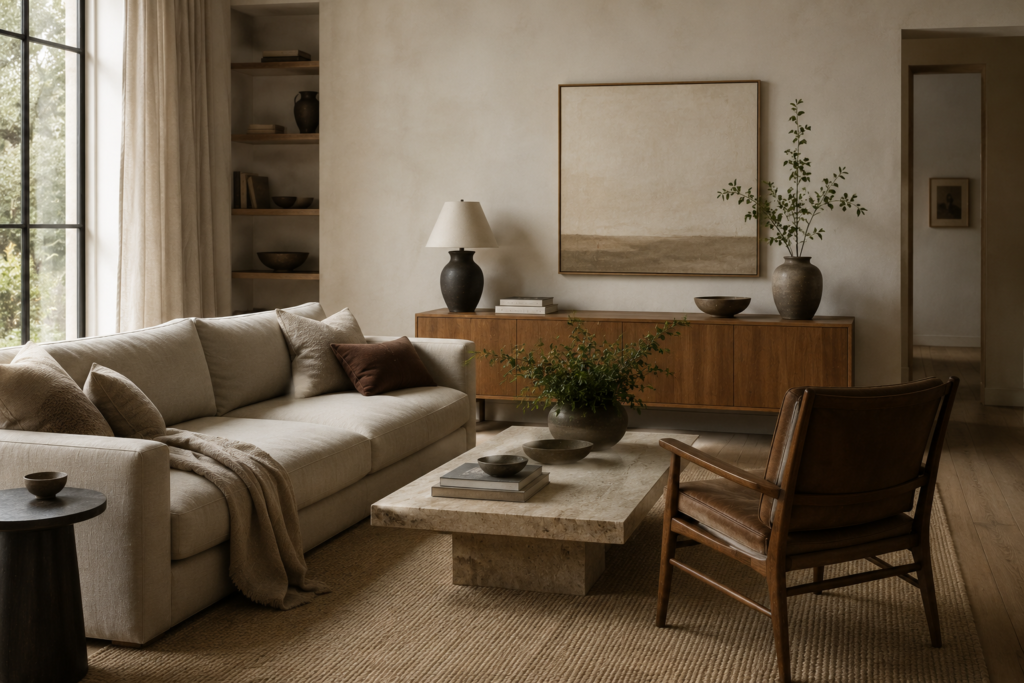
Some of the most expensive-looking rooms don’t look expensive at all.
There is no enormous chandelier announcing itself from the ceiling. No marble covering every available surface. No obvious designer furniture positioned carefully for recognition.
Sometimes there isn’t even much colour.
Instead, you notice the way a timber cabinet has been made. The weight of a linen curtain. The subtle variation in a limestone floor. The proportions of a doorway. The way afternoon light falls across a plaster wall.
Nothing immediately demands your attention.
And yet somehow, everything feels right.
This is Quiet Luxury.
The term has become increasingly familiar through fashion and interiors, but the idea behind it is much older than the trend itself.
At its best, Quiet Luxury isn’t really about making a home look wealthy.
It’s about making it feel considered.
What Is Quiet Luxury?
Quiet Luxury is an approach to interiors built around quality, restraint, natural materials and craftsmanship rather than obvious displays of expense.
It tends to favour beautiful timber, natural stone, linen, wool, plaster, leather and carefully made furniture.
Colours are often muted.
Decoration is restrained.
Furniture has room around it.
And rather than relying on instantly recognisable statement pieces, the quality tends to reveal itself slowly.
You might not immediately know why a Quiet Luxury room feels expensive.
That’s rather the point.
The details aren’t shouting for attention.
They’re waiting to be noticed.
Quiet Luxury Isn’t Just Beige
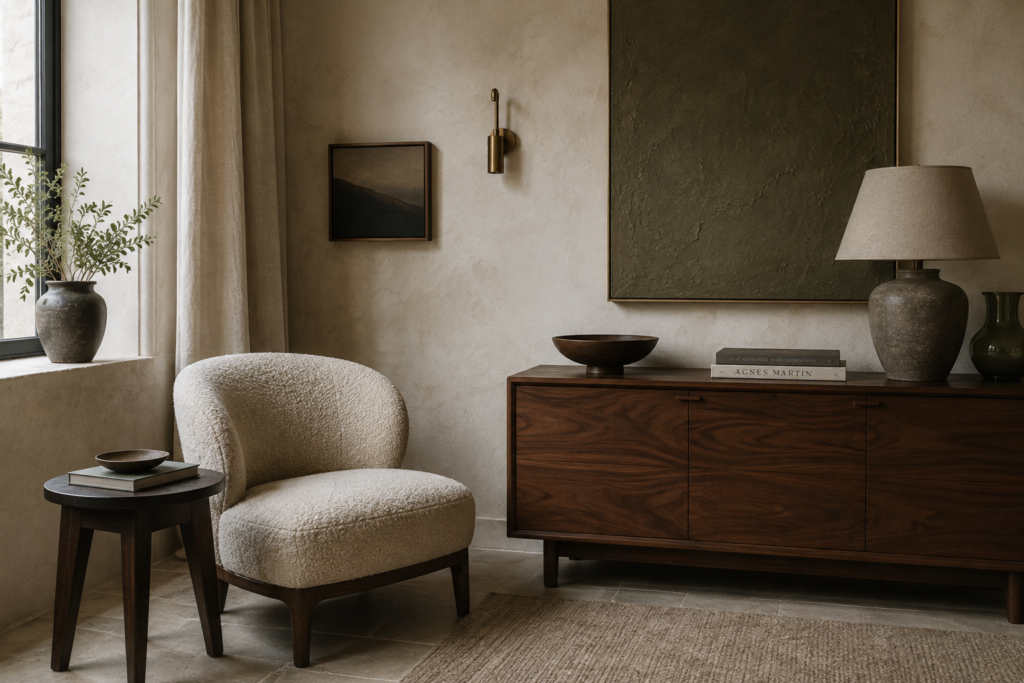
This is probably the biggest misconception surrounding the style.
Search for Quiet Luxury interiors and you will inevitably encounter an enormous amount of beige.
Beige sofas.
Beige rugs.
Beige walls.
Beige cushions arranged carefully on other slightly different beige cushions.
There is nothing inherently wrong with neutral interiors, but neutrality alone does not create Quiet Luxury.
A completely beige room filled with inexpensive synthetic materials is still a completely beige room filled with inexpensive synthetic materials.
What gives Quiet Luxury depth is material variation.
Warm oak against cool limestone.
Rough plaster beside smooth wool.
Heavy linen curtains against polished metal.
A leather chair slowly developing patina.
A handmade ceramic vessel sitting on beautifully figured timber.
Even when the colours are similar, the surfaces aren’t.
That’s what prevents restraint from becoming blandness.
The Luxury Is Often in the Architecture
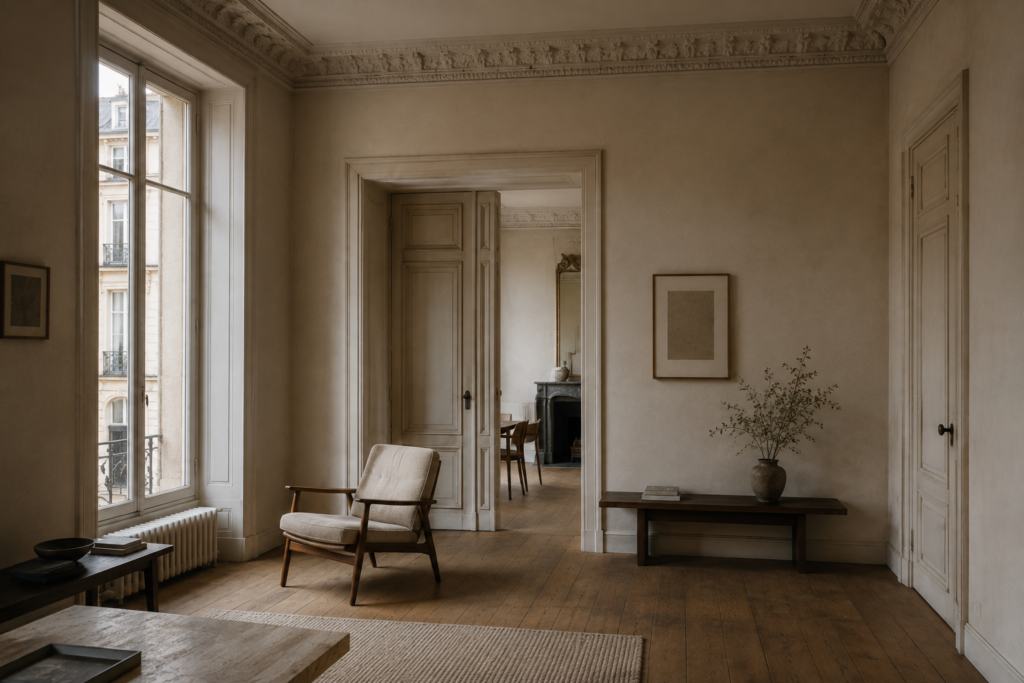
One of the most interesting things about Quiet Luxury is how little decoration a room actually needs when its architecture is good.
Proportion becomes enormously important.
So does natural light.
Doorways, ceiling heights, window placement, joinery and the relationship between rooms all contribute to the feeling.
A beautifully proportioned room with a limestone floor and three carefully chosen pieces of furniture can feel far more luxurious than a heavily decorated room filled with expensive objects.
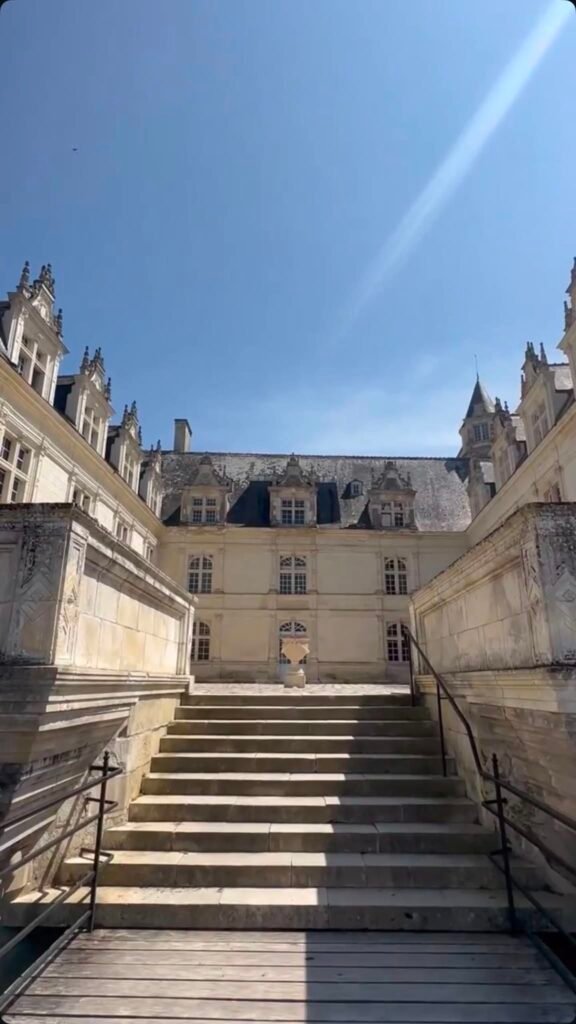
This is why Quiet Luxury often works particularly well in older European homes.
Tall windows, substantial walls, timber floors and beautifully proportioned rooms already provide much of what the interior needs.
But the same principles can be applied to contemporary architecture.
Good materials.
Good proportions.
Good light.
And fewer things competing for attention.
Materials Need to Feel Real
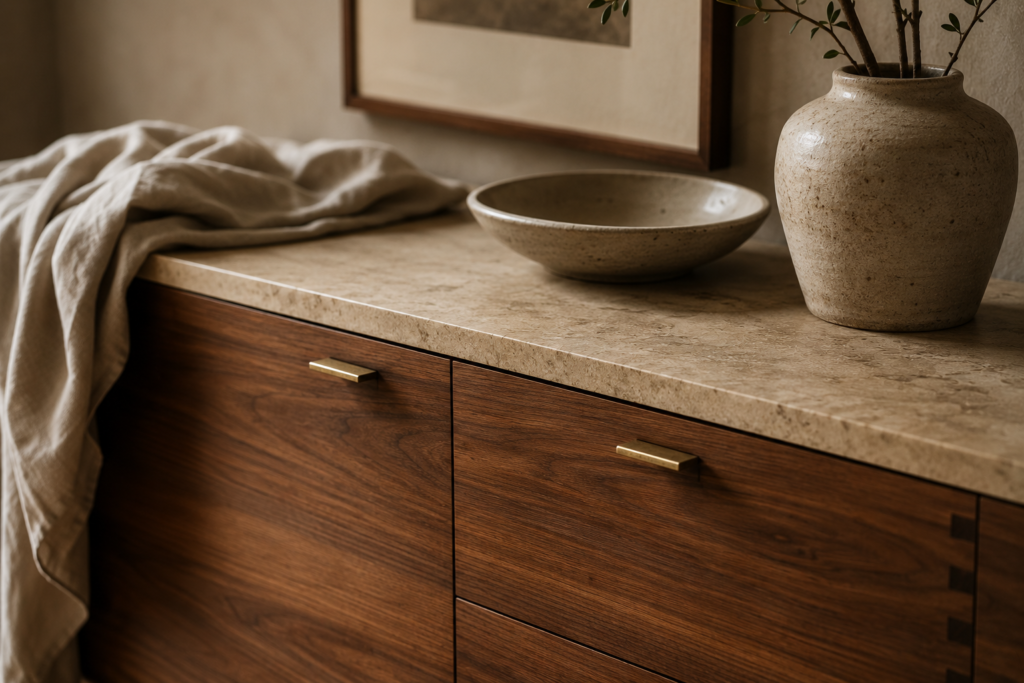
Quiet Luxury is not particularly forgiving of imitation.
Plastic pretending to be timber.
Printed stone patterns.
Artificial marble.
Highly synthetic fabrics designed to resemble linen.
These things can work perfectly well in many interiors, but when decoration is restrained, materials become much more noticeable.
There is nowhere for them to hide.
Natural stone doesn’t need to be flawless.
In fact, the veins, fossils, tonal changes and imperfections are part of its appeal.
Timber should reveal its grain.
Linen can wrinkle.
Leather should change with use.
Plaster can have subtle movement.
Quiet Luxury often becomes more beautiful when its materials stop looking new.
Craftsmanship Over Branding
There is a peculiar contradiction at the heart of Quiet Luxury.
Some of its most beautiful interiors can be extremely expensive.
Yet they often avoid the visual signals we traditionally associate with wealth.
Instead of asking, Who designed that chair?, you might find yourself wondering, Who made that?
A handmade dining table.
Beautifully fitted timber cabinetry.
A stone basin carved from a single block.
A perfectly proportioned upholstered chair.
Custom brass hardware.
These details may be expensive, but their value comes from material and workmanship rather than recognition.
The object doesn’t need a logo.
The construction tells you enough.
Furniture Needs Room to Breathe
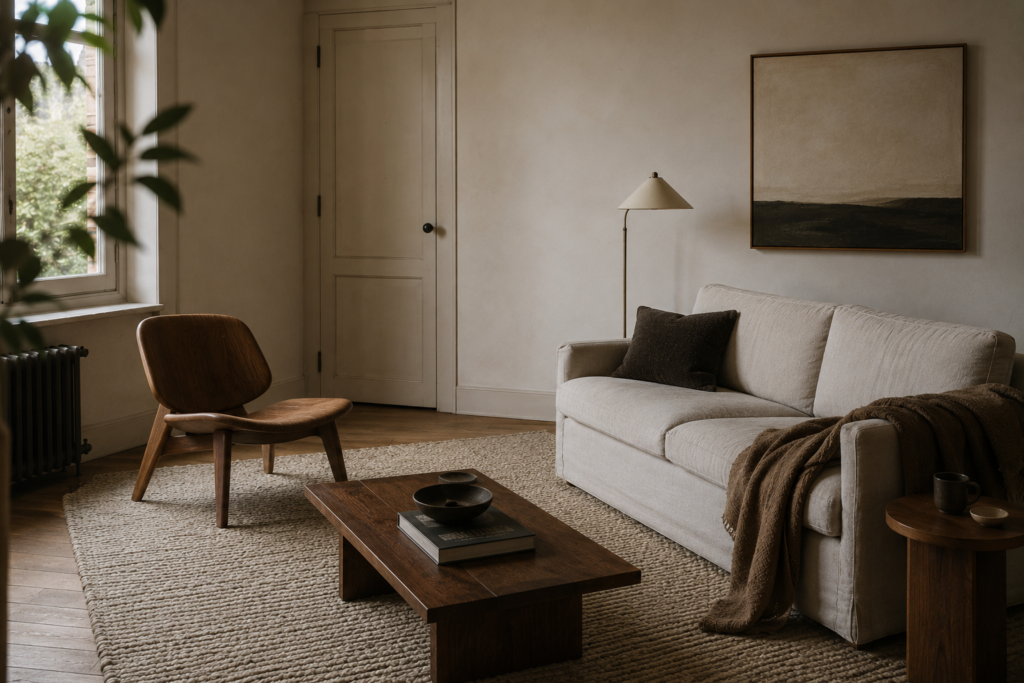
One of the easiest ways to make a room feel calmer is simply to put less in it.
Quiet Luxury interiors rarely benefit from every wall being occupied.
A chair can sit alone.
A console doesn’t necessarily need six objects arranged across it.
An empty corner can remain empty.
This creates visual breathing room and allows individual pieces to become more important.
It also means furniture needs to be chosen carefully.
When there are only a handful of pieces in a room, each one matters.
A beautifully shaped chair becomes almost sculptural.
A simple timber table can become the centre of the room.
A sofa doesn’t need elaborate detailing if its proportions and upholstery are right.
Restraint makes quality more visible.
The Colour Palette Is Quiet, Not Colourless
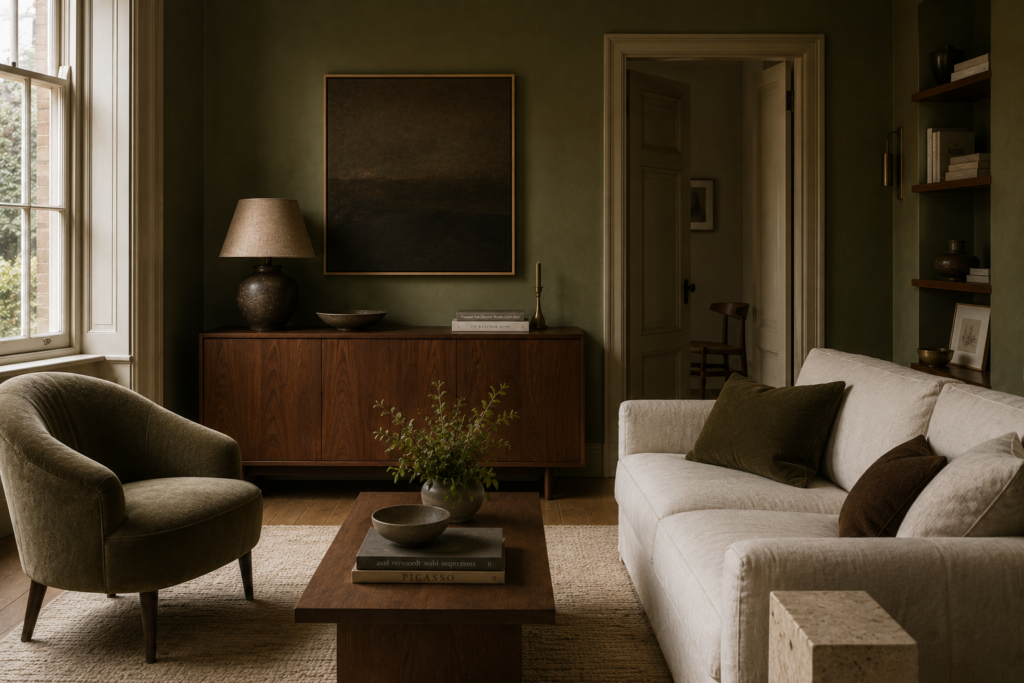
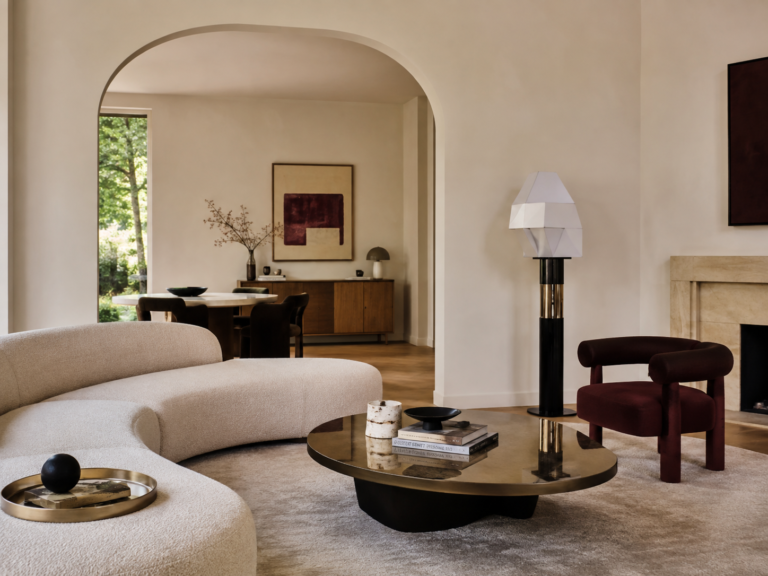
Cream, stone, oatmeal, warm white, taupe and brown naturally appear frequently in Quiet Luxury interiors.
But they aren’t compulsory.
Muted olive green can work beautifully.
So can tobacco, dusty blue, burgundy, ochre or deep chocolate.
Even black can be extremely effective when used sparingly.
The difference is usually saturation.
Quiet Luxury tends to avoid colours that feel overly sharp or artificial.
Instead, colours often appear as though they could have come from the materials themselves.
Stone.
Clay.
Wood.
Sand.
Leaves.
Leather.
Earth.
This creates rooms that feel connected rather than heavily colour-coordinated.
Texture Does the Work That Pattern Often Would
When colour and decoration are restrained, texture becomes incredibly important.
Bouclé has become strongly associated with this aesthetic, perhaps a little too strongly, but there are many other options.
Washed linen.
Heavy wool.
Mohair.
Raw silk.
Travertine.
Oak.
Walnut.
Limestone.
Handmade ceramics.
Woven rugs.
Plaster.
These materials interact with light differently throughout the day.
A perfectly flat white wall looks much the same from morning until evening.
A subtly textured plaster wall can change completely as shadows move across it.
Quiet Luxury is often less about what a room looks like in a photograph and more about what it feels like to occupy.
Lighting Should Almost Disappear
Lighting in a Quiet Luxury interior rarely needs to become the main event.
Rather than filling a ceiling with downlights, lighting can come from several quieter sources.
A simple table lamp beside a sofa.
A sculptural floor lamp.
Small wall sconces.
Concealed architectural lighting.
A restrained pendant above a dining table.
During the day, natural light should be allowed to do as much work as possible.
At night, the goal isn’t necessarily to make the room uniformly bright.
It’s to create pools of comfortable light where they’re needed.
The best lighting often becomes something you experience without consciously noticing.
Kitchens Are Where Quiet Luxury Makes Sense
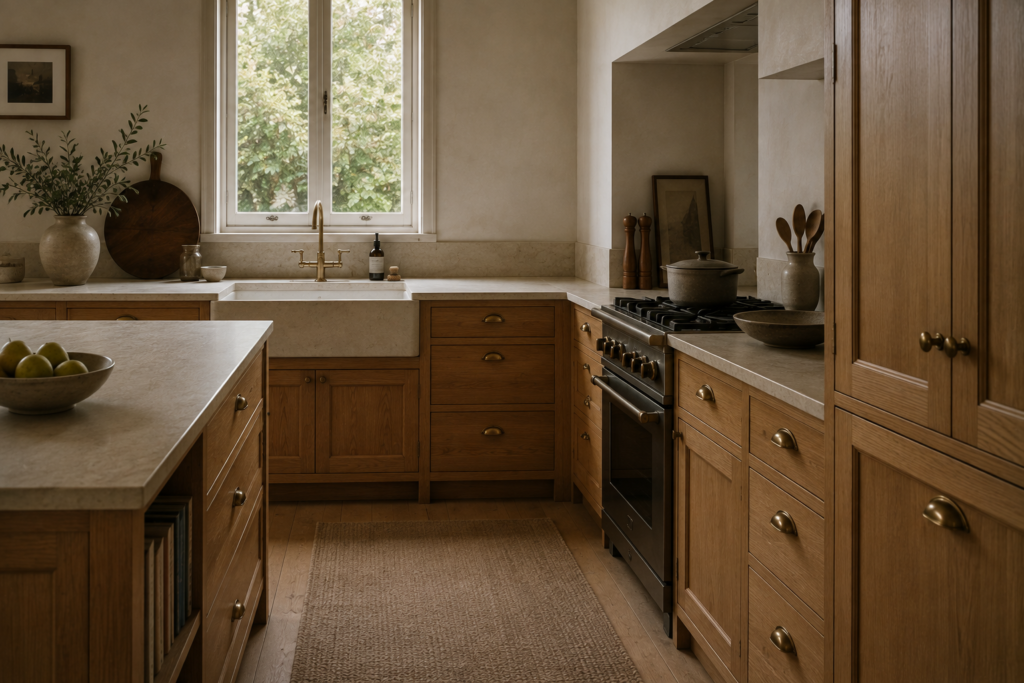
A kitchen is perhaps one of the best places to understand the difference between expensive and luxurious.
An expensive kitchen might announce itself immediately.
Bookmatched marble.
Highly polished surfaces.
Elaborate lighting.
Statement appliances.
A Quiet Luxury kitchen can be much less obvious.
Beautiful timber cabinetry.
A honed stone worktop.
Simple hardware.
A deep sink.
Good natural light.
Perhaps one open shelf displaying ceramics that are actually used.
The details become more important than spectacle.
Cabinet doors feel substantial.
Drawers close properly.
Stone feels good beneath your hand.
The room works beautifully.
That is luxury too.
Bedrooms Should Feel Almost Undecorated
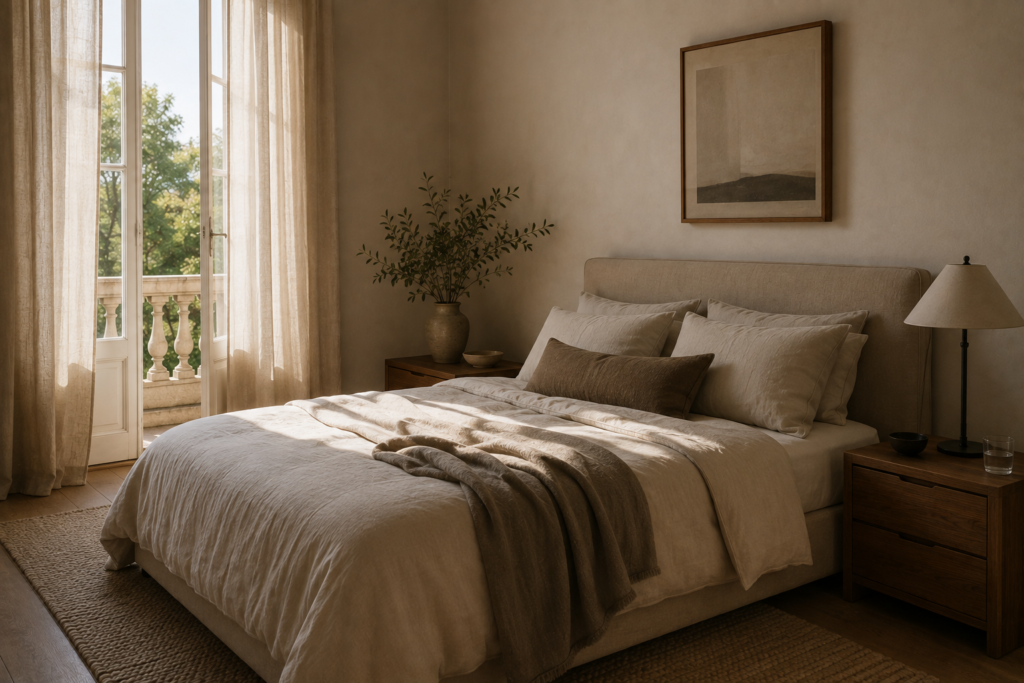
Quiet Luxury works particularly well in bedrooms because the style naturally encourages calm.
A good bed.
Beautiful linen.
Soft lighting.
A wool rug.
A timber bedside table.
Perhaps one piece of art.
That’s often enough.
The temptation is to continue adding until the room feels “finished.”
But Quiet Luxury frequently works better when you stop slightly earlier.
A bedroom doesn’t need to demonstrate every design idea in the house.
Sometimes luxury is simply waking up in beautiful sheets with sunlight coming through linen curtains.
Bathrooms Are About Materials, Not Size
A luxurious bathroom doesn’t necessarily need to be enormous.
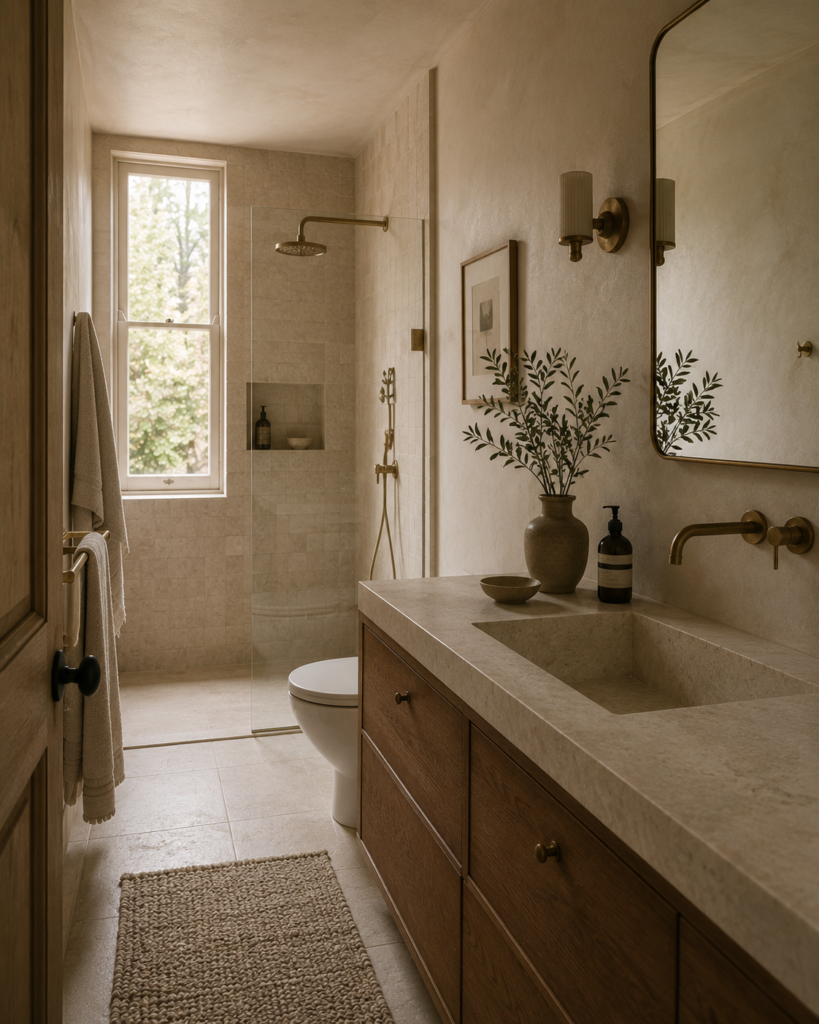
A relatively small room can feel exceptional when the materials are good.
Honed stone.
Handmade tiles.
A beautifully proportioned basin.
A substantial mirror.
Aged brass or polished nickel.
Soft towels.
Warm, flattering light.
The palette can remain extremely simple because water, stone, metal and fabric already provide plenty of contrast.
Again, the experience matters more than spectacle.
A tap that feels substantial in your hand may contribute more to the room than another decorative object ever could.
What Quiet Luxury Is Not
Quiet Luxury is not minimalism, although the two can overlap.
Minimalism often focuses on reduction itself.
Quiet Luxury is more comfortable with softness, history and imperfection.
Nor is it simply an expensive version of contemporary design.
You don’t need an unlimited budget to use its principles.
And it certainly isn’t about filling a room with objects designed to look expensive.
In fact, doing that usually achieves the opposite.
Quiet Luxury doesn’t need marble-patterned accessories, gold decoration or designer logos.
It needs things worth keeping.
How to Create Quiet Luxury Without Spending a Fortune
This is where the philosophy becomes surprisingly useful.
Instead of buying ten inexpensive decorative objects, buy one thing you genuinely love.
Choose natural materials where they make the greatest difference.
Spend money on things you touch every day.
Good sheets.
A comfortable chair.
A substantial dining table.
Quality handles.
A beautiful lamp.
Then allow inexpensive things to remain inexpensive.
A simple glass vase filled with branches can look perfectly at home on an expensive timber table.
Books don’t need to match.
Art doesn’t need to be famous.
A vintage chair can be more interesting than a new designer one.
Quiet Luxury isn’t necessarily about spending more.
Often it’s about buying less, but caring more about what you choose.
Let Things Age
Perhaps one of the most appealing aspects of genuine Quiet Luxury is that it doesn’t require a home to remain frozen in its finished state.
Timber changes colour.
Leather softens.
Linen wrinkles.
Brass dulls.
Stone develops marks.
A dining table records dinners.
A chair becomes associated with a particular corner of the house.
These things don’t necessarily diminish the interior.
They can make it better.
There is a difference between something being damaged and something showing evidence of life.
Quiet Luxury understands that distinction.
The Most Luxurious Thing Might Be Restraint
We live in a time when almost every interior style can be purchased instantly.
Entire rooms can be ordered.
Trends can be copied.
Objects can arrive tomorrow.
Quiet Luxury proposes something slower.
Choose carefully.
Wait for the right piece.
Repair something worth repairing.
Leave some space empty.
Use materials that become more beautiful with time.
Create rooms around the way you actually live rather than the way they might perform in a photograph.
The result may not immediately announce itself as luxurious.
Someone might walk into the room and not recognise a single brand.
They may not know what the stone cost.
They may not realise the curtains were made from linen or that the table was built by hand.
They might simply think:
This is a really beautiful room.
And perhaps that’s the quietest luxury of all.
Britt & Tyler
We’re Britt and Tyler, the two Australians behind Cocktails & Cathedrals. We’re drawn to old buildings, beautiful rooms, bookshops and places that seem to hold a story. Our journal brings those interests together, with a fondness for slow afternoons and a well-made cocktail. We hope it helps you find places you’ll want to linger.
Travel slowly. Stay beautifully.
A little more about us →