Industrial Romanticism: The Interior Design Style That Makes Raw Spaces Feel Beautiful
There is something undeniably beautiful about a room that was never designed to be beautiful.
An old warehouse with enormous steel-framed windows. A former workshop where the brick still carries the marks of a century of use. Rough plaster walls, exposed pipes, worn timber floors and ceilings high enough to make even substantial furniture feel small.
Industrial interiors have long celebrated these things.
But Industrial Romanticism does something slightly different.
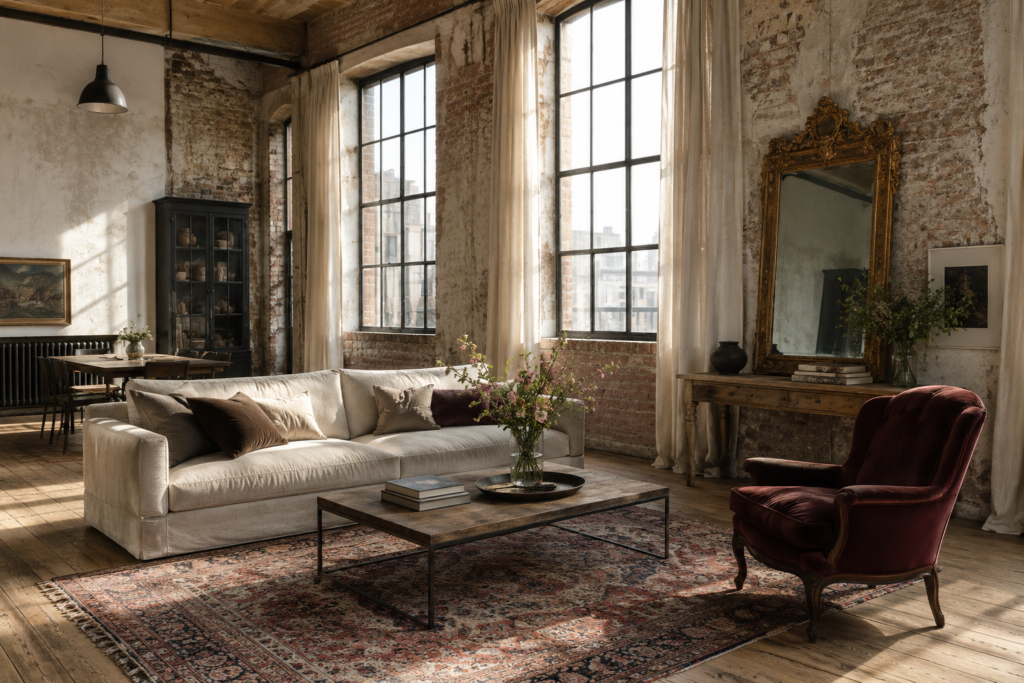
Instead of leaning further into the hardness of industrial architecture, it introduces softness, history and even a little decadence. Velvet sits against exposed brick. An antique gilt mirror hangs from unfinished plaster. Linen curtains fall from a blackened steel window. Candlelight reflects from aged brass while pipes and structural beams remain deliberately exposed.
The building is allowed to be rough.
Everything brought into it makes it feel human.
And that contrast is precisely what makes Industrial Romanticism so compelling.
What Is Industrial Romanticism?
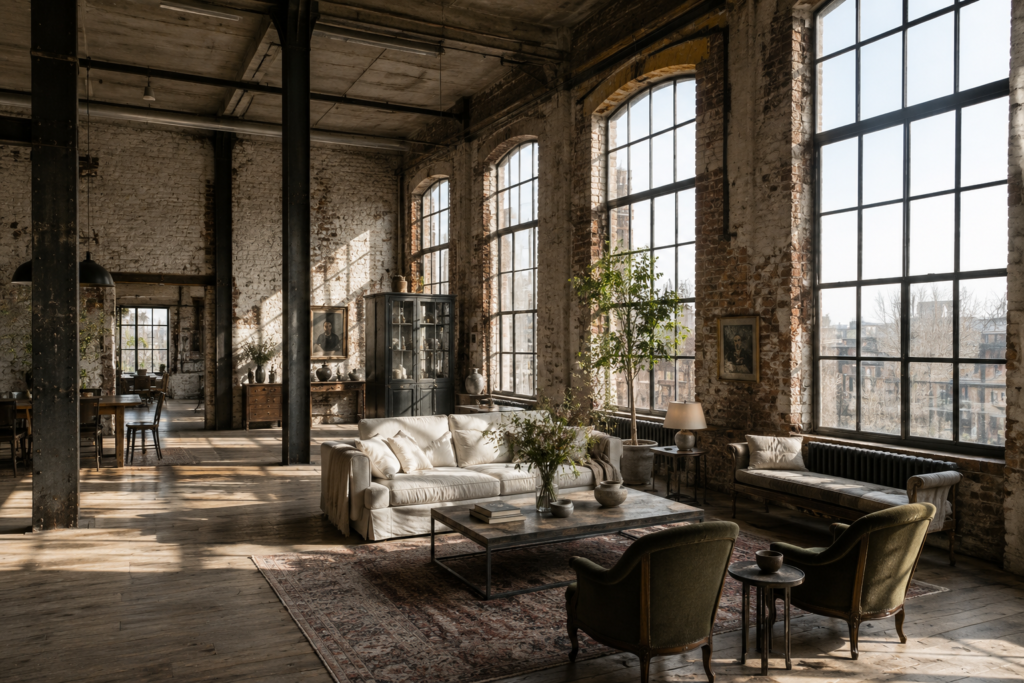
Industrial Romanticism is less a rigidly defined historical movement than a useful way of describing interiors that combine the rawness of industrial architecture with the atmosphere and emotional richness of romantic design.
Its industrial side comes from factories, warehouses, workshops and utilitarian buildings: exposed brick, steel, concrete, visible structure, large windows, worn timber and materials that were chosen originally for practicality rather than decoration.
The romantic side introduces something very different.
Soft textiles. Antique furniture. Moody colour. Flowers. Art. Curves. Patina. Candlelight. Objects collected because they are beautiful rather than useful.
Put the two together and neither side behaves quite as expected.
Industrial architecture stops feeling cold.
Romantic decoration stops feeling precious.
The result can feel like a Parisian apartment accidentally built inside an abandoned factory — or an old European workshop slowly transformed into a home without ever erasing what it once was.
It Begins With the Building
The best Industrial Romantic interiors often begin with architecture that already has a story to tell.
Exposed brickwork might be uneven or patched. Timber beams may carry old saw marks. Concrete might be cracked or discoloured. Steel columns remain visible rather than being boxed in. Old factory windows may be slightly imperfect.
These aren’t necessarily flaws to be corrected.
They are part of the room.
Industrial design has always understood the appeal of revealing how a building works. Instead of hiding structure behind plasterboard, it allows beams, pipes, ductwork and masonry to remain visible.
Industrial Romanticism keeps that honesty but changes the atmosphere around it.
A bare brick wall behind a black leather sofa feels industrial.
The same wall behind a faded velvet settee, enormous antique mirror and slightly unruly arrangement of flowers becomes something else entirely.
The architecture hasn’t changed.
The story has.
The Beauty of Things That Have Aged
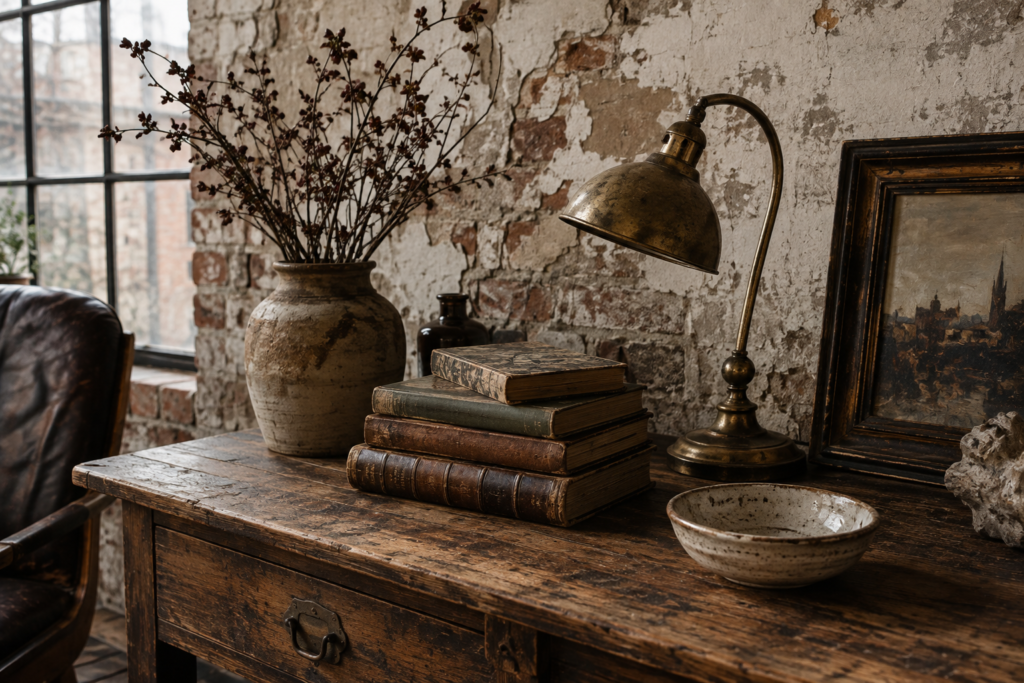
One of the most important ideas in Industrial Romanticism is patina.
Perfect finishes can actually work against the style.
Leather should soften. Brass can tarnish. Timber can carry scratches. Plaster doesn’t necessarily need to be perfectly smooth. Old furniture can reveal the evidence of previous owners.
There is a sense that the room has accumulated rather than simply been installed.
That doesn’t mean deliberately making new things look old.
Artificial distressing can quickly turn an atmospheric interior into something resembling a themed restaurant.
Real Industrial Romanticism is more convincing when materials are allowed to age naturally and old pieces are mixed comfortably with new ones.
A contemporary linen sofa might sit beside a nineteenth-century cabinet.
A modern steel kitchen might be illuminated by an antique glass pendant.
A heavily worn farmhouse table might be surrounded by surprisingly elegant dining chairs.
Nothing needs to belong to exactly the same period.
In fact, it is often better when it doesn’t.
A Darker, More Complicated Colour Palette
Traditional industrial interiors tend to stay within a relatively narrow palette: black, grey, brown, concrete and brick.
Industrial Romanticism can begin there, but it rarely ends there.
Deep burgundy, tobacco, oxblood, aubergine, forest green, midnight blue and dirty rose can all sit beautifully against industrial materials.
The important thing is that the colours feel aged rather than bright.
Instead of crisp white, think warm plaster or old ivory.
Instead of pure black, think charcoal or blackened steel.
Instead of vivid red, think dried roses, wine or faded velvet.
These colours bring emotional depth to the practical materials surrounding them.
Even pale rooms can work beautifully when the palette is softened with limewash, faded textiles and warm timber.
Industrial Romanticism doesn’t necessarily require darkness.
It requires atmosphere.
Where the Romance Comes In
This is where the style becomes particularly interesting.
Against all that brick, concrete and steel, introduce things that seem almost too delicate for the building.
A crystal chandelier.
A velvet chaise longue.
A huge gilded mirror.
Sheer curtains.
An antique oil painting.
A marble-topped table.
A vase filled with branches or flowers.
A slightly battered Persian rug.
These pieces don’t need to turn the room into a palace. In fact, they are often more powerful when used sparingly.
One ornate chandelier suspended from an exposed concrete ceiling can have more impact than an entire room filled with traditional decoration.
One enormous antique mirror leaning casually against a brick wall can do the same.
The contrast is the decoration.
Curtains Change Everything
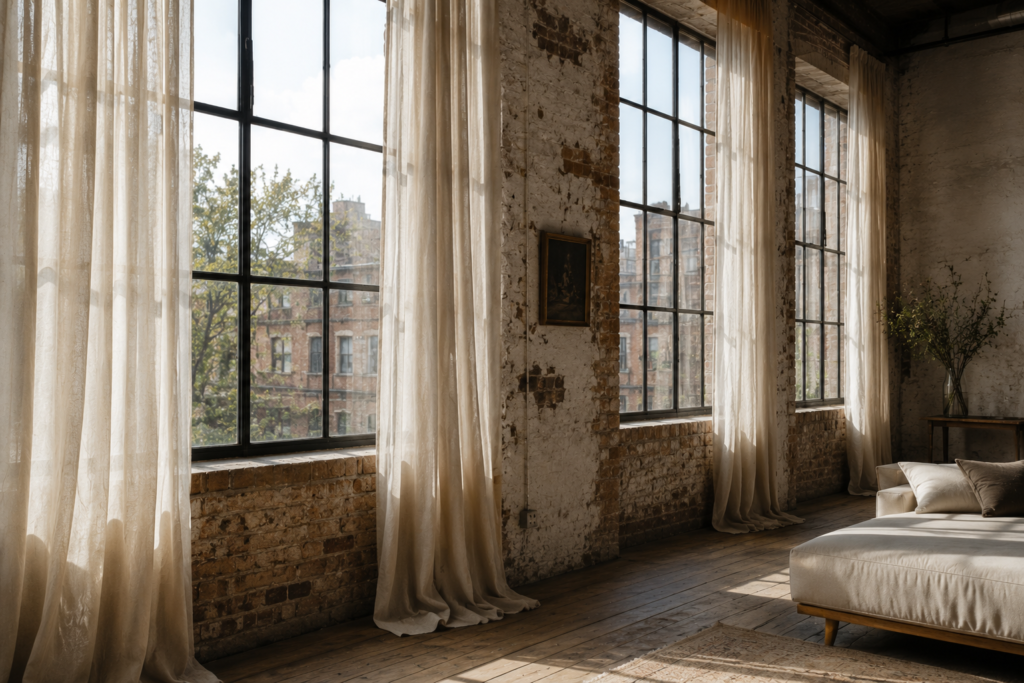
Industrial spaces are often associated with completely bare windows, particularly when those windows are large and steel-framed.
But adding fabric can completely change the character of the architecture.
Long linen, cotton or even velvet curtains soften enormous industrial windows without disguising them. Hung high and allowed to fall generously to the floor, they create movement in a room otherwise dominated by hard surfaces.
Sheer curtains are particularly beautiful.
During the day they diffuse harsh light coming through factory-style glazing. At night they create a softer boundary between the interior and the dark glass beyond.
It’s a simple addition, but perhaps one of the clearest examples of Industrial Romanticism at work:
steel and fabric, together.
Furniture Should Feel Collected, Not Coordinated
A perfectly matching furniture suite would feel strangely out of place here.
Industrial Romantic rooms are much more convincing when they look as though their contents arrived over many years.
A battered leather club chair might sit beside a contemporary sofa.
Bentwood chairs could surround a scarred timber table.
An ornate French cabinet might stand against an unfinished concrete wall.
A modern sculptural lamp might sit on an old workbench.
The industrial shell gives you permission to mix periods because the architecture itself acts as the common thread.
This is also where vintage and antique pieces become particularly valuable.
Not because everything needs to be old, but because older furniture introduces shapes, craftsmanship and imperfections that modern industrial interiors often lack.
Lighting Should Feel Warm and Slightly Theatrical
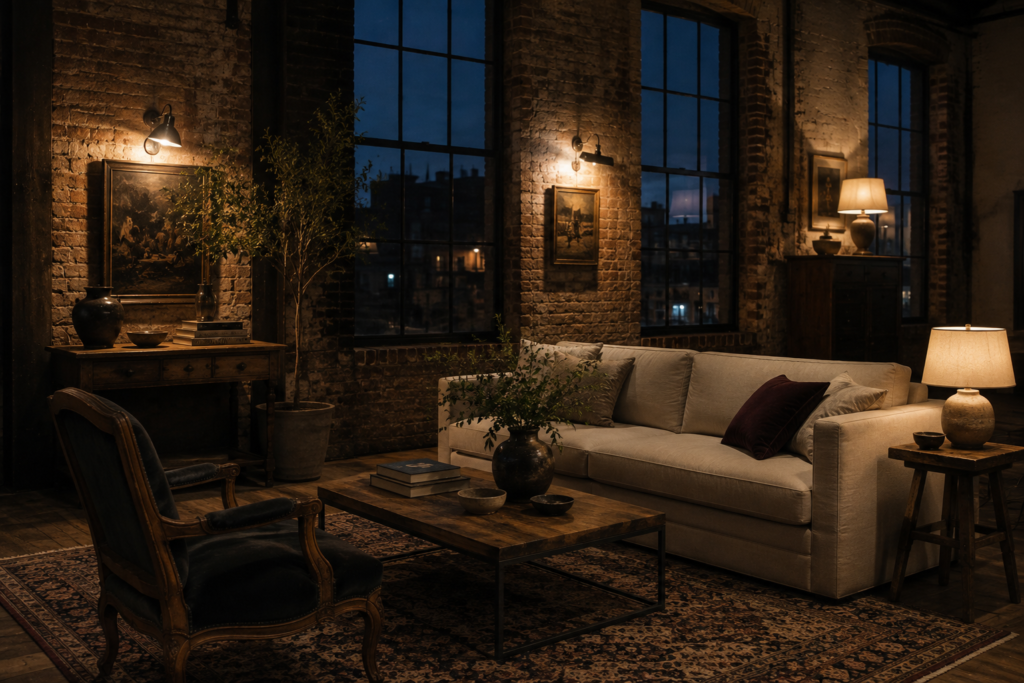
Lighting can make or break this style.
Industrial interiors sometimes fall into the trap of filling every room with exposed filament bulbs. A few can work, but an entire house of Edison bulbs can quickly feel more like a brewery than a home.
Industrial Romanticism benefits from a more layered approach.
Wall sconces.
Table lamps.
Picture lights.
Old glass pendants.
Candles.
A dramatic chandelier.
Pools of warm light are generally more atmospheric than illuminating every corner equally.
This is especially effective in large industrial spaces, where darkness can become part of the composition rather than something that needs to be eliminated.
A glowing lamp beside a velvet chair can make an enormous warehouse suddenly feel intimate.
Flowers Belong Here
Flowers might seem like an unlikely industrial design element.
That’s exactly why they work.
A loose arrangement of garden roses, branches, dried hydrangeas or wildflowers introduces something living and temporary into a room built from materials designed to survive for decades.
Avoid arrangements that feel overly formal.
A few oversized branches in an old ceramic vessel can be enough.
The same applies to indoor plants. Rather than filling the room with dozens of small pots, consider one or two substantial plants with strong sculptural forms.
Again, contrast matters more than quantity.
Kitchens Are Particularly Good at This
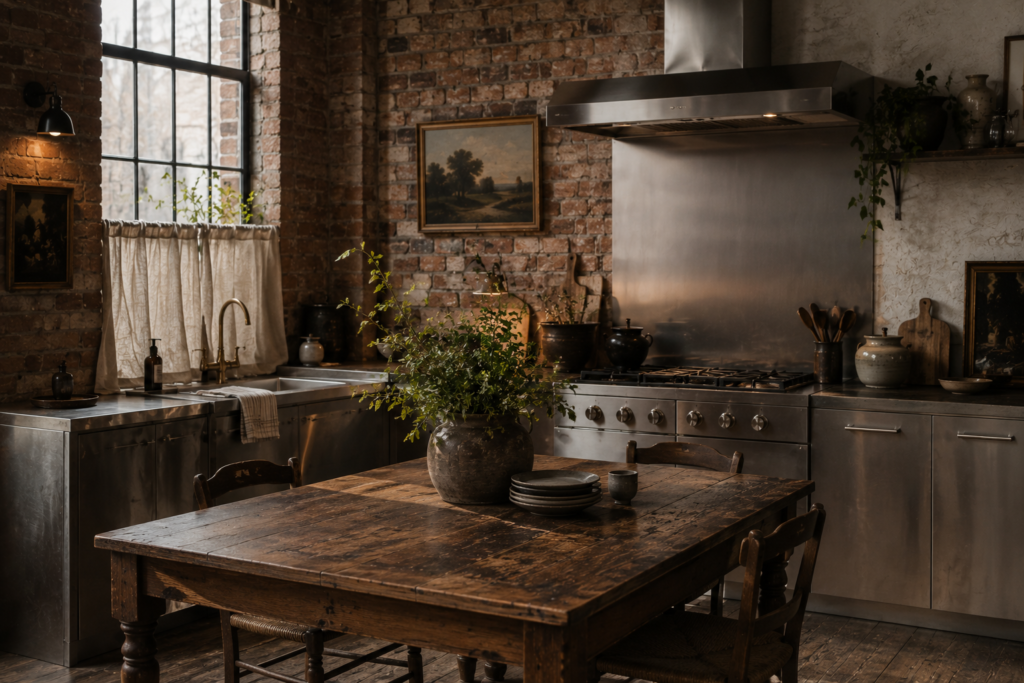
Industrial Romanticism translates beautifully into kitchens because kitchens are already practical spaces.
Stainless steel, stone, exposed shelving and substantial worktables naturally provide the industrial foundation.
Then soften them.
Add aged brass hardware.
Hang an antique painting where you might expect kitchen art.
Use handmade ceramics instead of perfectly matching dinnerware.
Place a worn timber table beside contemporary cabinetry.
Hang linen café curtains across the lower half of a window.
A large old cupboard can sometimes be more interesting than another wall of fitted cabinetry.
The room still functions as a modern kitchen.
It simply doesn’t look as though every object arrived on installation day.
The Bathroom Can Be Even Better
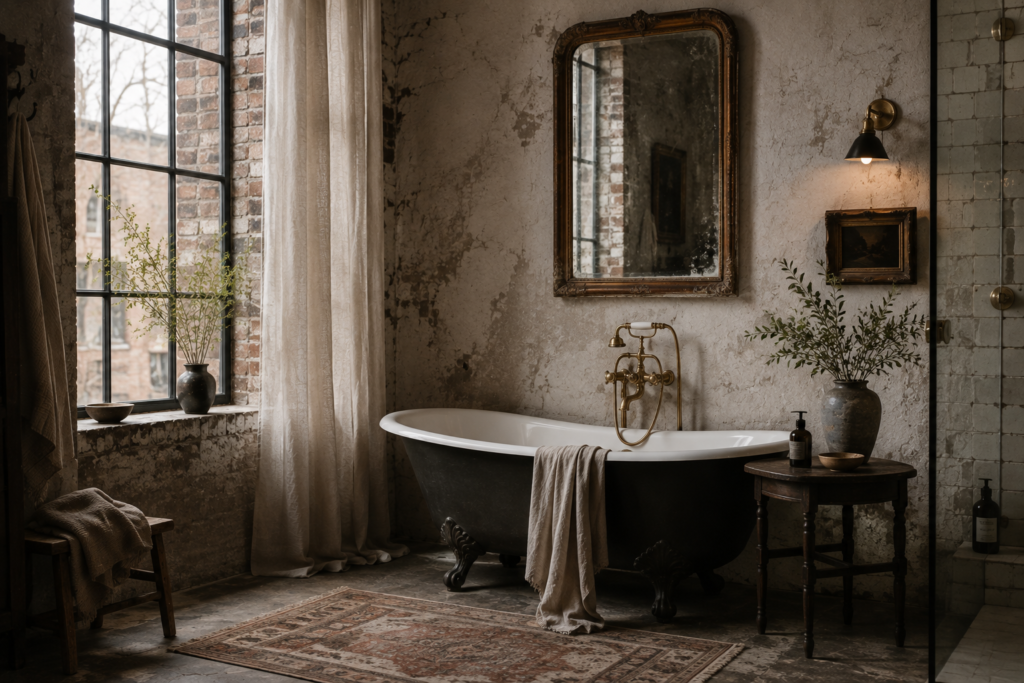
Few combinations capture the style better than an old freestanding bath against rough plaster or exposed brick.
Add aged brass taps, a large antique mirror and soft towels and suddenly the utilitarian architecture feels almost luxurious.
Marble works particularly well here because it sits somewhere between the two sides of the style.
It is durable and architectural, but also elegant and historically associated with grand interiors.
Even polished chrome can work when surrounded by warmer, more imperfect materials.
The aim isn’t to make everything old.
It’s to make everything feel considered.
What Industrial Romanticism Is Not
There is a fine line between an industrial interior and an industrial-themed interior.
Industrial Romanticism is not about covering a new suburban house with fake brick wallpaper, installing pipe shelving everywhere and filling the ceiling with reproduction factory lights.
Nor does it require turning your home into an antique shop.
The most successful spaces tend to exercise restraint.
If the architecture already provides plenty of industrial character, the furnishings can become softer and quieter.
If the architecture is relatively conventional, industrial elements can be introduced through genuine materials — steel-framed doors, limewashed walls, reclaimed timber, stone or carefully chosen lighting — rather than decorative imitation.
The room should feel as though its character developed naturally.
How to Bring Industrial Romanticism Into a Modern Home
You don’t need to live in a converted nineteenth-century factory.
Start with materials.
Allow timber to look like timber. Choose stone with variation. Consider limewash or textured plaster rather than perfectly flat paint. Introduce steel or aged metal in places where it makes architectural sense.
Then resist the temptation to make everything match.
Find one old piece you genuinely love.
Hang an oversized artwork.
Bring in linen.
Use a substantial rug.
Choose lighting that creates atmosphere rather than simply brightness.
Let books accumulate.
Display ceramics.
Bring home flowers.
And perhaps most importantly, don’t remove every imperfection.
A little roughness gives the beautiful things something to push against.
Why Industrial Romanticism Feels Relevant Again
For years, many interiors pursued a kind of perfection.
Seamless cabinetry. Invisible appliances. Flawless surfaces. Neutral furniture. Carefully controlled palettes.
There is certainly beauty in that approach.
But increasingly, people seem drawn to rooms that reveal a little more personality — spaces where objects have history, materials age, and not everything has been selected from the same collection.
Industrial Romanticism offers almost the opposite of the showroom interior.
It embraces contradiction.
Hard and soft.
Masculine and feminine.
Practical and decorative.
Old and new.
Grand and imperfect.
It can accommodate the antique chair inherited from a grandparent and the contemporary sofa bought last year. It can make chipped plaster feel intentional and an enormous bunch of flowers feel unexpectedly dramatic.
Most importantly, it leaves room for a home to change.
A Room Doesn’t Have to Be Perfect to Be Beautiful
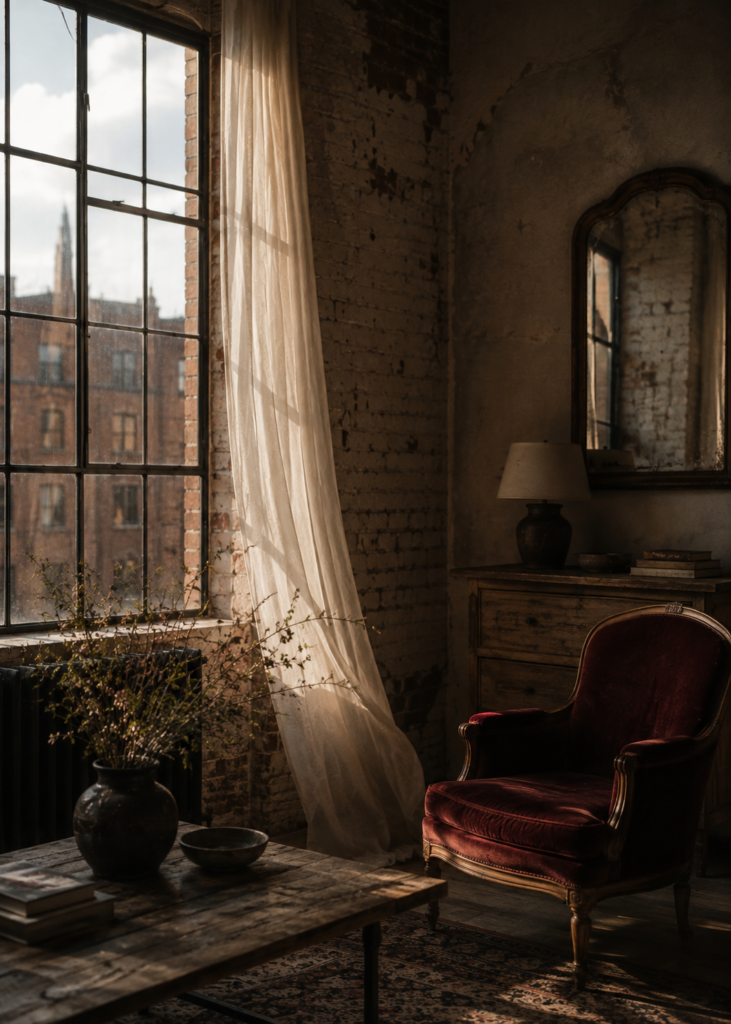
Perhaps that is the real appeal of Industrial Romanticism.
It doesn’t ask us to erase the history of a building or disguise the materials from which it was made.
But neither does it insist that rawness alone is enough.
Instead, it takes the hardest surfaces — brick, steel, concrete, old timber — and surrounds them with things that are fragile, tactile, personal and beautiful.
A curtain moving beside a factory window.
Flowers on an old workbench.
Velvet against exposed brick.
Candlelight reflected in tarnished brass.
Industrial Romanticism lives in those contradictions.
And somehow, the rougher the room becomes, the more beautiful the softness can feel.
Britt & Tyler
We’re Britt and Tyler, the two Australians behind Cocktails & Cathedrals. We’re drawn to old buildings, beautiful rooms, bookshops and places that seem to hold a story. Our journal brings those interests together, with a fondness for slow afternoons and a well-made cocktail. We hope it helps you find places you’ll want to linger.
Travel slowly. Stay beautifully.
A little more about us →