The Art of the European Café: 9 Ways to Bring Old-World Coffeehouse Style Into Your Home
INTERIORS & INSPIRATION · EUROPEAN LIVING
From marble-topped tables and velvet banquettes to antique mirrors and the gentle glow of brass lamps, discover how to capture the timeless atmosphere of Europe’s most beautiful coffeehouses at home.
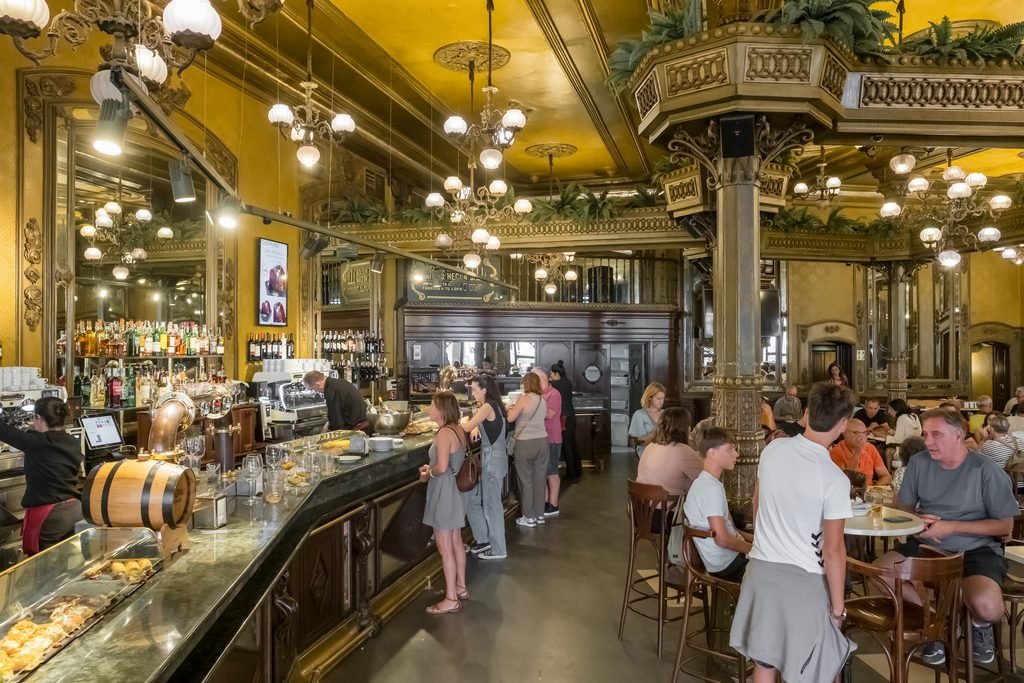
There is a particular kind of magic to an old European café.
Perhaps it’s the sound of porcelain cups being placed on marble tables, the soft murmur of conversation beneath a painted ceiling, or the way afternoon light catches the edges of an antique mirror. Outside, the city carries on. Inside, time seems to move a little differently.
In Vienna, coffeehouses have long been places to read, write, debate and linger. In Paris, mirrored walls and intimate banquettes create their own theatrical atmosphere. Across Budapest, Prague and Trieste, historic cafés remind us that a good cup of coffee deserves beautiful surroundings.
These are places designed not simply for drinking coffee, but for enjoying the pleasure of being somewhere.
The good news? You don’t need an ornate nineteenth-century building or a grand Parisian apartment to capture a little of that feeling.
Whether it’s a quiet corner of your kitchen, a dining room or a favourite reading nook, the secret lies in a handful of thoughtful details.
Here are nine ways to bring the romance of Europe’s old-world coffeehouses into your home.
1. Begin With a Marble-Topped Café Table
Few pieces of furniture evoke the classic European coffeehouse quite like a small, round marble table.
Think of the intimate tables scattered throughout Vienna’s historic cafés, where newspapers, coffee cups and slices of cake have shared the same polished surfaces for generations.
Marble has a wonderful ability to feel both luxurious and completely unpretentious. Its natural veining adds character, while the cool surface contrasts beautifully with dark wood, velvet and warm lighting.
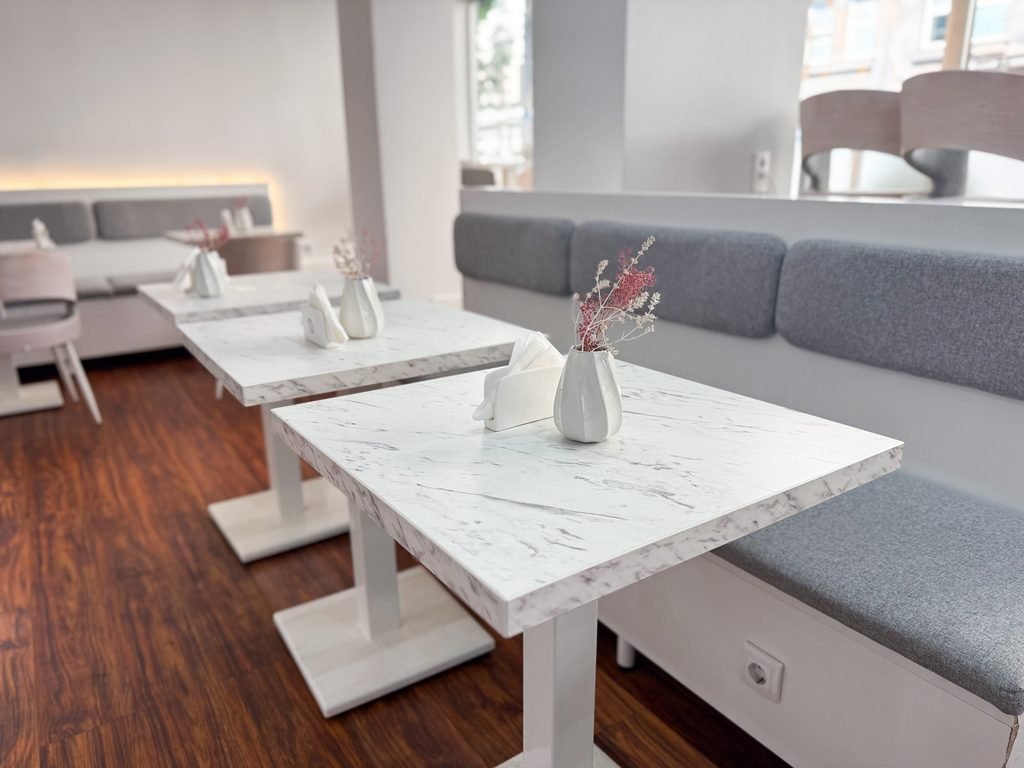
And unlike a large dining table, a small café table creates its own intimate little world.
Bring the look home
Choose a round marble or marble-topped table with a slender black cast-iron, brass or timber base. White Carrara-style marble is a classic, but cream, green and richly veined darker stone can feel equally beautiful.
Position it beside a window, beneath a pendant light or in an otherwise unused corner.
Add two chairs, a small ceramic vase and a favourite coffee cup. That’s all you need.
For smaller homes, even a 60–70 cm diameter table can create the atmosphere of a private European café.
The secret is restraint. Leave enough space for a book, a coffee and absolutely nothing urgent.
2. Choose Bentwood Chairs With a Little History
If there’s one chair that belongs in the European coffeehouse, it’s the bentwood chair.
Its graceful curves, rounded back and delicate proportions are instantly recognisable. Often finished in dark walnut or black, these chairs have furnished cafés, restaurants and elegant interiors for well over a century.
The most famous example is Michael Thonet’s No. 14 chair, introduced in 1859. Made using an innovative steam-bending technique, it became one of the defining furniture designs of European café culture.
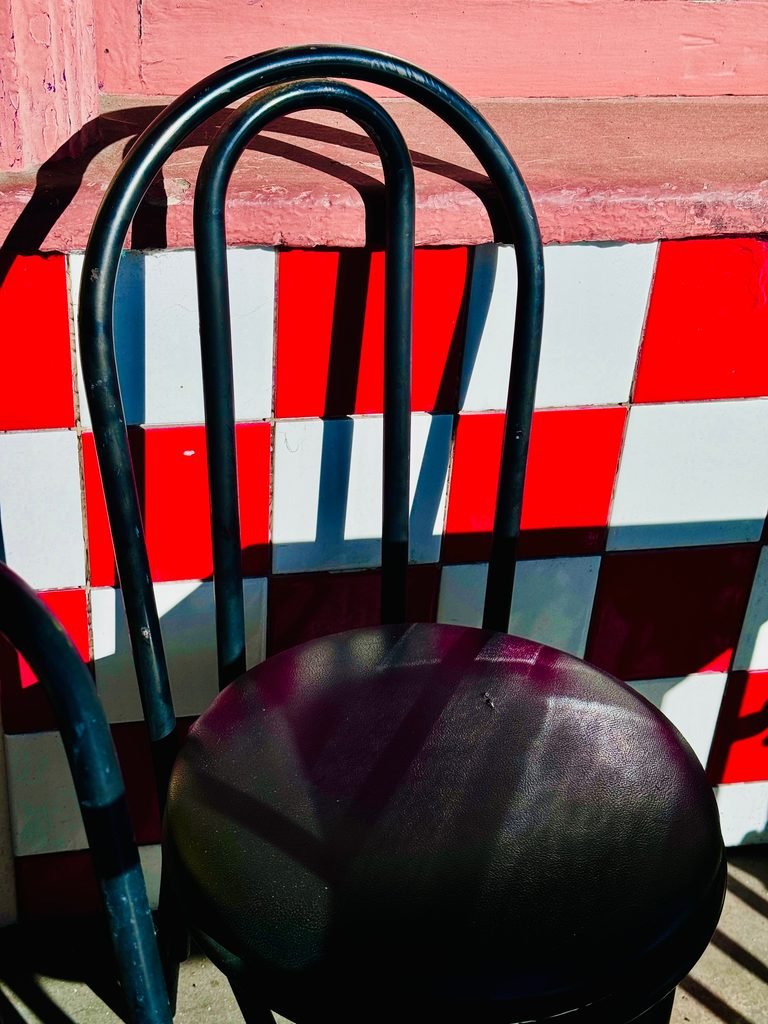
There is something wonderfully understated about bentwood furniture. It feels refined without being fussy, historic without appearing old-fashioned.
Bring the look home
Look for bentwood chairs with dark timber frames, curved backs and traditional cane or upholstered seats.
Original vintage chairs can be especially charming, though contemporary reproductions and second-hand finds are often more accessible.
Pair two with a small marble table, or use a mismatched collection around a dining table for a relaxed continental feel.
For additional warmth, add a small velvet seat cushion in oxblood, forest green or tobacco.
These chairs work beautifully in both traditional and contemporary homes, lending even the simplest space a little European history.
3. Introduce Velvet, Leather and Rich Upholstery
Imagine an old café in Budapest or Paris.
There are deep red banquettes lining the walls, dark timber tables, softly glowing lamps and perhaps a leather armchair tucked into a quiet corner.
The atmosphere is rich, intimate and unmistakably inviting.
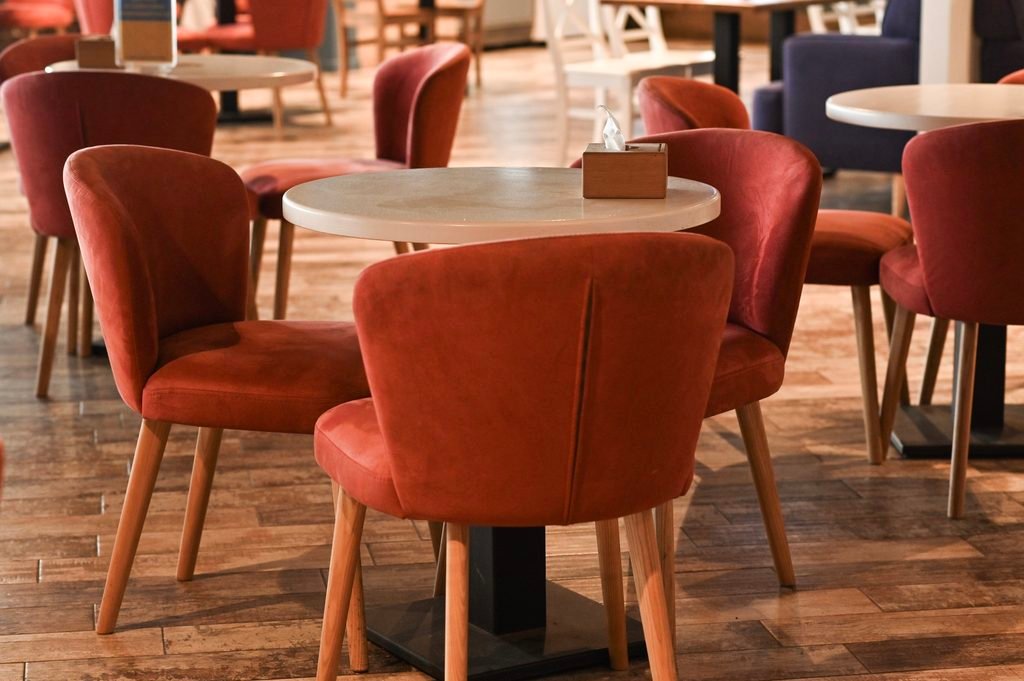
Velvet and leather have a way of making a space feel established, as though generations of interesting conversations have already taken place there.
You don’t need an entire upholstered banquette to achieve this effect. A single beautifully chosen piece can change the mood of a room.
Bring the look home
Consider introducing one of these classic materials through a velvet dining chair, small upholstered bench, vintage leather armchair or a collection of tactile cushions.
Choose colours inspired by traditional European interiors:
- Oxblood and burgundy for drama and warmth.
- Deep forest green for a sophisticated, literary atmosphere.
- Tobacco and cognac leather for a slightly masculine, old-world feel.
- Antique gold and muted rose for a softer Belle Époque influence.
If space permits, a built-in dining banquette upholstered in velvet can create a particularly convincing café atmosphere.
For something simpler, place a beautifully upholstered chair beside a small table and reading lamp.
The aim isn’t to make the room look expensive. It’s to make it feel inviting enough that nobody wants to leave.
4. Use Antique Mirrors to Create Light and Drama
Mirrors are one of the most enchanting features of traditional Parisian cafés.
Large, sometimes slightly foxed mirrors sit above timber panelling or behind upholstered banquettes, reflecting chandeliers, windows and the movement of people throughout the room.
They create depth and a sense of faded grandeur, making even a modest space feel a little theatrical.

At home, an antique-style mirror can achieve a similar effect.
Bring the look home
Choose a mirror with an aged brass, gilt, dark timber or gently distressed frame.
An oversized mirror positioned above a sideboard, fireplace or café table can create an immediate focal point.
For a more distinctly Parisian look, consider a tall arched mirror or one with an ornate nineteenth-century-inspired frame.
Position it where it can reflect natural light or the warm glow of a lamp.
You could even create the suggestion of an old café interior by pairing a large mirror with a slim timber console, a marble surface and two wall sconces.
Avoid overcrowding the surrounding wall. A beautiful mirror often needs very little company.
5. Create the Gentle Glow of an Old European Café
Lighting may be the single most important ingredient in creating an atmospheric interior.
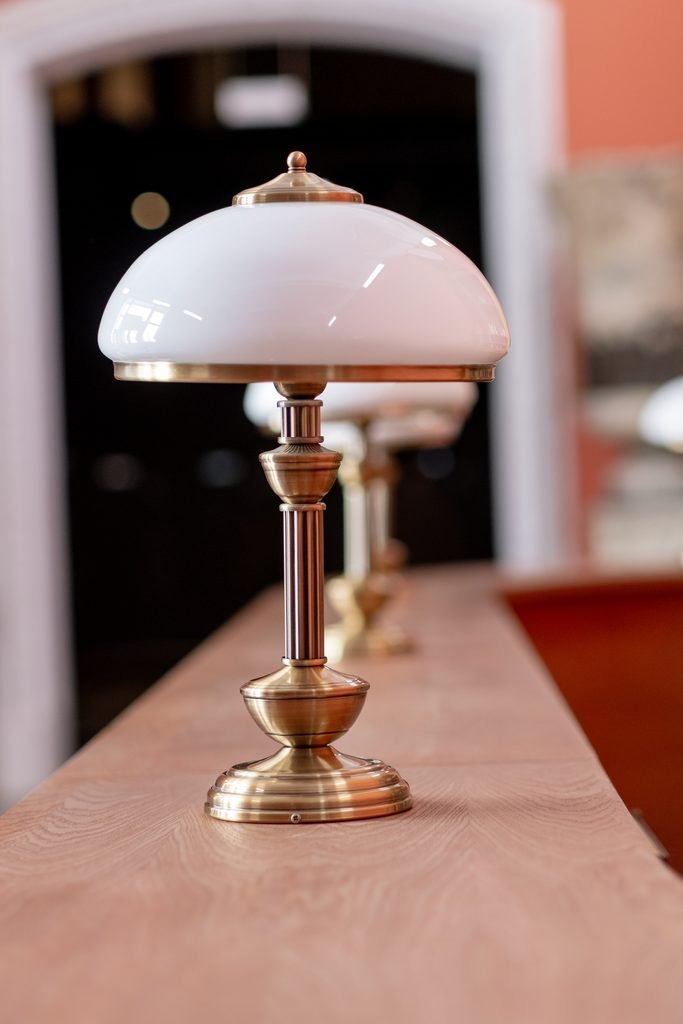
The most memorable European coffeehouses rarely depend on harsh overhead lighting. Instead, their interiors are softened by glowing wall sconces, shaded table lamps, chandeliers and reflected light.
Everything feels warmer and more intimate.
A beautiful room under bright white lighting can suddenly lose its charm. The same room illuminated by a handful of carefully placed lamps may feel entirely different.
Bring the look home
Start by replacing cool, stark light with warmer illumination.
Look for opal glass shades, antique brass fittings, small shaded table lamps and classic wall sconces.
A brass picture light above a painting can also contribute to the atmosphere.
Where appropriate, choose warm-white bulbs around 2700K and install dimmers to control the mood throughout the evening.
Try creating several pools of light rather than illuminating every corner equally.
A small lamp beside a chair, another on a sideboard and a pendant above a café table can be far more atmospheric than a single bright ceiling light.
For inspiration, picture a rainy evening in Vienna: warm windows glowing against the darkening street outside.
That’s the feeling we’re after.
6. Embrace Dark Timber and Beautiful Architectural Details
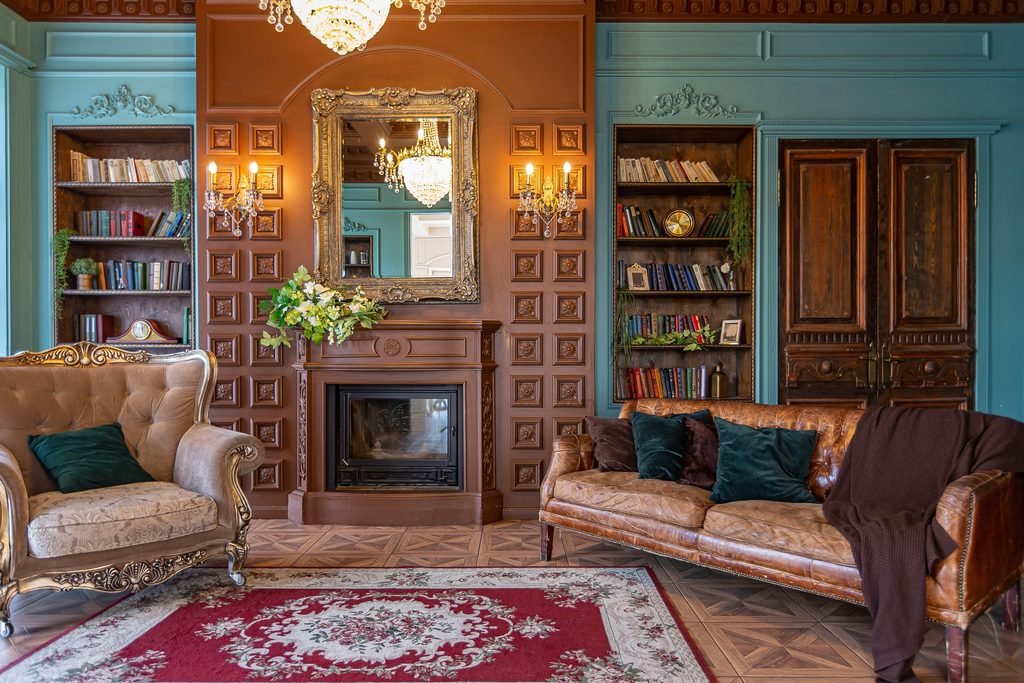
One of the reasons historic European cafés feel so memorable is their attention to architecture.
Timber panelling, decorative cornices, old doors, carved details and richly coloured walls create a sense of permanence.
A room might be grand, but it rarely feels sterile.
Even simpler neighbourhood cafés often possess a beautiful patina: surfaces that have softened with age and furnishings that feel collected rather than newly purchased.
Fortunately, architectural character can be introduced without undertaking an enormous renovation.
Bring the look home
Try adding timber panelling to the lower portion of a wall, painting a room in a deep historical colour or installing simple decorative mouldings.
Dark walnut, stained oak and espresso-coloured timber work beautifully alongside cream walls, antique brass and marble.
For a more dramatic effect, consider painting both the walls and timberwork in a rich, enveloping shade.
A deep olive, warm charcoal or burgundy can make a small room feel intimate rather than cramped, particularly when paired with thoughtful lighting.
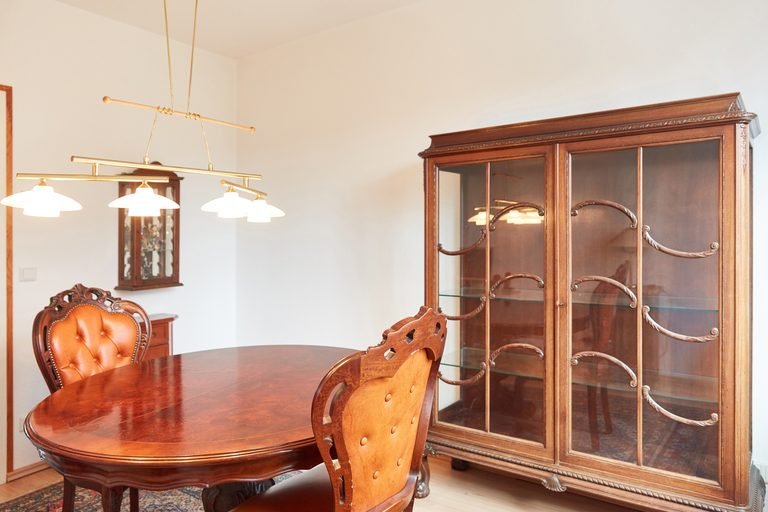
If you’re renting or prefer not to renovate, a vintage timber cabinet or beautifully framed artwork can introduce architectural warmth without changing the room itself.
The goal is to create a sense of depth and character, not to turn your home into a museum.
7. Borrow a Colour Palette From the Belle Époque
The great cafés of Europe are a masterclass in colour.
Rather than relying on bright white walls and contemporary neutrals, many historic interiors embrace deep reds, earthy greens, polished timber, warm creams and touches of gold.
These colours feel particularly beautiful together because they create contrast without becoming overwhelming.
The trick is choosing a restrained palette and allowing materials to provide much of the visual interest.
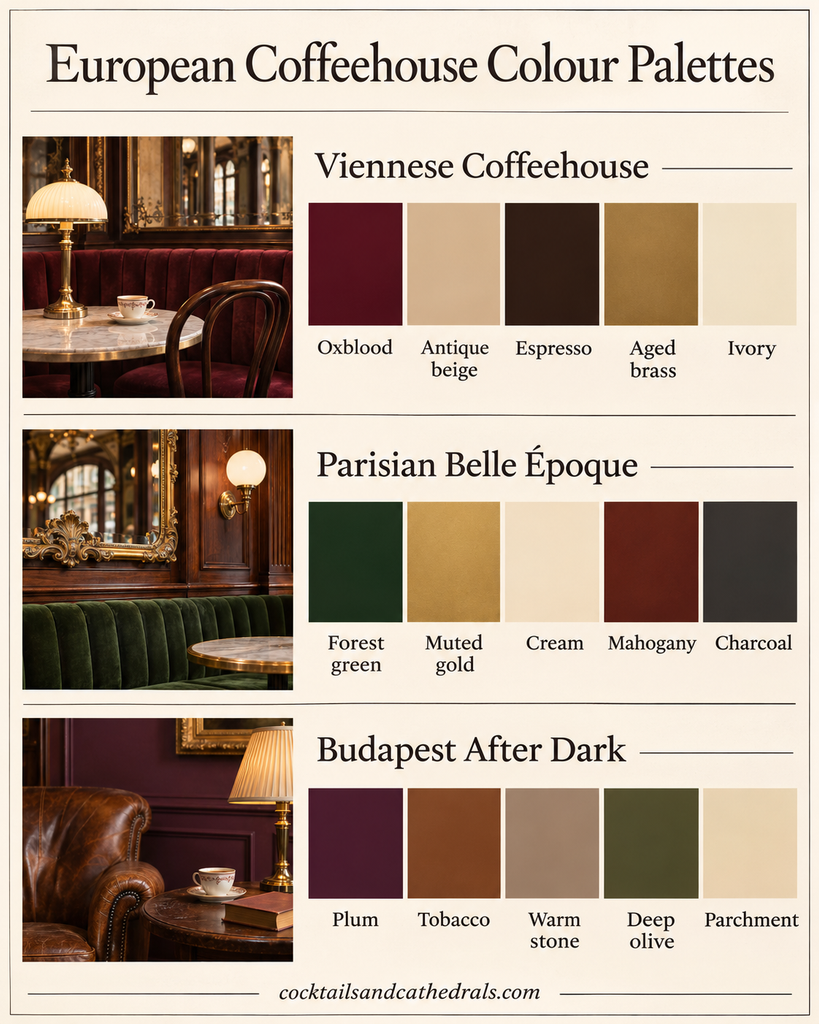
Here are three combinations inspired by Europe’s historic café interiors.
Bring the look home
Choose one darker colour as your anchor, one warm neutral to create balance and a metallic accent for subtle contrast.
For example, an oxblood upholstered chair, warm cream walls, dark timber furniture and a brass lamp can feel beautifully cohesive.
You don’t need to use every colour in equal measure.
In fact, the most elegant interiors often rely on just two or three dominant tones, with artwork, books and decorative objects providing the rest.
If you love this approach, explore our guide to 8 Art Nouveau Colour Palettes Inspired by Europe’s Most Beautiful Interiors for more inspiration drawn from the continent’s decorative heritage.
8. Add Books, Art and the Details of a Literary Café
For centuries, European cafés have been much more than somewhere to stop for a drink.
They have been meeting places for writers, artists, musicians, philosophers and anyone in search of good conversation.
Vienna’s coffeehouses were particularly important to literary and intellectual life. Around the turn of the twentieth century, establishments such as Café Griensteidl and Café Central became gathering places for writers and thinkers. City of Vienna+1
This is part of what makes the old-world coffeehouse so appealing.
There is a sense that ideas matter here. That conversation is worth lingering over. That reading a book for an entire afternoon is a perfectly respectable way to spend one’s time.
Recreating this atmosphere at home means paying attention to the smaller, personal details.
Bring the look home
Begin with books. A small stack on a café table, a shelf of well-loved novels or an old bookcase can bring immediate warmth.
Add a framed vintage print, a small landscape painting or an architectural illustration.
Old maps, black-and-white photographs and antique-style botanical prints can also work beautifully.
Choose a few meaningful objects rather than filling every surface.
A ceramic espresso cup, a vintage clock, an elegant tray or a favourite collection of books can be more effective than a room full of decorative accessories.
A good literary café feels as though it belongs to the people who spend time there.
Your home should feel the same.
9. Create a Coffee Ritual Worth Slowing Down For
Perhaps the most important element of European coffeehouse style isn’t furniture at all.
It’s the ritual.
In Vienna, traditional coffeehouse culture has been recognised on Austria’s national inventory of intangible cultural heritage since 2011. Its significance extends beyond the coffee itself to the social traditions, surroundings and unhurried enjoyment of time spent there. Österreichische UNESCO-Kommission+1
There is something lovely about the idea that coffee deserves a little ceremony.
Not elaborate ceremony. Just a moment of attention.
A proper cup and saucer. A comfortable chair. Perhaps a small pastry on a plate. A newspaper, a novel or a favourite piece of music playing softly in the background.
Nothing complicated, but everything intentional.
Bring the look home
Create a dedicated coffee station using a beautiful tray, your favourite cups and a few well-chosen accessories.
Rather than hiding everything away, display the objects you genuinely enjoy using.
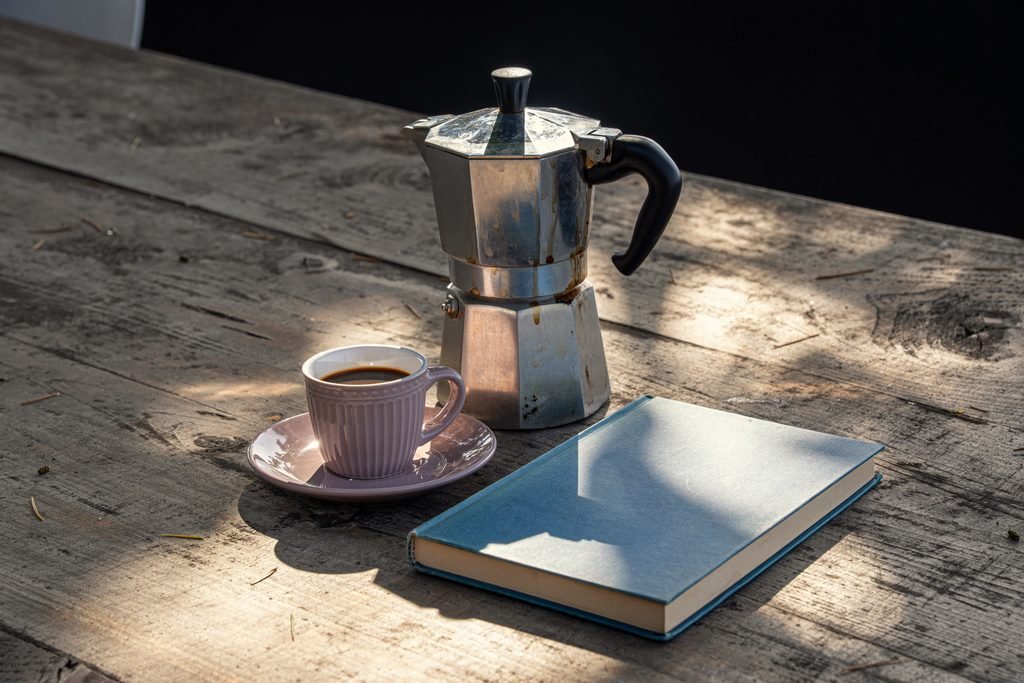
A moka pot, a small collection of porcelain cups or an attractive coffee grinder can become part of the room’s character.
If you have space, position your coffee station near your café table or reading corner.
On weekends, make a little occasion of it.
Choose some music, prepare your favourite coffee and sit somewhere beautiful without reaching immediately for your phone.
The real luxury of the European coffeehouse has never been simply its decoration.
It’s the permission to stay a little longer.
Bringing It All Together: Your Own Little Corner of Europe
Sushimia Boavista – Restaurants in the Porto Beach – Guide de Porto
The most beautiful European cafés were rarely designed in a single afternoon.
Their character emerged over decades, through layers of furniture, architecture, conversations and everyday rituals.
Your home can develop in much the same way.
Start small.
A round table beneath a window. A pair of bentwood chairs. An antique mirror that catches the afternoon sun.
Add a warm lamp, a favourite book and a cup of coffee served on a proper saucer.
Perhaps, over time, you’ll introduce a velvet chair, a richly coloured wall or a beautiful old cabinet.
There’s no need to recreate an entire Viennese coffeehouse or Parisian salon.
In fact, the most convincing interiors borrow the spirit of these places rather than copying them exactly.
They feel personal, a little imperfect and wonderfully lived-in.
And on a quiet Sunday morning, when the light falls across the marble and the coffee is still warm, you may find that your favourite corner of Europe is a little closer than you imagined.
Because sometimes the most beautiful way to travel is to bring a little of somewhere else home.
Britt & Tyler
We’re Britt and Tyler, the two Australians behind Cocktails & Cathedrals. We’re drawn to old buildings, beautiful rooms, bookshops and places that seem to hold a story. Our journal brings those interests together, with a fondness for slow afternoons and a well-made cocktail. We hope it helps you find places you’ll want to linger.
Travel slowly. Stay beautifully.
A little more about us →
One Comment