Organic Modern: The Interior Design Style You Probably Already Love
There is a particular kind of interior that has become almost impossible to avoid.
You have probably saved one without thinking about it.
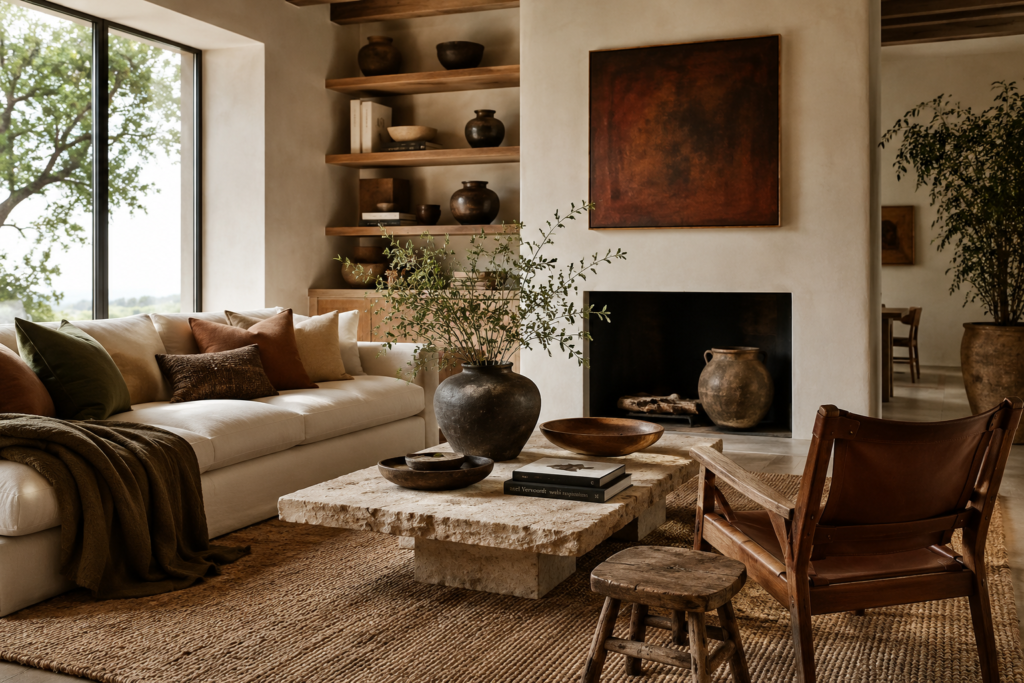
A room with warm plaster walls. A beautifully simple timber table. A low linen sofa. Perhaps a piece of travertine, a handmade ceramic vessel or an enormous branch sitting somewhat improbably in a vase. The furniture is modern, but nothing feels especially sharp. The palette is quiet without being clinical. There may not be very much in the room at all, yet somehow it doesn’t feel empty.
It feels calm.
And expensive.
And, increasingly, familiar.
This is Organic Modern — one of those interior design styles that many people recognise long before they know what to call it.
At its simplest, Organic Modern takes the restraint of modern design and softens it with the materials, textures and irregularities of the natural world.
But the best examples are considerably more interesting than beige sofas and olive trees.
What Is Organic Modern Interior Design?
Organic Modern is built around a fairly simple contradiction.
Modernism provides the structure. Nature provides the softness.
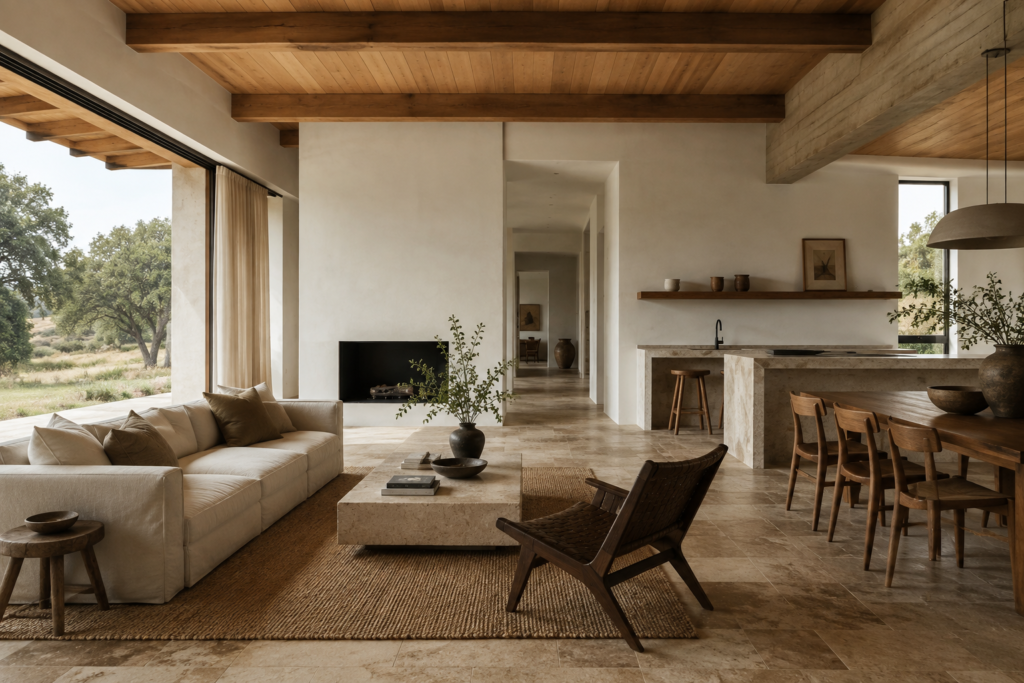
The architecture tends to be clean and relatively restrained. Rooms are uncluttered. Furniture is chosen deliberately rather than accumulated endlessly. There is usually plenty of negative space.
Then something warmer is introduced.
Raw timber.
Veined stone.
Linen.
Wool.
Clay.
Leather.
Plaster.
Woven fibres.
Instead of decorating a room with pattern and colour, Organic Modern interiors often create interest through material variation.
A rough wall sits behind a smooth stone table. A heavy timber chair is placed beside soft linen upholstery. Honed limestone meets aged wood. A beautifully imperfect ceramic bowl sits on an otherwise very precise kitchen bench.
It is this tension that stops the style becoming straightforward minimalism.
Organic Modern doesn’t reject simplicity.
It simply makes simplicity feel human.
It Is Modernism Without the Coldness
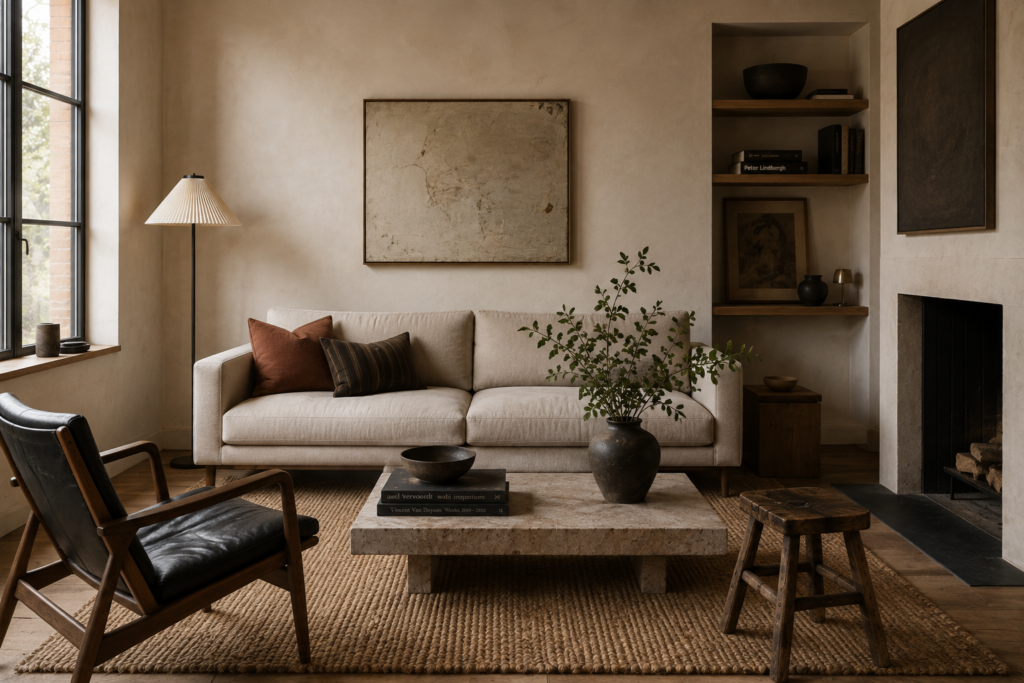
Modern interiors have always had a slight image problem.
At their best, they can be extraordinary: elegant proportions, beautiful architecture, exceptional furniture and almost obsessive attention to detail.
At their worst, they can feel like somewhere you’re waiting for a dental appointment.
Organic Modern keeps much of what makes modern design appealing — clean lines, functional spaces, simplicity and visual calm — while removing some of its severity.
The difference can be surprisingly small.
A polished white floor becomes limestone.
A glossy cabinet becomes oak.
A perfectly white wall becomes warm limewash or textured plaster.
A severe rectangular coffee table becomes a piece of stone with a softly irregular edge.
The room is still modern.
It has simply stopped trying quite so hard to look modern.
The Palette Is Neutral — But It Shouldn’t Be Flat
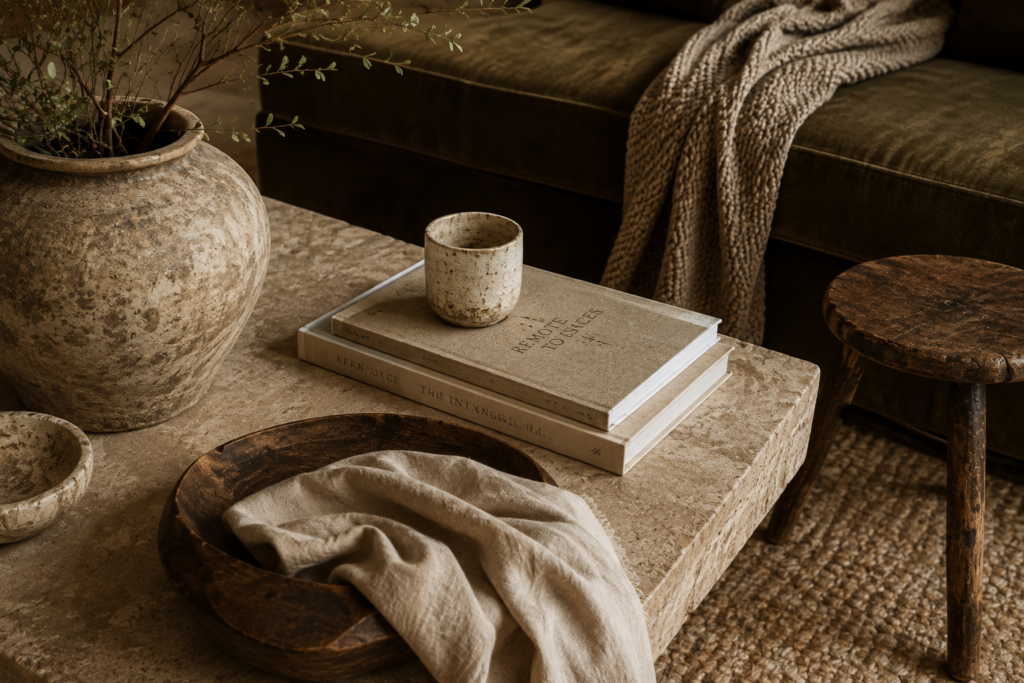
This is where Organic Modern can go badly wrong.
Search for the style online and eventually everything begins to resemble the same bowl of porridge.
Cream sofa.
Cream rug.
Cream walls.
Beige cushions.
Pale timber.
Olive tree.
Done.
But a good neutral interior isn’t really about beige.
It’s about variation within restraint.
Think chalk, mushroom, sand, tobacco, clay, limestone, warm grey, caramel, charcoal, muted olive and the countless colours found naturally in timber and stone.
A room might technically contain very little colour and still have enormous depth.
The trick is allowing materials to do some of the work that colour normally would.
Oak brings warmth.
Walnut brings darkness.
Travertine brings movement.
Linen brings softness.
Plaster catches light differently throughout the day.
A handwoven rug creates shadow and texture underfoot.
Suddenly “neutral” isn’t one colour at all.
It’s an entire landscape.
Natural Materials Matter More Than Natural Colours
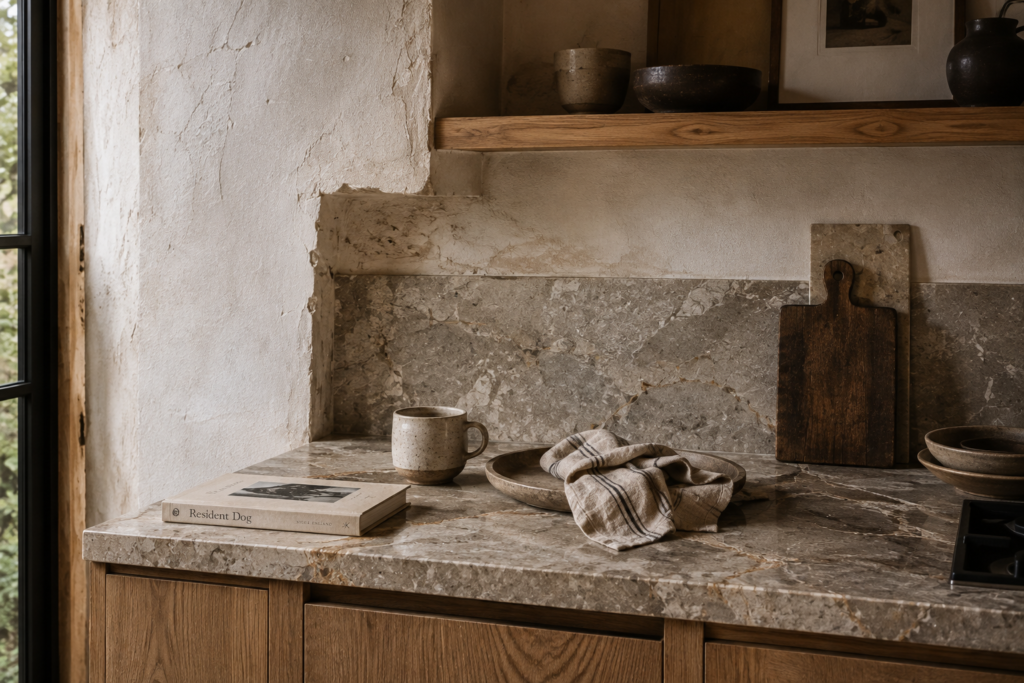
There is a temptation to recreate Organic Modern entirely through colour.
Paint something beige, buy a cream sofa and add a few brown cushions.
But the style becomes far more convincing when the materials themselves are genuine.
Real timber develops marks.
Stone has fossils, veins and imperfections.
Linen creases.
Leather changes colour where it is touched.
Handmade ceramics are rarely completely symmetrical.
These imperfections are important because Organic Modern interiors are often extremely controlled. Without them, the room can begin to feel like a render.
Natural materials interrupt that perfection.
A beautifully figured slab of stone doesn’t need decoration because the stone itself is the decoration.
An old timber stool can become more interesting than an elaborate side table.
A slightly irregular plaster wall changes constantly as daylight moves across it.
The materials are allowed to have a personality of their own.
Curves Have Become Part of the Language
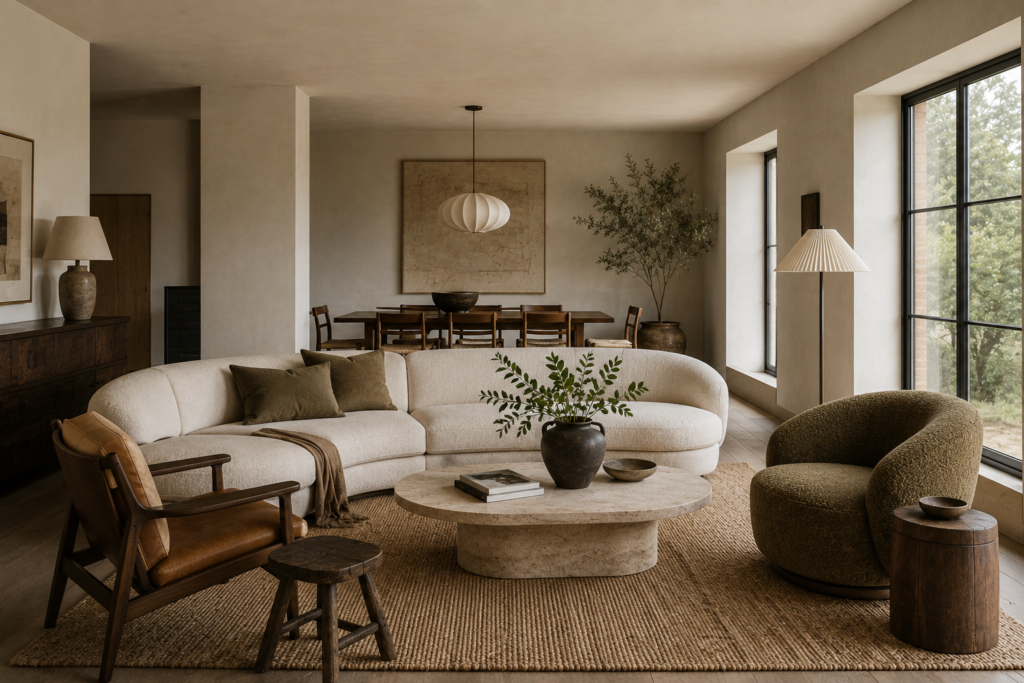
One of the easiest ways to recognise contemporary Organic Modern interiors is their relationship with shape.
The straight lines of modern architecture are increasingly paired with softer forms: rounded sofas, barrel chairs, oval tables, irregular stone surfaces and sculptural lighting.
The idea isn’t to eliminate straight lines.
It’s to create contrast.
A very rectilinear room becomes more inviting when a curved sofa sits in the middle of it.
A square kitchen becomes softer beneath a rounded pendant.
A large stone coffee table can look almost as though it has been eroded rather than manufactured.
The forms begin to reference things that don’t quite exist in perfect geometry: pebbles, branches, cliffs, shells and landscapes.
Used sparingly, those shapes make a modern room feel considerably less rigid.
Organic Modern Is Not the Same as Japandi
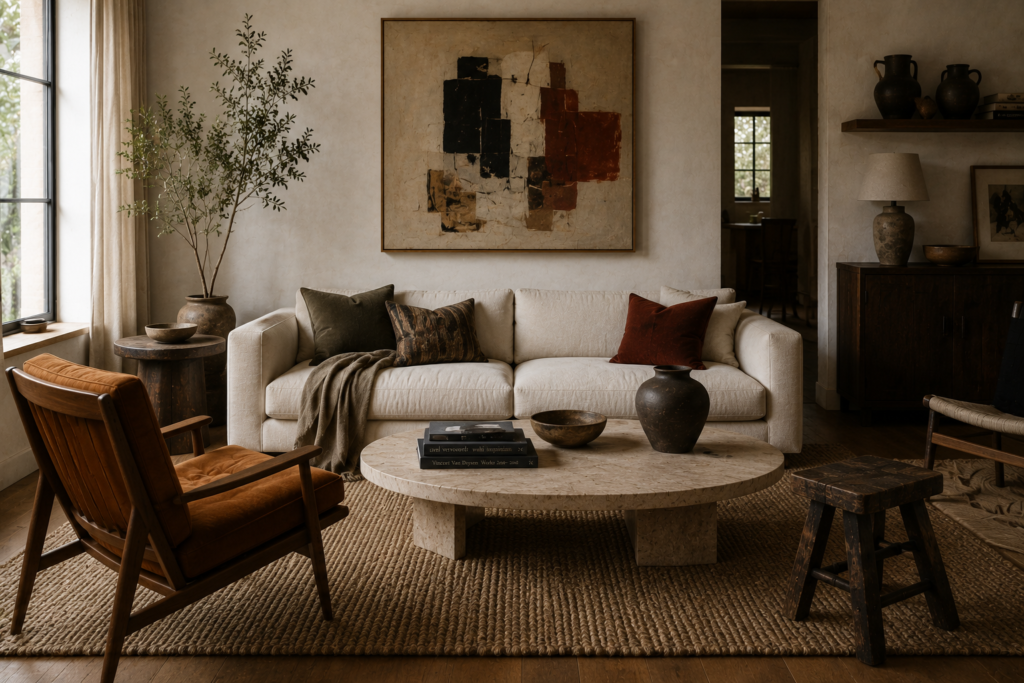
The two styles are close enough that they are often confused.
Both value simplicity.
Both favour natural materials.
Both tend towards restrained palettes and uncluttered rooms.
And both are interested in craftsmanship and the beauty of objects that don’t need excessive decoration.
But Japandi has a much more specific lineage, combining elements of Japanese and Scandinavian design.
Organic Modern is looser.
It can contain a 1970s Italian chair, a chunky French farmhouse table, contemporary Australian architecture, Mexican ceramics, Mediterranean limestone or a piece of mid-century furniture and still make perfect sense.
There isn’t really a geographical rulebook.
The common language is material, form and restraint.
That makes Organic Modern less of a historical design movement and more of a contemporary way of bringing several compatible ideas together.
A Little Imperfection Makes It Better
Perhaps the most interesting development within Organic Modern is the growing appreciation for imperfection.
Not manufactured imperfection.
Actual imperfection.
A weathered bench.
An old wooden bowl.
A slightly wonky ceramic vase.
Stone with dramatic natural variation.
A vintage chair sitting among otherwise contemporary furniture.
These pieces matter because the style can otherwise become suspiciously perfect.
There is a difference between a home that feels calm and one that feels untouched.
The best Organic Modern interiors leave room for age, wear and evidence of human life.
They understand something that traditional houses have always understood instinctively:
perfection isn’t necessarily beautiful.
Sometimes the scratch in the timber is what makes the timber interesting.
You Don’t Need an Architectural Masterpiece to Make It Work
Organic Modern photographs exceptionally well in enormous houses.
Twenty-foot ceilings.
Walls of glass.
A view across the Pacific.
A limestone fireplace roughly the size of a suburban garage.
Helpful.
But not essential.
The principles actually translate remarkably well to ordinary homes.
You don’t need to replace everything.
Start with removing rather than adding.
Allow a little more empty space around furniture.
Swap several small decorative objects for one larger, more interesting piece.
Bring in timber that actually looks and feels like timber.
Use linen curtains rather than something overly formal.
Choose a wool or jute rug.
Look for secondhand furniture with simple shapes and good materials.
Add stone through a side table, lamp or smaller object rather than renovating an entire kitchen.
And resist the urge to make everything match.
A modern sofa beside an old wooden stool is often more convincing than buying an entire “Organic Modern” furniture collection.
The Kitchen Is Where Organic Modern Really Works
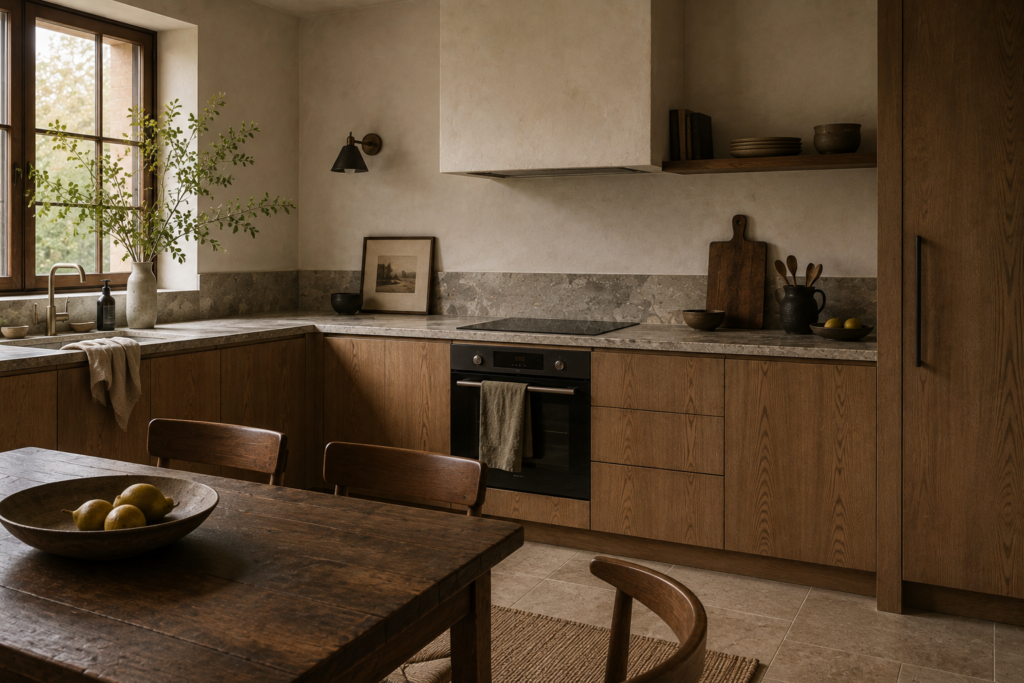
Few rooms demonstrate the style better than a kitchen.
Modern kitchens benefit enormously from simplicity. They need functional layouts, durable surfaces and cabinetry that doesn’t visually overwhelm the room.
But those same qualities can make them sterile.
Organic Modern kitchens solve this through material.
Simple timber cabinetry.
Natural stone.
Handmade tiles.
Plaster walls.
Brushed or aged metal.
Perhaps a substantial timber dining table nearby.
The cabinetry can remain extremely contemporary while everything surrounding it becomes tactile.
Even a fairly ordinary kitchen can move in this direction by avoiding too many competing finishes.
Let one beautiful material dominate.
If the stone is spectacular, the cabinetry can be quiet.
If the timber has wonderful grain, the benchtop doesn’t need to shout.
Good Organic Modern design rarely has five things asking for attention simultaneously.
Bedrooms Should Feel Almost Undecorated
Organic Modern bedrooms are particularly good at demonstrating the power of restraint.
There might be little more than a bed, two simple tables, a rug and one piece of art.
But texture becomes everything.
Washed linen bedding.
A wool blanket.
Timber.
Soft curtains.
A plaster or limewashed wall.
Warm pools of light rather than bright overhead illumination.
Nothing is particularly dramatic in isolation.
Together, however, the materials create the sense of comfort that decoration would normally provide.
The room doesn’t feel unfinished.
It feels quiet.
And there is an important difference.
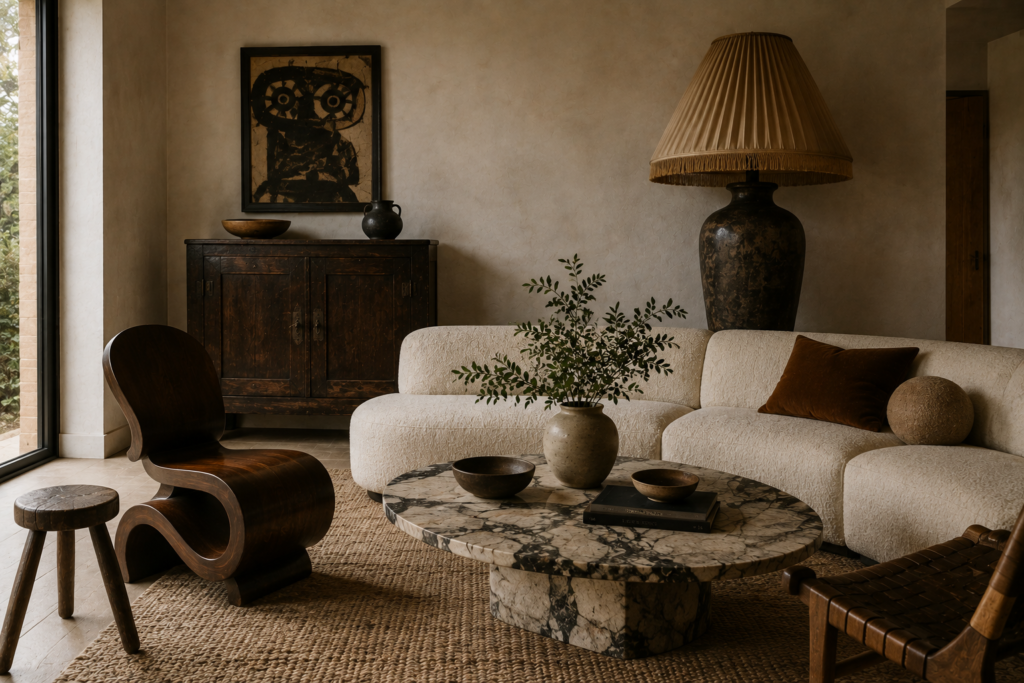
The Style Works Best When Something Doesn’t Quite Belong
This might be the secret to preventing Organic Modern from becoming generic.
Put something slightly unexpected in the room.
Not something loud.
Just something with character.
An antique chair.
A strange piece of pottery.
A battered timber bench.
A sculptural 1970s lamp.
A piece of contemporary art that isn’t beige.
A deeply veined piece of marble.
A dark wooden cabinet in an otherwise pale room.
Without something like this, Organic Modern can become so harmonious that there is nothing left to look at.
Beautiful interiors need a little tension.
The eye needs somewhere to stop.
Why Organic Modern Feels So Relevant Now
For years, mainstream interiors seemed to move between two extremes.
At one end was minimalism: immaculate white rooms, clean surfaces and very little visible life.
At the other was the reaction against it — maximalism, colour, pattern, collected objects and increasingly expressive interiors.
Organic Modern occupies an interesting place between the two.
It offers the visual calm of minimalism without demanding that your home resemble an art gallery.
It allows beautiful objects, but doesn’t require hundreds of them.
It embraces contemporary design while acknowledging that natural materials often become more beautiful as they age.
And perhaps most importantly, it creates homes that photograph beautifully without necessarily feeling designed purely for photographs.
At least, when it’s done properly.
A Style You May Already Have Been Saving
That may explain why Organic Modern has become so recognisable.
It doesn’t announce itself.
There are no obvious motifs.
No particular period of furniture is compulsory.
No single country owns it.
You recognise it mostly through atmosphere.
Warmth without clutter.
Minimalism without sterility.
Nature without rusticity.
Modernism without severity.
And perhaps that’s why so many people discover the name only after they’ve been looking at the style for years.
If your saved interiors are full of quiet rooms, old timber, beautiful stone, rumpled linen, sculptural furniture and walls that look just a little imperfect, you may not be searching for “warm minimalism” after all.
You may simply have been looking at Organic Modern.
Britt & Tyler
We’re Britt and Tyler, the two Australians behind Cocktails & Cathedrals. We’re drawn to old buildings, beautiful rooms, bookshops and places that seem to hold a story. Our journal brings those interests together, with a fondness for slow afternoons and a well-made cocktail. We hope it helps you find places you’ll want to linger.
Travel slowly. Stay beautifully.
A little more about us →