Budapest Art Nouveau: A Walking Guide to the City’s Most Beautiful Buildings
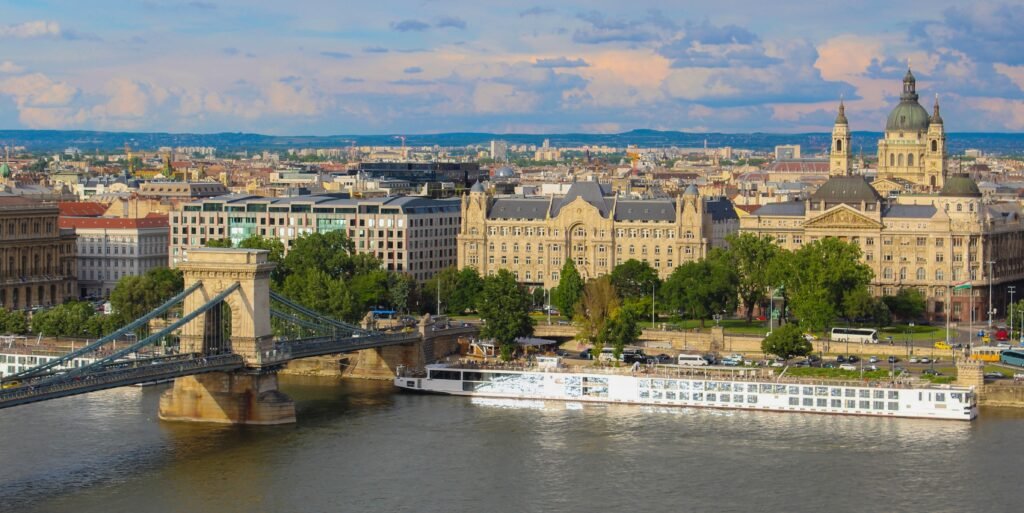
Budapest is a city that rewards anyone who remembers to look up.
Above the cafés, trams and broad boulevards are tiled rooftops, curling iron balconies, strange ceramic creatures, floral mosaics and façades that seem to have been designed with almost no interest in restraint.
This is Budapest’s Art Nouveau side — or, as the style is usually known in Hungary, Szecesszió, the Hungarian Secession.
And while Vienna, Paris and Brussels often dominate conversations about European Art Nouveau, Budapest developed something distinctly its own. Hungarian architects borrowed from the wider movement but mixed it with folk patterns, colourful ceramics, Eastern influences and an emerging desire to create a recognisably Hungarian architectural language.
The result is wonderfully eccentric.
This walking route takes you past some of the best Art Nouveau buildings in Budapest, from the fantastical Museum of Applied Arts to the extraordinary rooftops of Ödön Lechner and the elegance of Gresham Palace.
Allow around half a day if you simply want to walk and photograph the buildings. Give yourself longer if you plan to go inside the Liszt Academy, stop for coffee or wander into the surrounding streets — which is highly recommended.
What Makes Budapest Art Nouveau Different?
Art Nouveau spread across Europe around the turn of the 20th century, but it rarely looked exactly the same from one country to another.
Vienna had the geometric elegance of the Secession movement. Brussels had Victor Horta’s flowing interiors. Barcelona had Gaudí.
Budapest had Ödön Lechner.
Lechner became one of the most important figures in Hungarian architecture by trying to develop a national style rather than simply copying what was happening elsewhere in Europe. His buildings combined modern construction with Hungarian folk-inspired ornament, colourful Zsolnay ceramics and influences drawn from Persian and other Eastern decorative traditions. Immigration Museum Collections
Once you recognise his work, Budapest begins to look different.
Look for roofs that appear embroidered rather than tiled. Flowers moulded into façades. Glazed ceramic details in turquoise, yellow and green. Animals hiding among the ornament.
This isn’t the pale, restrained Budapest of classical apartment blocks and Neo-Renaissance palaces.
It is Budapest showing off.
Stop 1: Museum of Applied Arts
Üllői út 33–37
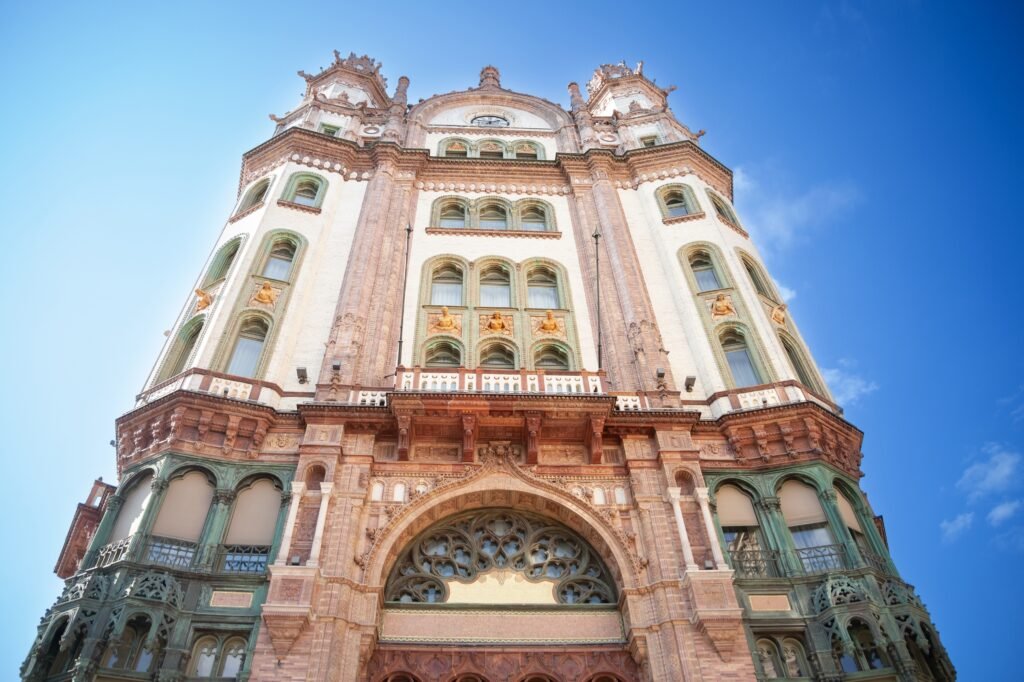
If you’re going to understand Hungarian Art Nouveau, this is the right place to begin.
Designed by Ödön Lechner and Gyula Pártos and completed in 1896, the Museum of Applied Arts is one of the defining buildings of Hungarian Secession. Immigration Museum Collections
And it is difficult to mistake for anything else.
The roof erupts in green and yellow glazed ceramics. The façade mixes pale stone with decoration that feels simultaneously Hungarian, Eastern and fantastical. Rather than hiding ornament around doors and windows, Lechner allowed it to spread across the entire building.
The effect is almost textile-like.
That was partly the point. Lechner wanted architecture to express something specifically Hungarian, and the brilliantly coloured ceramics produced by the Zsolnay factory in Pécs became one of his favourite materials. Immigration Museum Collections
What to look for
Stand far enough back to take in the roof before concentrating on the entrance.
The building gets more interesting the longer you study it: patterned tiles, unusual arches, carved surfaces and decoration that feels closer to embroidery than conventional stone architecture.
Photography tip: this is one of those buildings where a wider shot works beautifully, but don’t leave without photographing the roof details.
Before you visit
The main Museum of Applied Arts building is currently closed during its long-running renovation, so treat this primarily as an architectural exterior stop for now. Its collections continue to be presented elsewhere, including at the György Ráth Villa. Museum.hu
And don’t skip it because you cannot go inside.
The exterior alone is one of the most extraordinary buildings in Budapest.
Stop 2: Liszt Academy of Music
Liszt Ferenc tér 8
From the Museum of Applied Arts, begin working north towards Liszt Ferenc tér.
The neighbourhood changes gradually as you approach central Pest, and eventually you arrive at one of Budapest’s loveliest squares — and one of its great Art Nouveau interiors.
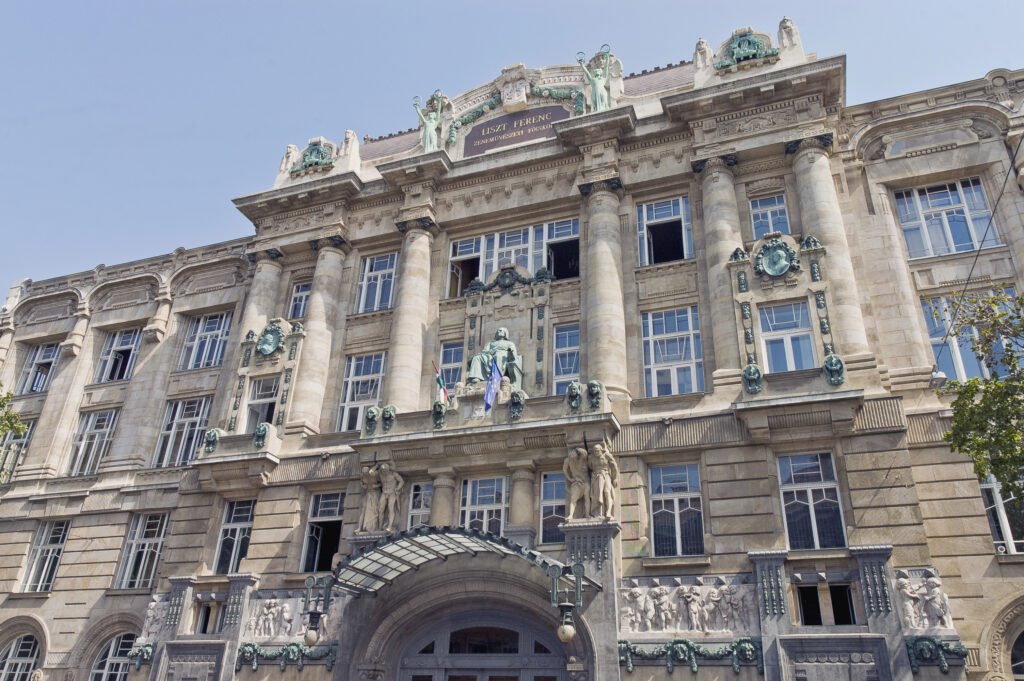
The current Liszt Academy of Music building was completed in 1907 and designed by Flóris Korb and Kálmán Giergl. The exterior blends styles, but inside, Art Nouveau takes over. Liszt Academy Concerts
There are ceramics, stained glass, gold detailing, flowing botanical ornament and a Grand Hall where almost every decorative element appears to have been considered.
The interiors also reveal Budapest’s connection with the wider Central European Art Nouveau world. The Academy notes influences from Austrian Jugendstil alongside materials from leading Hungarian workshops, including Zsolnay ceramics and stained glass by Miksa Róth. Liszt Academy Concerts
Don’t just photograph the façade
If you choose one building on this route to properly explore inside, make it this one.
The Liszt Academy currently offers organised guided tours of the historic building, including the restored Grand Hall and other Art Nouveau interiors. Zeneakadémia
Otherwise, spend a little time around Liszt Ferenc tér itself. This is also an easy place to stop for coffee before continuing towards Lipótváros.
Stop 3: Walkó House
Aulich utca 3
Walkó House is where this route becomes more intimate.
Unlike Budapest’s enormous museums and public buildings, this is the type of Art Nouveau you could easily walk past while concentrating on Google Maps.
Don’t.
Designed by Albert Kálmán Kőrössy, the façade is filled with the natural forms so closely associated with European Art Nouveau: twisting plants, flowers, animals and a striking female figure representing Eve reaching towards the forbidden fruit. We Love Budapest
There are even squirrels among the decoration.
That mixture of architecture and storytelling is part of what makes wandering Budapest’s Secession buildings so enjoyable. The decoration isn’t simply there to make a façade prettier. Often it contains symbols, references to the building’s owner or clues about its original purpose.
This is a building to photograph in pieces rather than in one big shot.
Look above the windows.
Look beneath the balconies.
Then look up again.
Stop 4: The Former Postal Savings Bank
Hold utca 4
A few minutes away is one of the masterpieces of Hungarian Art Nouveau.
The former Royal Postal Savings Bank, now used by the Hungarian State Treasury, was designed by Ödön Lechner with Sándor Baumgarten and constructed at the beginning of the 20th century. Gyűjtemény
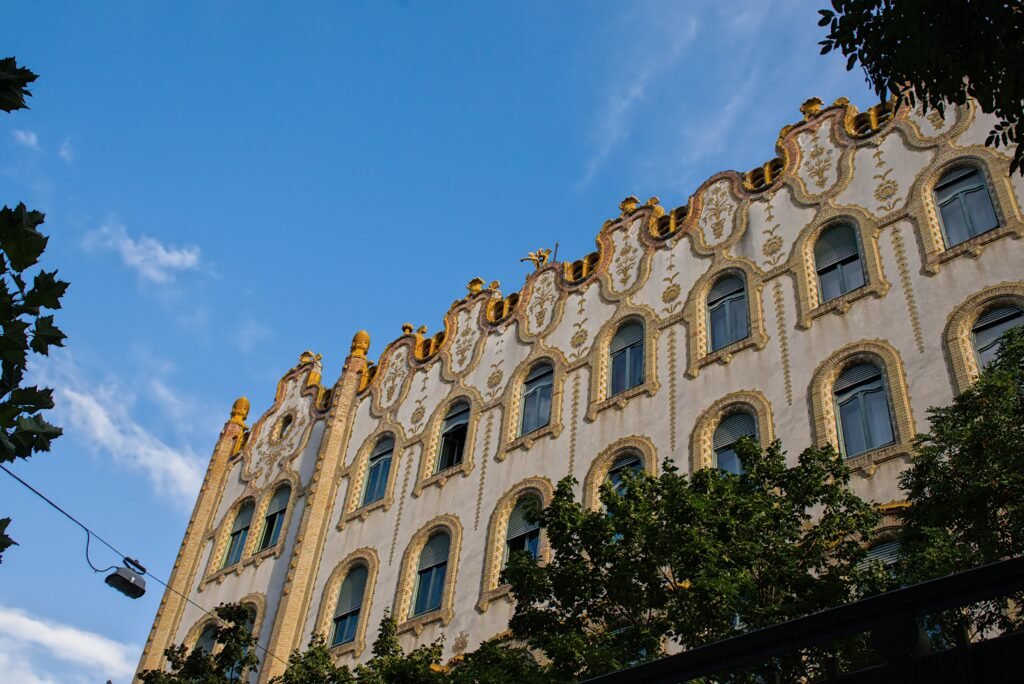
At street level, it is impressive.
The trouble is that some of its greatest details are above you.
Very far above you.
The rooftop is decorated with colourful Zsolnay ceramics, while Lechner incorporated flowers, folk-inspired patterns and wonderfully peculiar symbols into the building.
Among them are bees and beehives — a fitting motif for a savings institution, suggesting thrift, work and the accumulation of wealth. We Love Budapest
There are also mythical-looking creatures and ceramic forms that make the roof feel like something from a Hungarian fairy tale.
The frustrating thing about the Postal Savings Bank
You cannot fully appreciate it from the pavement.
The street is relatively narrow, and the most spectacular roof decoration sits high above eye level — something contemporary Budapest guides still warn visitors about. We Love Budapest
So walk around it.
Cross the road.
Move further down Hold utca.
And use a zoom lens if you have one.
It may be the best example in Budapest of why Art Nouveau requires you to stop rushing.
Stop 5: Bedő House — The House of Hungarian Art Nouveau
Honvéd utca 3
Then comes the building that looks almost impossibly suited to its current purpose.
The Bedő House, also known as the House of Hungarian Art Nouveau, was designed by Emil Vidor and completed in 1907.
Its soft green façade, rounded windows and asymmetrical lines feel very different from Lechner’s highly decorative national style. Here, the influence of French and Belgian Art Nouveau becomes easier to see.
Yet there are Hungarian touches too, including floral detailing and distinctive balcony railings. We Love Budapest
It’s elegant rather than monumental.
And that is precisely why it belongs on this walk.
Budapest did not have a single version of Art Nouveau. Architects interpreted the movement differently, producing buildings ranging from flamboyant ceramic-covered landmarks to graceful residential façades like this one.
The contrast becomes particularly clear when you see them within the same afternoon.
Look closely at the entrance
This is one building where the details around doors, windows and ironwork matter as much as the overall façade.
The flowing lines and botanical shapes feel much closer to the romantic Art Nouveau associated with Brussels or Paris than to the more idiosyncratic buildings of Lechner.
It’s also extremely photogenic.
And considerably easier to fit into a camera frame than the Postal Savings Bank.
Stop 6: Gresham Palace
Széchenyi István tér 5–6
Finish the main walk on the Danube.
Directly opposite the Chain Bridge stands Gresham Palace, arguably Budapest’s most glamorous Art Nouveau building.
Completed in 1906, the palace was originally constructed for the Gresham Life Assurance Company and contained offices and luxurious apartments. Today it is the Four Seasons Hotel Gresham Palace Budapest. Four Seasons Press Room
Where Lechner’s work can feel experimental and distinctly Hungarian, Gresham feels cosmopolitan.
Its façade is symmetrical and grand, but look closer and the Art Nouveau details emerge: curved windows, sculptural ornament, ironwork, mosaics and floral motifs.
Inside, restored features include stained glass, elaborate iron gates, floor mosaics and the remarkable glass-covered spaces for which the building is known. Four Seasons Press Room
The best way to see Gresham Palace
Approach it from the Chain Bridge side.
The building was designed for this setting — facing the Danube with Buda rising beyond the river.
Then go closer.
The enormous façade is impressive from across the square, but the craftsmanship becomes much more obvious around the entrances and windows.
This is a good place to end the walk because Gresham represents another side of turn-of-the-century Budapest.
Confident.
Wealthy.
International.
And determined to look spectacular.
Bonus Stop: Gellért Bath
Kelenhegyi út 2
If your legs are still cooperating, cross to Buda for one more extraordinary example of Hungarian Secession.
The Gellért Bath and Hotel complex opened in 1918 and was created from designs by architects Artúr Sebestyén, Ármin Hegedűs and Izidor Sterk. Gellért Thermal Bath
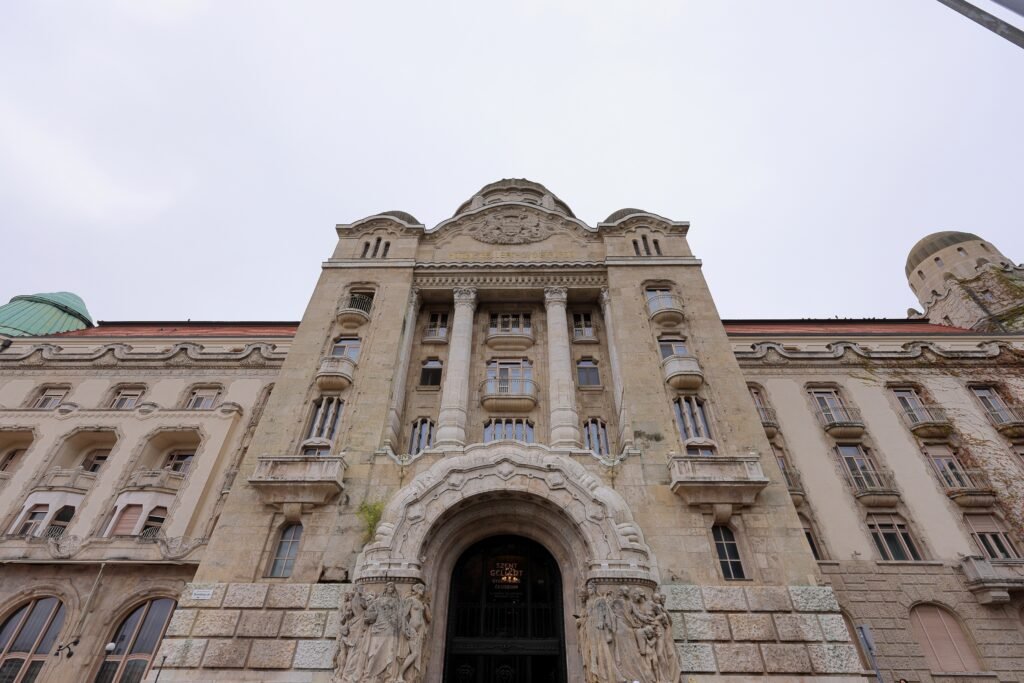
The bath became famous for its mosaics, decorative tiles, stained glass and almost theatrical bathing spaces.
This is Art Nouveau designed not simply to be looked at, but to be experienced.
Unfortunately, there is an important temporary catch.
Gellért Bath closed for renovation on 1 October 2025 and is currently expected to reopen in 2028. Gellért Thermal Bath
For the moment, consider it an exterior architectural stop rather than somewhere to finish your afternoon with a swim.
When it eventually reopens, it deserves to return to the very top of any Budapest Art Nouveau itinerary.
One More Stop for Serious Art Nouveau Fans
If this walk leaves you wanting more, make time for the György Ráth Villa at Városligeti fasor 12.
It belongs to the Museum of Applied Arts and houses Art Nouveau – A Hungarian Perspective, an exhibition drawn from the museum’s Art Nouveau collection. Muzej
This is particularly worthwhile if the architecture has made you curious about what happened inside these buildings.
Furniture, ceramics, glassware and decorative objects show that Hungarian Secession wasn’t simply an architectural style.
It was an entire approach to design.
Rooms, chairs, lights, windows, ceramics and buildings were intended to speak the same visual language.
What to Look for While Walking Through Budapest
Once you’ve seen a few of these buildings, you’ll begin spotting Secession details everywhere.
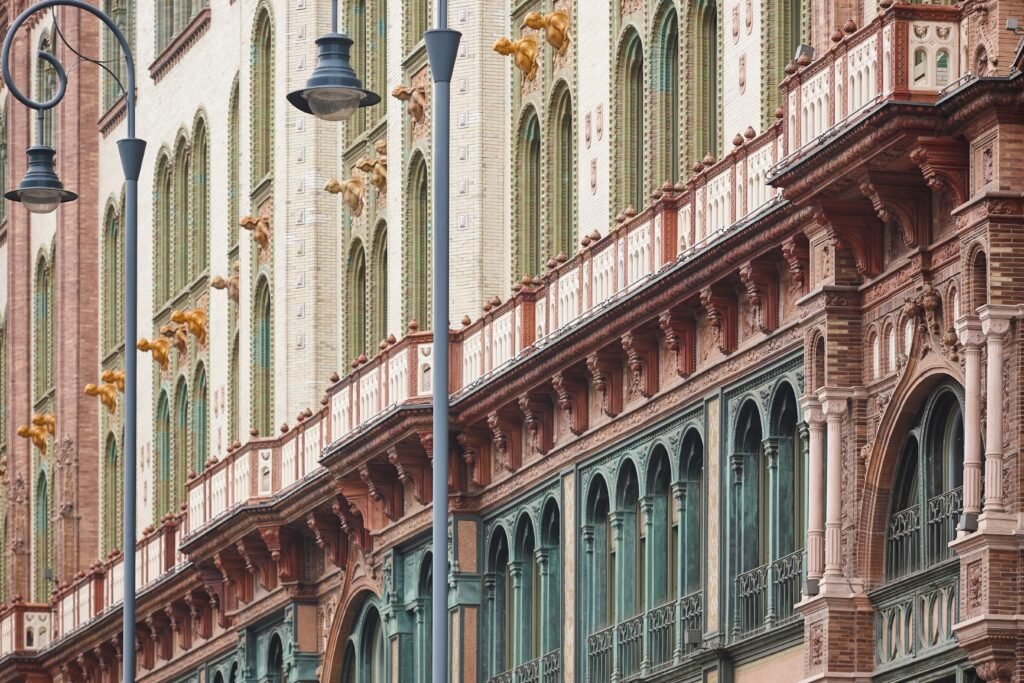
You don’t need an architectural guidebook in your hand. Just keep an eye out for:
- colourful glazed Zsolnay tiles
- flowers and curling plant forms
- peacocks, bees and other animals
- unusual iron balconies and gates
- asymmetrical windows
- stained glass
- Hungarian folk-inspired patterns
- decorative ceramic rooftops
- female figures woven into façades
- motifs connected to the original purpose of a building
And perhaps the most useful rule of all:
Look above the ground floor.
Budapest shops, signs and traffic can make a street appear fairly ordinary at eye level while an astonishing 120-year-old façade is sitting directly above them.
Why Budapest Is One of Europe’s Great Art Nouveau Cities
It would be easy to visit Budapest and remember only the obvious landmarks.
Parliament.
Buda Castle.
Fisherman’s Bastion.
The Chain Bridge.
But the city’s Art Nouveau buildings tell a different story.
Around 1900, Budapest was expanding rapidly, and architects were experimenting with what a modern Hungarian capital should look like. Art Nouveau provided an opportunity to abandon some of the rules of historic European architecture and create something new.
Ödön Lechner pushed that idea further than almost anyone.
Rather than producing a Hungarian version of Paris or Vienna, he tried to give modern architecture a language of its own — one filled with colour, ceramics, folk motifs and influences drawn from far beyond Western Europe. The Museum of Applied Arts describes him as the leading style-creating figure of Hungary’s turn-of-the-century architecture. Immigration Museum Collections
Other Budapest architects took the movement in different directions.
Some became more restrained.
Some looked towards Vienna.
Others towards France and Belgium.
And occasionally they created interiors so extravagant that more than a century later you still have to stop for a minute when you walk inside.
That variety is what makes exploring Art Nouveau in Budapest so rewarding.
There isn’t one masterpiece.
There is an entire city full of them.
Planning Your Budapest Art Nouveau Walk
For the main route, begin at the Museum of Applied Arts, continue north towards the Liszt Academy, then work your way through the Art Nouveau streets around Szabadság Square and Lipótváros, finishing at Gresham Palace and the Danube.
You could race through it.
But that rather misses the point.
Give yourself time for coffee. Wander down side streets. Photograph strange ceramic animals. Take unnecessary detours because you’ve spotted another interesting balcony.
Budapest’s Art Nouveau isn’t something confined neatly inside a museum.
It is scattered across apartment buildings, banks, concert halls, hotels and streets that people still use every day.
And once you start noticing it, you’ll find yourself looking up for the rest of the trip.
A natural place to continue exploring Budapest
If you’re planning more than one day in the city, this article pairs particularly well with The Architecture of Budapest: Why the City Looks So Grand for the bigger architectural picture, then A Literary Weekend in Budapest for cafés, writers and bookish stops.
And if it’s the colours rather than the buildings that caught your attention, our Budapest Colour Palettes explore the Danube blues, café burgundies, aged brass, creamy stone and oxidised greens that make the city so distinctive.
Britt & Tyler
We’re Britt and Tyler, the two Australians behind Cocktails & Cathedrals. We’re drawn to old buildings, beautiful rooms, bookshops and places that seem to hold a story. Our journal brings those interests together, with a fondness for slow afternoons and a well-made cocktail. We hope it helps you find places you’ll want to linger.
Travel slowly. Stay beautifully.
A little more about us →