Vienna in 3 Days: A Beautiful Slow-Travel Itinerary for Architecture, Cafés and Hidden Bars
Three days of grand architecture, old-world coffeehouses, beautiful streets and the occasional very good cocktail.
There are cities that encourage you to hurry.
Vienna is not one of them.
You could spend three days racing between palaces, museums, churches and monuments, ticking off the famous sights while barely stopping for coffee. There are certainly enough magnificent buildings to keep you occupied.
But that would be a rather unfortunate way to experience a city that has spent centuries perfecting the art of sitting in cafés.
Vienna is at its most enjoyable somewhere between the major attractions.
It is the unexpected courtyard behind an enormous palace. The narrow street lined with beautiful old apartment buildings. The slightly worn café where the waiter appears entirely unconcerned about how long you intend to stay.
It is the contrast between imperial grandeur and wonderfully ordinary daily life.
And after dark, it is a small cocktail bar tucked into a building that has witnessed more than a century of the city’s history.
This three-day Vienna itinerary is designed for travellers who enjoy architecture, literature, beautiful interiors, historic cafés and discovering a city on foot.
There are famous landmarks, of course.
But there is also time to wander, sit, look around and occasionally do absolutely nothing.
Which, in Vienna, seems entirely appropriate.
Day 1: The Imperial City, Old Streets and Historic Coffeehouses
St Stephen’s Cathedral → Graben → Hofburg → Ringstrasse → an atmospheric cocktail bar
Your first day belongs to Vienna’s historic centre, the Innere Stadt.
This is where the city’s extraordinary architectural history is compressed into a relatively small area. Gothic churches stand among Baroque palaces, nineteenth-century apartment buildings and some remarkably restrained early modernist architecture.
The best way to explore it is on foot.
Morning: Begin at St Stephen’s Cathedral
Start at Stephansplatz, preferably before the square becomes particularly busy.
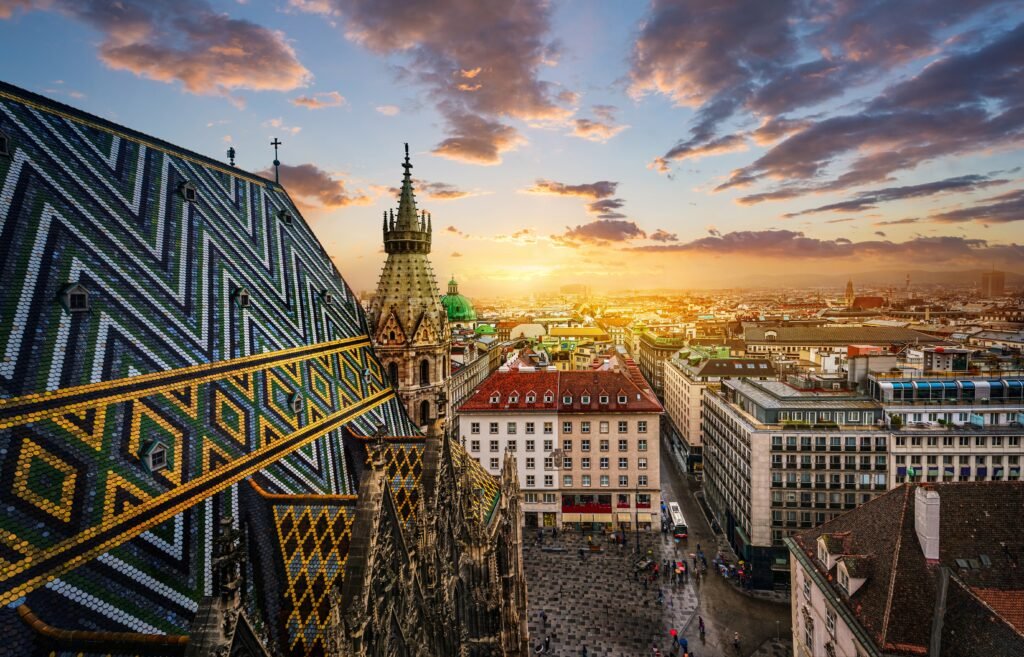
St Stephen’s Cathedral is one of those buildings that almost seems too large for its surroundings.
Its Gothic tower rises above the rooftops, while the extraordinary patterned tiles of its roof bring unexpected colour to an otherwise rather restrained cityscape.
Spend some time outside before heading in.
Look at the carved stonework, the elaborate roof and the contrast between the cathedral and the buildings surrounding it.
If you’re interested in photography, the smaller streets leading towards the cathedral can offer some lovely framed views of its tower.
From Stephansplatz, wander into the lanes around Domgasse and Blutgasse.
Here, the atmosphere changes.
The vast public square gives way to narrow streets, old courtyards and buildings on a more human scale.
It is one of the pleasures of Vienna that something so monumental can sit beside something so intimate.
Late Morning: Graben, Kohlmarkt and the Beautiful Art of Looking Up

Continue towards Graben, one of Vienna’s most elegant pedestrian streets.
There are expensive shops, beautiful shopfronts and the elaborate Baroque Plague Column rising above the crowds.
But the most interesting things are often above the ground floor.
Look at the windows, balconies, stone carvings and rooflines.
From Graben, turn into Kohlmarkt and walk towards Michaelerplatz.
The approach is wonderful.
At the end of the street, the grand entrance to the Hofburg appears, a reminder that Vienna was once the administrative heart of an enormous empire.
Before entering the palace complex, however, look across Michaelerplatz at the Looshaus.
Designed by Adolf Loos and completed in 1912, its relatively plain upper façade was controversial when it appeared opposite the elaborate imperial architecture.
The contrast is fascinating.
Vienna had spent generations celebrating ornament, grandeur and decoration. Now architects were beginning to question whether buildings needed all that embellishment at all.
If you’d like to understand why the city looks the way it does, our guide to the architecture of Vienna explores the history behind its grand façades, palaces and remarkable buildings.
Lunch: Make Time for a Proper Viennese Café
By now, you’ve earned a long coffee break.
And it really should be long.
For a classic Viennese coffeehouse experience, head to Café Hawelka on Dorotheergasse, a short walk from Stephansplatz and Graben.
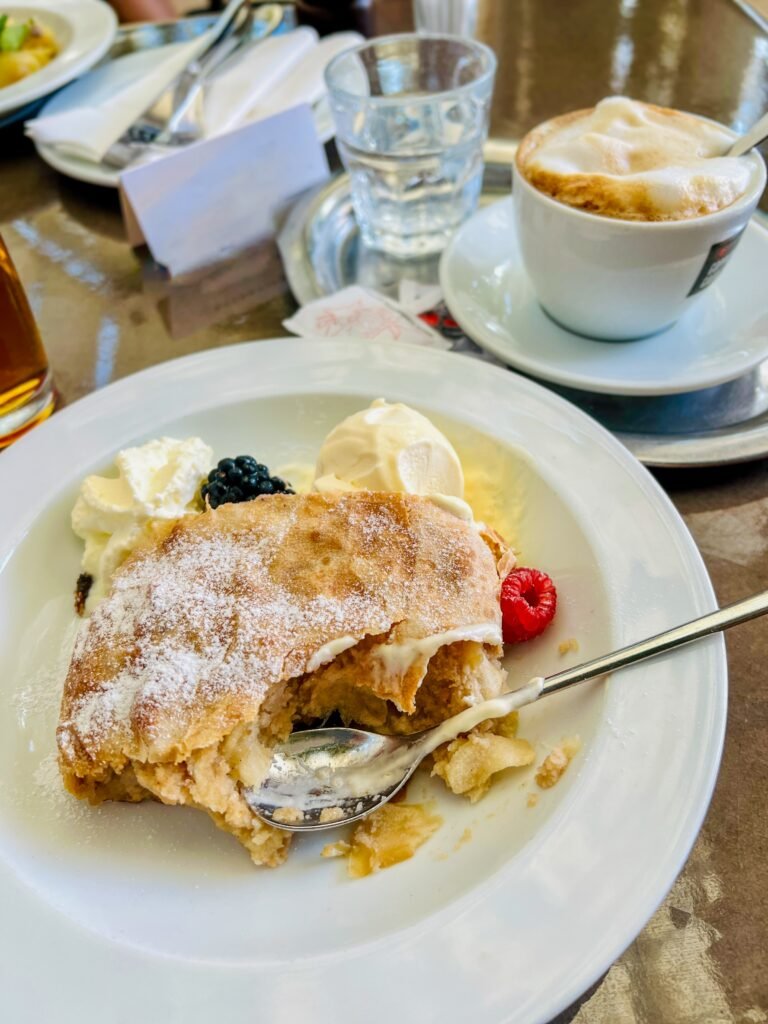
Opened by Leopold and Josefine Hawelka in 1936, it became associated with Vienna’s artistic and intellectual life.
The appeal isn’t immaculate luxury.
It is character.
The furnishings are wonderfully old-fashioned, the atmosphere has a certain lived-in quality, and the café feels like a place where people have been having interesting conversations for a very long time.
Order a Wiener Melange, perhaps something sweet, and resist the urge to immediately check your phone.
If you prefer something a little more polished, Café Korb near St Stephen’s is another excellent alternative, known for its mid-century character and traditional Viennese café atmosphere.
Vienna’s coffeehouses were once gathering places for writers, journalists, artists and thinkers. Some came to work. Others came to argue. Many seem to have done both.
Our literary weekend in Vienna explores that world in more detail, including the streets, cafés and bookish corners associated with the city’s literary past.
Afternoon: The Hofburg and the Ringstrasse
After lunch, return towards the Hofburg.
For centuries, this vast complex served as a residence and centre of power for the Habsburg dynasty.
Rather than trying to visit every museum and imperial apartment, begin by walking through the courtyards and out towards Heldenplatz.
The scale is extraordinary.
The buildings seem determined to remind you that the Austrian Empire was once a very serious political force.
Continue towards Maria-Theresien-Platz, where the Kunsthistorisches Museum and Natural History Museum face one another across a formal square.
Even if you don’t go inside, the architecture deserves your attention.
The enormous domes, sculptural details and symmetrical façades represent nineteenth-century Vienna at its most confident.
If art is a particular interest, choose the Kunsthistorisches Museum as your main indoor visit of the afternoon. Otherwise, enjoy the surrounding streets and gardens and save your museum energy for another day.
One of the secrets to enjoying Vienna is accepting that you cannot see everything.
And you don’t need to.
Evening: Dinner and a Cocktail at Loos American Bar
After a rest at your hotel, return to the old city for dinner.
Then finish your first evening somewhere rather special.
Loos American Bar, on Kärntner Straße, was designed by Adolf Loos in 1908.
It is tiny — famously only around 27 square metres — but the interior is remarkable.
Dark wood, mirrors, brass and richly veined stone create the impression of a much larger space.
It feels intimate, elegant and almost theatrical.
And unlike a preserved museum interior, it is still being used for precisely what it was designed for.
A drink.
Space is limited and it can become crowded, but for anyone interested in architecture and beautiful interiors, it is worth trying.
There are very few bars where the building itself is quite as interesting as what’s in the glass.
Day 1 at a glance: Medieval streets, imperial architecture, a historic coffeehouse and a cocktail in one of Vienna’s great modernist interiors.
Day 2: Art Nouveau, Beautiful Cafés and Vienna’s Creative Side
Karlsplatz → Secession → Naschmarkt → Café Sperl → MuseumsQuartier
If your first day was about imperial Vienna, your second is about the city that began questioning all that grandeur.
Around the turn of the twentieth century, Vienna became a centre of extraordinary artistic experimentation.
Painters, architects, designers, writers and thinkers were challenging old conventions and imagining new ways of living.
Gustav Klimt, Otto Wagner, Josef Hoffmann and Adolf Loos were among the figures helping transform the city’s visual identity.
And much of their work can still be discovered on an enjoyable walk.
Morning: Karlskirche and the Secession Building
Begin around Karlsplatz.
The magnificent Karlskirche, with its great dome and dramatic columns, is a masterpiece of Baroque architecture.
Nearby, however, Vienna’s architectural language changes considerably.
Look for the elegant Otto Wagner Stadtbahn pavilions at Karlsplatz, with their distinctive green metalwork and decorative surfaces.
They are reminders that even railway architecture became part of Vienna’s artistic transformation.
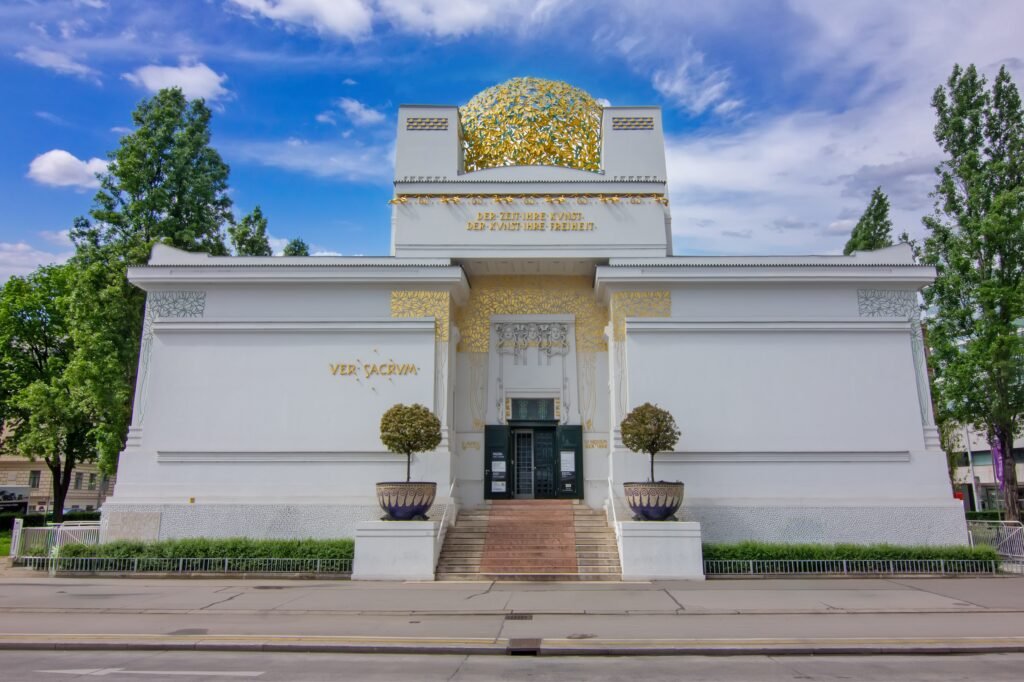
From here, walk to the Secession Building on Friedrichstraße.
Completed in 1898 and designed by Joseph Maria Olbrich, the building became a symbol of the Vienna Secession movement.
Its white geometric forms are crowned by an extraordinary golden dome made from laurel leaves.
The locals nicknamed it the golden cabbage.
Not an entirely unreasonable description.
The building marked a deliberate break from the conservative artistic traditions of the time.
Inside, Gustav Klimt’s famous Beethoven Frieze is one of the highlights, provided the exhibition spaces are open during your visit.
If you enjoy architecture, it is worth spending time here rather than simply photographing the dome and moving on.
Late Morning: Otto Wagner and the Naschmarkt
From the Secession, continue towards the Naschmarkt.
The market is one of Vienna’s most recognisable food destinations, with stalls, cafés and restaurants stretching along the Wienzeile.
It is an enjoyable place to browse, although it can become busy and is more tourist-oriented than some visitors expect.
For architecture lovers, the real treasure is nearby.
At Linke Wienzeile 38–40 stand two of Otto Wagner’s extraordinary apartment buildings.

The Majolikahaus is covered in colourful floral ceramic tiles, while the neighbouring building features elaborate gilded medallions and decorative details.
They are strikingly different from the enormous stone palaces of the Ringstrasse.
Here, ornament feels lighter, more experimental and closely connected to the Art Nouveau movement spreading across Europe.
Look carefully at the façades.
The decoration is integrated into the buildings rather than simply added as an afterthought.
If these buildings capture your imagination, our dedicated Vienna Art Nouveau and the Secession: A Walking Guide to the City’s Most Beautiful Buildings explores more of the city’s extraordinary turn-of-the-century architecture.
Lunch: Café Sperl and a Little Old-World Vienna
A short walk from the Naschmarkt brings you to Café Sperl on Gumpendorfer Straße.
Opened in 1880, it is one of Vienna’s classic historic coffeehouses.
And it is rather beautiful.

The interior has dark timber, upholstered seating, marble-topped tables, mirrors and billiard tables that seem entirely at home in the nineteenth century.
It doesn’t feel like somewhere that has been designed to look historic.
It feels like somewhere that simply never had much reason to change.
This is an excellent place for a relaxed lunch, coffee or cake.
Order something, find a comfortable table and stay a while.
There is a very particular kind of pleasure in a café where the furniture is older than most modern countries’ political institutions.
Afternoon: MuseumsQuartier and Vienna’s More Relaxed Side
After lunch, wander north towards the MuseumsQuartier.
This large cultural district occupies a mixture of historic and contemporary buildings and contains several major museums.
It is also a pleasant place simply to spend time.
The Leopold Museum is particularly interesting for travellers drawn to Vienna’s artistic history. Its collection includes important work by Egon Schiele and other artists associated with Austrian modernism.
But you needn’t spend the afternoon indoors.
Walk through the courtyards, browse the surrounding streets and perhaps continue into the nearby seventh district, Neubau.
This neighbourhood feels rather different from the formal old city.
There are independent shops, cafés, galleries and a more contemporary creative atmosphere.
It is still unmistakably Vienna, just less concerned with demonstrating the magnificence of the Habsburg dynasty.
If you’d rather prioritise Gustav Klimt’s The Kiss, you could visit the Upper Belvedere instead of the MuseumsQuartier. It is a separate journey, so treat it as an alternative rather than an additional obligation.
Evening: A Hidden Cocktail Bar
For your second evening, explore another side of Vienna’s cocktail culture.
The city has a growing collection of intimate, inventive bars, some hidden behind unremarkable entrances.
One interesting option is Tür 7, a small boutique bar where guests ring a doorbell to enter and drinks are tailored through conversation rather than selected from a conventional printed menu.
Reservations are recommended.
Alternatively, Kleinod Prunkstück on Bäckerstraße offers a more lively setting, with beautiful materials, carefully made cocktails and an upstairs bar experience focused on the drinks themselves.
Both offer something different from the grandeur of Vienna’s historic cafés.
And that contrast is part of the pleasure.
For more ideas, see our guide to Vienna’s Hidden Bars, which explores the city’s atmospheric cocktail spots and lesser-known places for an evening drink.
Day 2 at a glance: Art Nouveau buildings, Otto Wagner’s extraordinary façades, Café Sperl, contemporary art and a memorable cocktail bar.
Day 3: Schönbrunn Palace, Beautiful Gardens and One Last Viennese Evening
Schönbrunn Palace → Gloriette → Hietzing → a final evening of music or cocktails
For your third day, venture beyond the historic centre.
Vienna’s public transport makes it relatively straightforward to move between neighbourhoods, and the U4 underground line provides a convenient connection to Schönbrunn.
This is one of the city’s most famous attractions.
And, unlike some heavily visited landmarks, it genuinely deserves its reputation.
Morning: The Beauty of Schönbrunn Palace
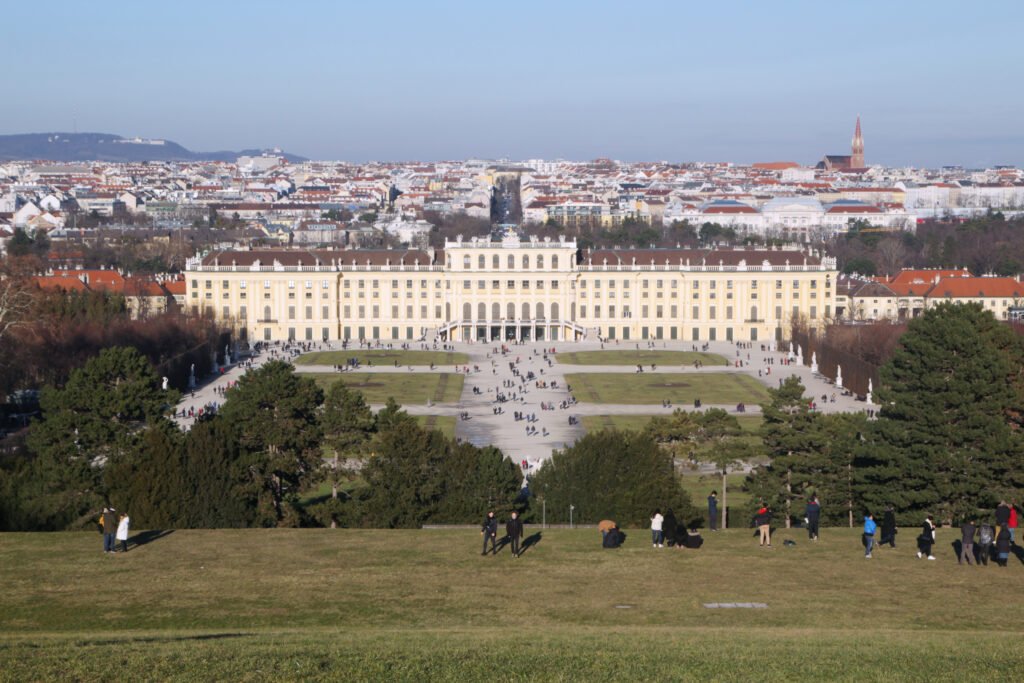
Schönbrunn Palace was the Habsburgs’ grand summer residence.
The enormous Baroque complex contains more than 1,400 rooms, although visitors see only a selection of the interiors.
From the outside, its long yellow façade, formal gardens and remarkable symmetry are immediately impressive.
The palace is magnificent, certainly.
But the gardens are just as memorable.
If you enjoy historic interiors, book one of the palace tours in advance. The rooms reveal the extraordinary wealth, ceremony and tastes of the imperial court.
If you prefer spending time outdoors, concentrate on the grounds.
Walk through the formal gardens, past the fountains and towards the hillside behind the palace.
At the top stands the Gloriette, a monumental structure overlooking the gardens and the city beyond.
It is worth the uphill walk.

From here, the symmetry of the palace grounds becomes particularly clear, while Vienna stretches into the distance.
It is one of those views that makes you understand the imperial appetite for grand gestures.
Even the garden was designed to impress.
Allow a generous morning for Schönbrunn, particularly if you intend to tour the interiors.
Lunch: Escape into Hietzing
Rather than immediately rushing back into central Vienna, spend a little time in nearby Hietzing.
This leafy district has a calmer, more residential atmosphere.
There are attractive streets, elegant old buildings and cafés that feel a little removed from the busiest tourist routes.
Café Dommayer, now part of the Oberlaa café group, is a pleasant choice for coffee, cake or a light lunch.
It has a long connection with Vienna’s musical and coffeehouse traditions, and its garden is particularly inviting in good weather.
Afterwards, wander through a few of the surrounding streets.
This is a different Vienna.
Less monumental.
More domestic.
The sort of neighbourhood where you begin imagining what it might be like to live in one of those elegant old apartments rather than simply photograph them.
Afternoon: Leave Something Unplanned
By your third afternoon, there is a good chance you’ve walked considerably further than intended.
You have probably visited more cafés than you normally would.
And you’ve almost certainly taken photographs of buildings whose names you cannot remember.
That’s a successful trip.
Instead of scheduling another major attraction, leave some space in the afternoon.
Return to a favourite street.
Spend an hour browsing bookshops.
Visit a museum you missed.
Or simply find another café and watch Vienna go about its business.
If you happen to be interested in interiors, the city is especially rewarding.
The marble, walnut, brass, muted greens and warm stone colours that appear throughout its architecture offer wonderful inspiration for home design.
We’ve explored these ideas in 5 Timeless Vienna Colour Palettes for an Elegant Old-World Home, along with our guide to Viennese interior design styles.
Sometimes the best thing you bring home from a city isn’t a souvenir.
It’s an idea.
Evening: Finish Vienna with Music
For your final evening, consider attending a concert or performance.
Vienna’s musical heritage is not simply something preserved in museums.
It remains part of the city’s cultural life.
Depending on your interests and the performance schedule, you might book a concert at the Musikverein, an evening at the Vienna State Opera or another smaller classical performance.

Book ahead if there is something particular you’d love to see.
There’s something rather satisfying about spending three days admiring Vienna’s buildings and then finishing inside one of its extraordinary performance spaces.
Of course, you could equally choose a final dinner followed by a cocktail somewhere beautiful.
That would be entirely in keeping with the spirit of this itinerary.
Day 3 at a glance: Imperial gardens, a quieter neighbourhood, an unhurried afternoon and one last beautiful Viennese evening.
Where to Stay in Vienna for Three Days
For a short visit, location makes a significant difference.
Innere Stadt (1st District) is the most convenient choice if you want to walk to historic landmarks, cafés and elegant restaurants. It is also generally one of the more expensive areas.
Neubau (7th District) is an appealing alternative for travellers who enjoy independent shops, art, design and neighbourhood cafés. It feels more contemporary while remaining well connected to the historic centre.
Mariahilf (6th District) offers another good balance, with easy access to the Naschmarkt, Café Sperl and the MuseumsQuartier.
For a trip like this, we’d lean towards a characterful smaller hotel or beautifully restored historic property over a large international chain.
Vienna has too many wonderful old buildings to spend your nights in somewhere entirely forgettable.
Practical Tips for a Slow Weekend in Vienna
Is three days enough for Vienna?
Three days is enough to discover the city’s atmosphere, explore the historic centre, enjoy several remarkable cafés and visit one or two major museums or palaces.
It isn’t enough to see everything.
But that’s rather the point.
Do you need a car?
No.
Much of this itinerary is walkable, and Vienna’s underground trains and trams make reaching Schönbrunn and other neighbourhoods straightforward.
Comfortable shoes are considerably more useful than a rental car.
When is the best time to visit?
Spring and autumn are particularly appealing for walking.
In spring, the gardens come alive. Autumn brings softer light, cooler days and a wonderfully atmospheric quality to the historic streets.
Winter can also be beautiful, especially during the Christmas market season, although shorter days and colder weather change the rhythm of sightseeing.
Summer offers long evenings but can be hot and busy.
Should you book attractions and cafés in advance?
Book popular palace tours, major museum exhibitions and performances ahead where possible.
It’s also worth checking current opening times for historic cafés and smaller cocktail bars. Renovations, seasonal opening hours and private events can occasionally affect access.
For somewhere tiny, such as an intimate cocktail bar, a little planning can make the difference between a memorable evening and standing outside wondering what to do next.
Vienna Is a City Worth Taking Slowly
Three days in Vienna will not make you an expert on the city.
You won’t have explored every museum, visited every grand palace or discovered every beautiful courtyard.
There will be streets you never reach and cafés you only notice on your final afternoon.
But you will begin to understand something about the city.
Its grandeur is obvious.
Its quieter pleasures take a little longer to reveal themselves.
Vienna is a city where a morning can begin beneath a Gothic cathedral, continue through an imperial palace and end with coffee in a room that has barely changed in a century.
Where architecture tells the story of empires, artistic rebellion and changing ideas about beauty.
And where an evening drink can take place inside a genuine piece of architectural history.
The best way to experience all of this isn’t to hurry.
It is to leave enough time for the unexpected.
One more street.
One more café.
One more look inside a beautiful old building.
And perhaps, before you go home, one last cocktail.
Because Vienna has never really been a city that rewards rushing.
It rewards staying a little longer.
Explore More of Vienna
There’s always more to discover in a city like Vienna. If you love books and old-world atmosphere, wander through our Literary Weekend in Vienna, or discover why Vienna’s architecture looks so grand. For a closer look at the city’s artistic side, follow our Vienna Art Nouveau and Secession Walking Guide, then settle into one of Vienna’s beautiful historic cafés. And if you’d like to bring a little Viennese elegance home, explore our seven timeless Viennese interior design styles and five Vienna-inspired colour palettes.
Britt & Tyler
We’re Britt and Tyler, the two Australians behind Cocktails & Cathedrals. We’re drawn to old buildings, beautiful rooms, bookshops and places that seem to hold a story. Our journal brings those interests together, with a fondness for slow afternoons and a well-made cocktail. We hope it helps you find places you’ll want to linger.
Travel slowly. Stay beautifully.
A little more about us →